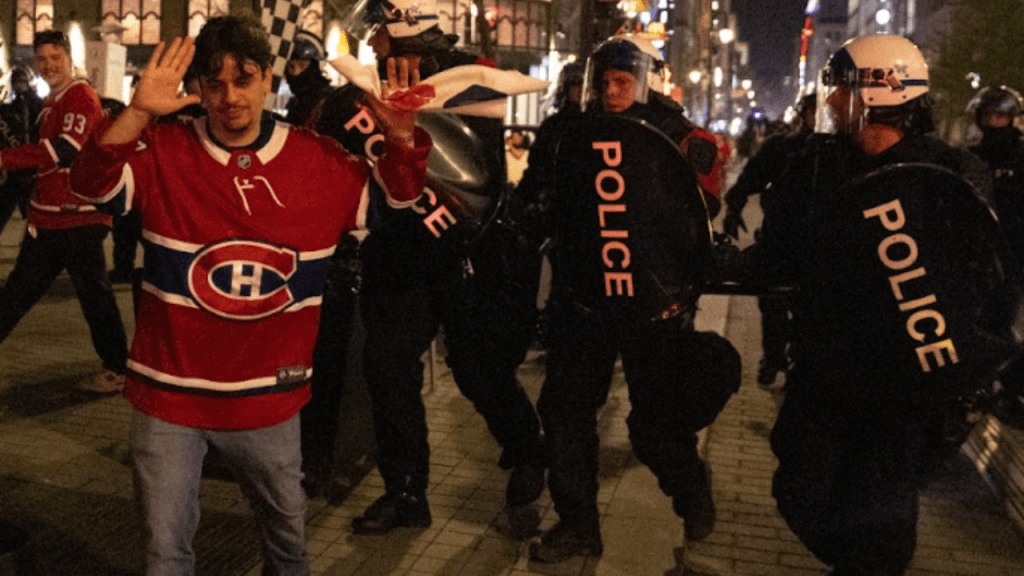
Montreal riot police Habs 2026 stood in formation before the overtime goal, before a single object was thrown, before any pretext existed to justify them.
The Montreal Canadiens beat the Buffalo Sabres 3-2 in overtime of the deciding Game 7 on Monday night, and downtown Montreal erupted the instant the puck crossed the line.
Fireworks went up immediately. Fans flooded Sainte-Catherine Street, climbed onto signs and street fixtures, and honked car horns into the night. It was loud, euphoric, and entirely predictable.
So was what followed.
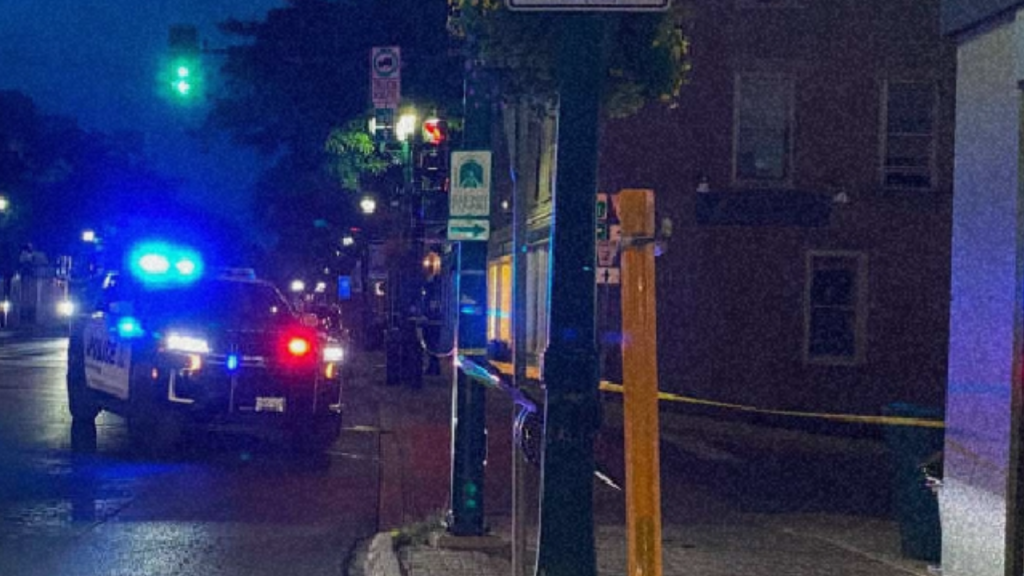
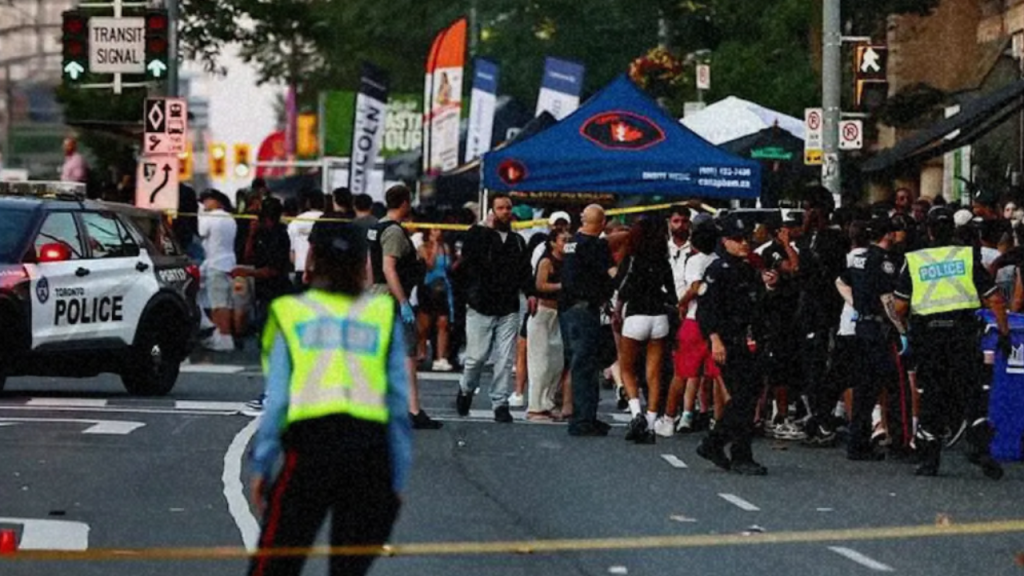
Riot police were already staged in formation before the celebration became anything resembling a riot. Officers in full gear began soft-dispersal tactics within minutes of the goal, advancing shield-first into crowds.
Officers began to clear people out no more than a few minutes after the winning goal — before the crowd had finished forming, let alone done anything to provoke a response.
There was no attempt to let the celebration breathe, no attempt to isolate actual criminal activity, no meaningful distinction drawn between celebrants and anyone the SPVM would later call agitators. The operation was built around one objective: clear the streets as fast as possible.
The SPVM later justified the escalation by citing fireworks and objects thrown toward officers. But fireworks were guaranteed the moment the Canadiens won.
The police knew that before overtime started. They knew it the way they have known it before every elimination game this spring, because this paper has been documenting the pre-announced deployment template across numerous articles during these playoffs.
The fireworks were not a surprise. They were the input the apparatus had already built its response around.
The fireworks were the pretext
It was the largest police operation downtown Montreal has seen for a sporting event in years. Officers kept advancing until the crowds had fully dispersed, and the fireworks the SPVM later cited were the pretext, not the cause.
The timeline is the argument.
One flashpoint came almost immediately after the overtime goal, as officers moved into celebratory crowds near the Bell Centre.
A second escalation came more than thirty minutes later near Peel and Sainte-Catherine, where riot police again pushed crowds with chemical irritants and shield formations.
This was not one spontaneous confrontation that got out of hand. It was a sustained operation with multiple staged phases.
The aggression of the deployment also produced moments that bordered on farce.
During one confrontation, a police officer reportedly fell from his bicycle while pushing into the crowd. According to on-scene photojournalist William Wilson, something that appeared to be the officer’s firearm fell from the holster during the collision before another officer quickly retrieved it and returned it.
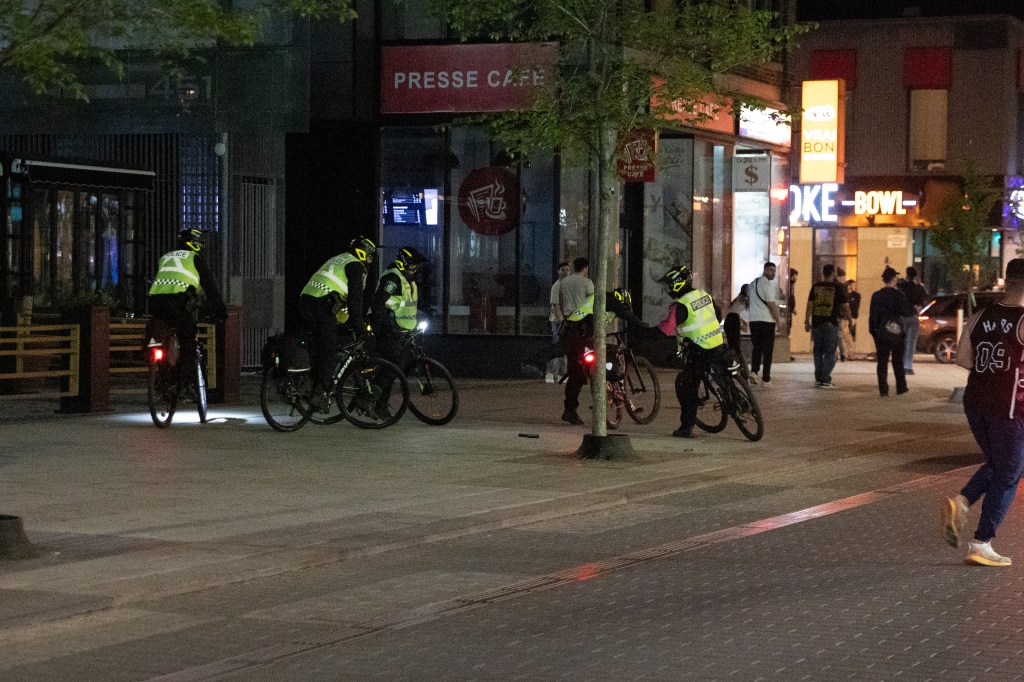
The detail matters less for the object than for what it reveals about the operation. Officers were moving aggressively enough through dense celebratory crowds that equipment was being dislodged in the physical confrontations, even as police and media narratives framed the night as controlled crowd management. A controlled operation does not shake loose its own gear. A chaotic charge into a crowd does.
The coverage that followed did the apparatus a favour.
Outlets reporting the night reached for the same passive constructions every time: tensions rose, a small group became aggressive, pyrotechnics were launched toward officers.
The grammar removed police agency from the sentence entirely, as though the riot shields advanced on their own initiative and the chemical irritants deployed themselves.
Eyewitness accounts describe something simpler. Police charged into the crowds first, then cited the crowd’s reaction as the justification for charging further.
The Lonardi ruling changed the incentives
The structural reason the SPVM deploys this way is the Lonardi ruling, which the earlier pieces in this series have already laid out in full. The short version is that the 2018 Supreme Court decision moved the financial exposure for riot damage off individual participants and back onto the city and its insurers. That single shift changed the municipal incentive overnight.
Once the city could no longer recover collective damage from arrested rioters, crowd management stopped being about tolerating celebration while containing damage. It became about preventing liability before any damage could occur. The posture flipped from reactive to preemptive, and private-property protection quietly became more important than public celebration. That is the whole engine, and it does not need re-explaining every time it runs. It needs only to be named, because it is the thing that put officers in formation before the puck crossed the line.
Two fines, zero arrests
The official numbers tell the story the headlines did not. As of the following day, Montreal police reported two public-mischief fines and zero arrests. That figure is the entire case against the operation. The scale of the deployment resembled a major riot response, and a major riot response that confronts organized violence produces arrests. This one produced two tickets.
If the police genuinely believed they were facing organized violence, the arrest count should reflect it. If fireworks constituted the threat the SPVM cited, someone should have been charged in connection with them. Neither happened. The contradiction exposes the logic underneath the operation. The deployment was never scaled to actual criminality. It was scaled to perceived risk, and in present-day Montreal the greatest perceived risk is no longer public disorder itself. It is uncontrolled public disorder that produces liability exposure for the city.
Montreal was not unique for celebrating
The justification for aggressive crowd suppression in Canada almost always returns to Vancouver in 2011, when the Stanley Cup riot became the permanent reference point for every police deployment involving a sports crowd since.
But Vancouver followed a devastating loss and hours of sustained destruction. Montreal on Monday followed a win, and the celebration that produces after a win is a different event than the one that produces after a loss.
The international comparison makes the point sharper. When large crowds fill European city centres after a World Cup, fireworks, flares, smoke, and mass public drinking are treated as the predictable byproducts of collective joy.
The Toronto Raptors’ 2019 championship run produced weeks of celebrations where crowds climbed streetcars and flooded busy intersections without immediate riot suppression.
Montreal’s response stood apart because the SPVM moved almost instantly from crowd control into crowd domination.
The closer precedent is Montreal’s own. In 2021, during the Canadiens’ run to the Stanley Cup Final, Montreal police tear-gassed celebrating fans twice in under two weeks, on both occasions without first issuing a dispersal order.
The template that ran on Monday is not new and it is not imported. It is the same municipal apparatus running the same playbook it ran four years ago, refined by everything it has learned about deploying without consequence since.
Public safety came second
One eyewitness described a man collapsing in the crowd while paramedics remained inaccessible behind riot formations.
Another described a man in a wheelchair being moved through dispersal chaos while chemical irritants were deployed nearby.
These are precisely the situations that crowd-management planning is supposed to anticipate and prioritize, and on Monday they were secondary to tactical suppression.
The distinction matters because the SPVM justifies aggressive crowd tactics as a public-safety measure. Genuine public-safety planning starts from the assumption that people in a mass gathering will celebrate, drink, overheat, faint, panic, and occasionally need medical help, and it builds the operation around keeping those people safe.
The deployment Monday was optimized for dispersal first and public care second. A plan that puts a riot line between a collapsing person and the paramedics is not a public-safety plan. It is a property-protection plan wearing the language of one.
Social media finished the job
The repression did not end when the streets cleared. Online reaction shifted quickly toward moral-panic narratives about classless fans and demands for harsher policing, despite the fact that virtually no one had been arrested. Every image of riot police charging civilians became, in the retelling, retroactive proof that the intervention had been necessary in the first place.
The logic runs in a circle and closes on itself. The police deploy as a riot force. The public sees a riot force in the streets. The public concludes a riot must have been underway to require it. The visual aesthetics of militarized policing become their own justification, and the absence of arrests — the single fact that should puncture the narrative — disappears underneath the images. It functions as a kind of panopticon in reverse, where the spectacle of force manufactures the consent for force after the fact.
The win activated the deployment
Montreal still markets itself as a city of nightlife, festivals, public culture, and spontaneous celebration. The contradiction gets harder to ignore every year. The city that hosts fireworks festivals and packs its squares for public events now treats uncontrolled celebration itself as the threat, and deploys riot formations within minutes of collective euphoria. The same public spectacle the city sells to tourists is the one its police force is built to suppress when it happens without a permit.
The foundation for that transformation did not appear by accident. The Lonardi ruling changed the economics of disorder, and once the city became structurally exposed to riot liability, the police incentives changed to match. That is why the operation looked prepared before the crowd had reacted to anything.
The fans on Sainte-Catherine were not the cause of the deployment and the fireworks were not its trigger. The deployment existed before the puck dropped.
The Canadiens victory did not start it. It activated it.
Sources
- Montreal Gazette / Evan Buhler photo coverage — Habs fans celebrate Game 7 win, riot police on Sainte-Catherine, May 18, 2026
- Supreme Court of Canada — Montréal (Ville) v. Lonardi, 2018 SCC 29, decided June 8, 2018 (full decision)
- Supreme Court of Canada — Lonardi case summary, File No. 37184
- Globe and Mail — Supreme Court rules against Montreal over 2008 hockey riot vandalism, June 8, 2018
- Global News — Montreal police defend tear-gassing Canadiens fans without warning, July 6, 2021 (precedent)
- CBC News — Montreal police use tear gas to disperse Habs fans after series victory, July 2021 (precedent, 15 arrests / 60 tickets)
- William Wilson Photography — editorial archive of SPVM deployments
- Spark Solidarity — SPVM beating Habs fans for celebrating is a pattern, May 4, 2026 (Round 1 deployment)
- Spark Solidarity — SPVM Round 2 deployment is scheduled for Saturday night, May 14, 2026 (the four levers)
- Spark Solidarity — Rad Pride Montreal clashes with police, August 11, 2024