
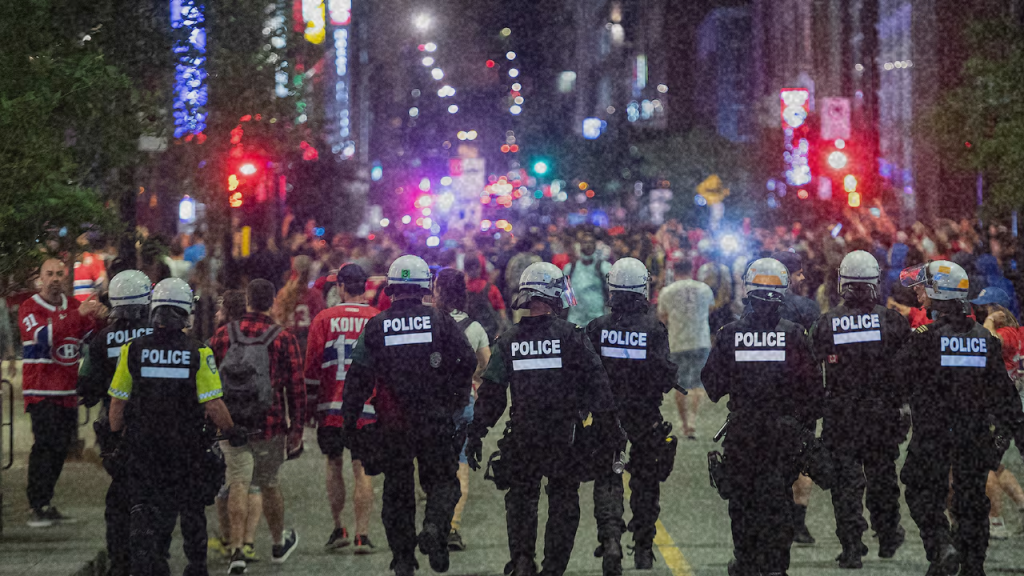
SPVM’s Game 7 deployment is set: a burned cruiser Saturday, a predictable playbook, and a massive crowd expected; regardless of the outcome.
Saturday night, Maisonneuve and St-Urbain
The Canadiens lost Game 6 to the Buffalo Sabres 8-3 on Saturday night at the Bell Centre, blowing a 3-1 first-period lead, conceding seven unanswered goals, and sending the series back to Buffalo for Game 7 tonight at 7:30 p.m.
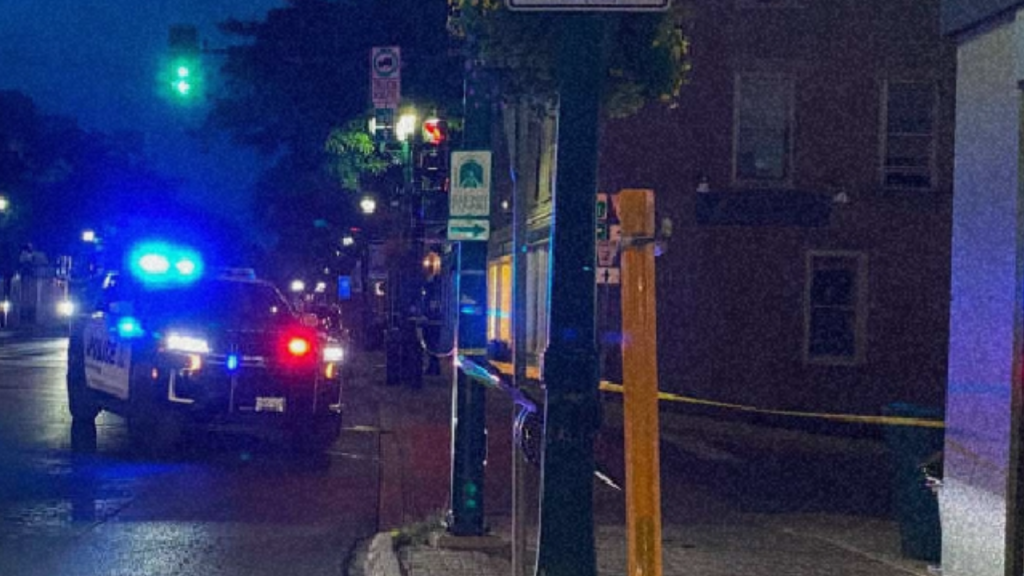
The crowd of 20,962 left the Bell Centre around 10:30 p.m. Sometime before midnight, an SPVM patrol SUV was set on fire on rue Saint-Urbain directly beside SPVM headquarters, adjacent to PDQ 21 — one of the force’s own downtown neighbourhood police stations.
Radio-Canada reported the call came in at 12:30 a.m. The marked patrol vehicle, number 78-22, was destroyed. When officers arrived from inside the station their own vehicle was parked next to, no suspects remained on scene, but Radio-Canada reported that incendiary materials were recovered at the location. The Dose.ca report noted that suspects were caught on surveillance cameras before the incident and again as they fled.
The mainstream framing has converged on a binary. Either the perpetrators were Habs fans acting on elimination-night rage, or they were anonymous opportunists exploiting the crowd. Saturday-night Montreal has a third population the binary brackets out — people working inside a long-running anti-police political tradition with documented capacity for actions of exactly this profile.
This piece is not in the business of speculating about which of those three populations was on St-Urbain on Saturday night. That is the investigation’s question, and the institutional incentives running the investigation are themselves part of what this piece is naming. The focus here is what the apparatus does with the act regardless of who performed it.
One question follows from the surveillance-camera footage, and it is not about who the suspects were. If the cameras already had the location in frame, what was the SPVM doing in the minutes between the first set of images and the second? The vehicle was parked directly beside SPVM headquarters. Whatever the institution was doing in those minutes, it produced the optic the institution will spend the next budget cycle pointing at.
The institution absorbs whatever it is given
The previous SparkSol piece traced the SPVM’s playoff-deployment template through its full institutional history — the 1969 Murray-Hill founding, the 2008 cruiser-fire launch of the chemical-weapon track, the 2018 Lonardi closure of the civil-recovery pathway, and the 2021 four-deployment cadence that established the current standing protocol. The historical pattern is established. What this piece adds is the conceptual frame the pattern actually runs on.
German sociologist Max Weber defined the state as the institution holding the monopoly on the legitimate use of physical violence within a given territory — a structural fact, not a political preference. Police institutions are the operational arm of that monopoly. They have institutional interests in maintaining and expanding it. They are not neutral actors waiting to be activated by external events; they are actors with a standing program of self-reproduction, and every event in their operational environment gets processed against that program.
The SPVM’s standing program for half a century has been to expand its license to deploy force, expand its budget, expand its chemical-weapon authorities, and expand the public’s acceptance of those expansions as natural. The 1969 Murray-Hill founding was the program operating openly. Every cycle since has been the same program operating through events that look superficially different.
The dialectical process this produces is the part most public commentary misses. The apparatus does not need to author each individual event. It needs each event to land in a configuration the apparatus can absorb.
This concept embodies what mid-twentieth-century European political theorists named the strategy of tension. From Italy’s Years of Lead and its links to the Gladio operation network, to West Germany’s Autumn, to the FBI’s COINTELPRO operations, each case demonstrated how the state need not directly provoke every act of disorder. Its machinery is structured to absorb disorder — regardless of origin — into expanded authority and control.
Bombings claimed by far-right cells, by far-left cells, by no one. All produced the same downstream effect: expanded surveillance, expanded police authority, public acquiescence to escalating state power as the trade for security against a designated threat.
The SPVM is not running Gladio. It does not need to. The institutional structure does the work that Gladio had to do operationally. Passive allowance is, in fact, the more likely posture, because it provides plausible deniability while achieving the same institutional goals — a tactic with a clear track record dating to the SPVM’s origins. The Saturday-night SUV at PDQ 21 will be processed through the same institutional machinery that has absorbed every cruiser-burning since 1969.
Why Monday night is the wrong terrain
Sports crowds in this city have always carried class antagonism toward the state and toward capital. That fact is not in dispute, and this article is not in the business of disowning it. The 1870s lacrosse class lines, the 1955 Richard riot, the 1986 and 1993 Cup celebrations under deindustrialization and free-trade austerity — the history covered in previous pieces is the history of working-class fan bases expressing political-economic grievances through the only available channel.
The 1993 looter quoted in the Associated Press named the exchange directly. “The Habs won the Cup and big bonuses. This is what we get.” He was not wrong about the exchange. The fans produced the value, the corporate class extracted it, the fans got the property-damage tab and the cops on Sainte-Catherine.
What has changed since 1969 is not the crowd. It is the apparatus. The SPVM has spent fifty-seven years building infrastructure specifically to absorb the class antagonism of sports crowds into its own expanded license.
The cruiser-burn-by-Habs-fan in 2026 is no longer raw class antagonism finding its target. It is raw class antagonism that gets routed through an institutional machine that converts it into more deployment authority, more chemical-weapon track, more public consent to expanded force.
The ‘Not True Habs Fans’ Rhetorical Trap
The “not true Habs fans” rhetorical trap is the operative mechanism, and it works two ways.
When the apparatus can credibly point to “criminals, extremists, anarchists,” the dialectic runs through a clean named-enemy frame. The Habs fan in the crowd is offered solidarity with the apparatus against the discrete extremist subgroup, and the trade is cheap for the institution to offer.
When the apparatus cannot — when the cruiser-burner is unambiguously a Habs fan, drunk in a Suzuki jersey, with no political program more developed than the 1993 looter’s own words — the institution shifts to a different absorption track.
The frame becomes “the fan base requires policing.” The deployment is justified against the entire crowd.
The replacement frame is less successful as public messaging — most Montrealers know fans are fans — but is far more institutionally useful, because it justifies blanket chemical-weapon deployment against everyone downtown rather than against a discrete subgroup the cops could plausibly isolate.
Both tracks feed the same program. The radical-enemy track produces named-extremism doctrine and surveillance expansion. The general-public track produces blanket-deployment doctrine and chemical-weapon authorization. The apparatus has built both rails in parallel and routes whatever event arrives onto whichever rail fits. It does not matter who lights the match.
The class antagonism is not the problem. It is real, historically continuous, and has anchors that radicals in this country have been theorizing for as long as the radicals in this country has existed.
The problem is that the apparatus has positioned itself to harvest that antagonism into its own consolidation. Every burned cruiser tonight — regardless of who lights the match, regardless of what political program they carry, regardless of whether the act is a discrete anarchist operation or a drunk fan’s rage-response to a playoff series win, or an elimination loss — feeds the same dialectical machine and produces the same end-state.
The hockey crowd is the wrong terrain not because the crowd lacks class consciousness, and not because the crowd does not have legitimate grievances against the state and against capital. The crowd has both. It is the wrong terrain because the apparatus has built fifty-seven years of infrastructure specifically to convert the expression of those grievances into more apparatus. Awareness of the trap is the only thing that operates on the timescale of a single night.
Tonight is the institution’s Game 7 too
Game 7 is tonight, 7:30 p.m., KeyBank Center in Buffalo. The winner faces the Carolina Hurricanes in the Eastern Conference Final. The Bell Centre is hosting a watch party with three outdoor screens. The downtown deployment is ready.
The May 1 pre-announcement is on the record. SPVM Inspector David Shane — the same officer who gave the 2021 “we’re satisfied” line — told Canadian Press that decisive matches would produce scaled-up operations with chemical irritants always a possibility. Then May 3 happened. Hundreds of officers on Crescent Street, riot units, chemical-irritant authorization pre-cleared, fans in Suzuki and Caufield jerseys beaten in the street. The Gazette ran the SPVM line the next morning. The deployment was banked.
Saturday, May 16, the apparatus added a new wrinkle. The Markerzone piece Saturday documented the SPVM urging fans to stay alert, report dangerous situations when safe to do so, and help keep the area under control. The institutional language compared the desired fan mindset to “a coach behind the bench.” The fan base is now being recruited as a passive surveillance arm of the deployment apparatus. Then, by midnight, the burned SUV at PDQ 21.
Two outcomes are possible on the ice tonight, and the institution’s posture is identical for both. If the Habs win, a celebration crowd pours onto the streets and onto Sainte-Catherine and the 2008 template runs — except now there is a burned cruiser from forty-eight hours earlier providing the institutional alibi.
If the Habs lose, an elimination crowd gathers downtown anyway, and the same template runs against a grieving constituency.
The institution is not waiting for the Habs to win to deploy. It is waiting for a crowd to form. The pre-announced loop has done its work. The pretext arrived ahead of schedule. The civilian-surveillance request is on the record. The chemical-weapon track is operational.
Game 7 is, for the SPVM, the last sanctioned opportunity this season to bank the deployment as institutional success. The institution wants it to happen as much as hockey fans in Montreal want the Habs to win.
What solidarity actually looks like tonight
An earlier piece named the four levers available for changing the deployment posture in the medium term — restoring solidary liability, a provincial recovery fund, binding municipal bylaw, and cost reallocation to the corporate beneficiaries.
Those levers operate on the timescale of municipal budget cycles and provincial legislative sessions. Tonight runs on the timescale of a single deployment, and the only thing that operates on that timescale is the people on the street.
Solidarity, on the night, is not an ideological position. It is an operational one. Solidarity tonight means treating the fan in the Suzuki jersey next to you as someone whose safety matters, regardless of whether you and that fan agree on a single political question outside hockey.
The deployment template does not distinguish between the average Montrealer, the radical who doesn’t watch hockey, or the father and son from Saint-Hyacinthe who drove down for the watch party.
Tear gas does not check your priors.
Riot units do not pause to take a political census.
The hockey fans the apparatus brutalizes on Crescent Street tonight, if it gets the chance, will include hockey fans, socialists, conservatives, libertarians, students, retirees, francophone Quebecois, anglophone Montrealers, recent immigrants, third-generation Habs fans, people who agree with most of what is written on this website, and people who would not read it if you paid them.
The constituency the apparatus is acting against is the constituency that has produced the value the Molsons, Quebecor, and the downtown BIA have been extracting for thirty years.
A hockey crowd is, on the night, the closest thing Montreal has to a cross-class, cross-political assembly of the working population of this city. It assembles around a common emotional investment, and it disperses peacefully if the apparatus lets it. The apparatus does not want to let it.
If you are going downtown tonight, the practical version of solidarity is short and concrete. Travel in groups, not alone. Identify the exits from whatever space you end up in before the crowd thickens. Keep an eye on the people around you, especially the ones most likely to be targeted by riot units — anyone visibly intoxicated, anyone moving slowly, anyone in a wheelchair, anyone with a child, anyone whose first language is not French and who might not understand the dispersal order if one is given.
If chemical irritants are deployed, the immediate priorities are saline rinses for eyes, breathing through wet cloth, moving uphill and upwind, helping anyone struggling to walk.
If you see police acting on someone, witness it. Film if you can do so without escalating the encounter.
The photographic archive of SPVM deployments exists because someone with a camera kept showing up. The institutional record the Gazette ran on May 4 — no arrests, no injuries — is the record the apparatus produces when no one is documenting.
Do not engage with violent provocateurs, which are almost always the police themselves. The history of every deployment in this city is the history of a small number of actors producing the property damage the institution needs as alibi — sometimes fans, sometimes opportunists, sometimes the apparatus itself, sometimes organized anti-police actors operating on their own political program.
All of those can show up in the same crowd on the same night.
Tonight, the Habs fan who is not part of any of those programs has no obligation to participate in escalation produced by anyone else.
Walk away from confrontation.
The deployment is what the apparatus wants. The win condition is the crowd dispersing without giving the institution its photograph.
One night, one crowd, one apparatus
The four-lever analysis is the long game.
Tonight is not the long game. Tonight is game 7.
Tonight is the night the apparatus has been waiting for since the playoffs started. The fans will show up because the fans always show up. The institution will deploy because the institution always deploys.
The variable that has not been priced into the cycle is whether the crowd, on the night, treats itself as a single constituency with a shared interest in surviving the deployment intact.
Thirty-three years after 1993, the looter’s own words still describe the exchange. The corporate class extracts the revenue. The municipal political class extracts the legitimacy. The apparatus extracts the budget.
The fan in the jersey extracts a chemical-irritant cloud and a hospital visit.
That dynamic has not changed. The police have simply become more adept at enforcing their monopoly on violence.
The choice Habs fans and Montreal residents have tonight is whether they look out for one another while the system runs its predetermined playbook.
If the Habs win, celebrate. If they lose, mourn.
Either way, get home. Either way, get everyone you came with home. Either way, get the fan you didn’t come with home if you can.
The Bell Centre is just a building. Sainte-Catherine is just a street. The institution, unchanged since 1969, wants the night to end with injuries, a cruiser in flames, and a press release the next morning blaming it on organized arson by criminals and anarchists.
Go Habs go. Take care of each other.
Sources
- CBC News — Sabres quiet Bell Centre crowd with 7 unanswered, beat Habs to force Game 7, May 16, 2026
- Dose.ca — An SPVM car was set on fire after the Canadiens’ loss, May 17, 2026
- CTV News Montreal — Montreal police SUV set on fire downtown near headquarters, May 17, 2026
- Radio-Canada / Stéphane Grégoire — Une autopatrouille incendiée près du quartier général du SPVM, May 17, 2026 (via Clash MTL Instagram)
- Markerzone — Montreal police involvement before Canadiens-Sabres is causing major concern, May 16, 2026
- CBC News — How Montreal police and the city prepare for Habs playoff gatherings, May 1, 2026 (David Shane)
- Cult MTL — Anarchists claim responsibility for Montreal police car fire, July 23, 2020
- CBC News — Anti-NATO demonstration in Montreal, November 23, 2024
- Jacobin — The 1993 Montreal Hockey Riot Raged Against Political Dysfunction and Deindustrialization (Taylor C. Noakes, April 2023)
- Wikipedia — Murray-Hill riot, October 7, 1969 (SPVM consolidation event)
- William Wilson Photography — Editorial archive of SPVM deployments
- The Link — SPVM increase in chemical irritant usage sparks outcry (Mirren Bodanis, February 24, 2026)

 Spark Solidarity