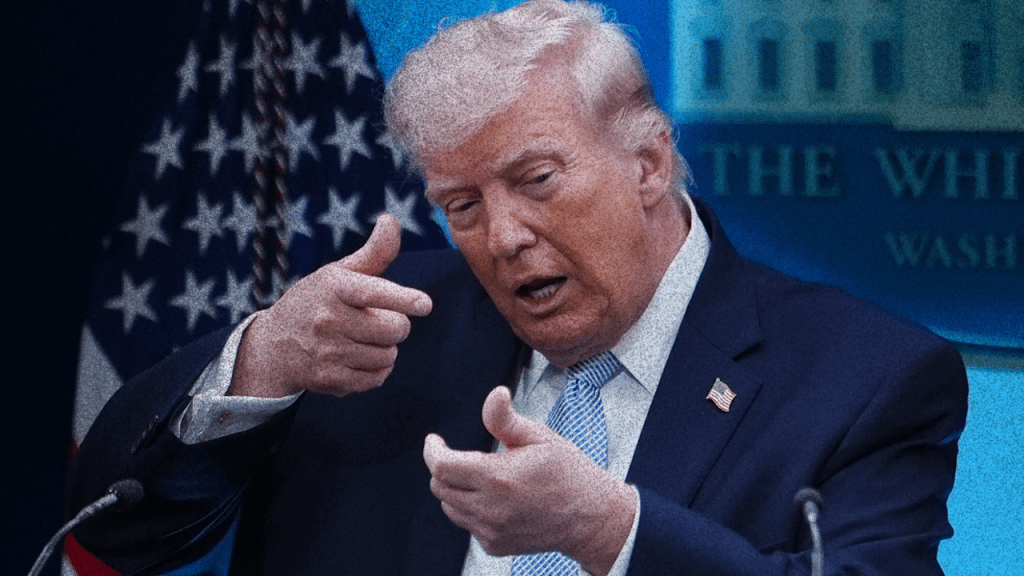
Trump’s Hormuz ultimatum — “A whole civilization will die tonight” — is not a diplomatic warning. It is civilizational threat deployed as energy market coercion, and the absence of organized American resistance to it is the political crisis inside the crisis.
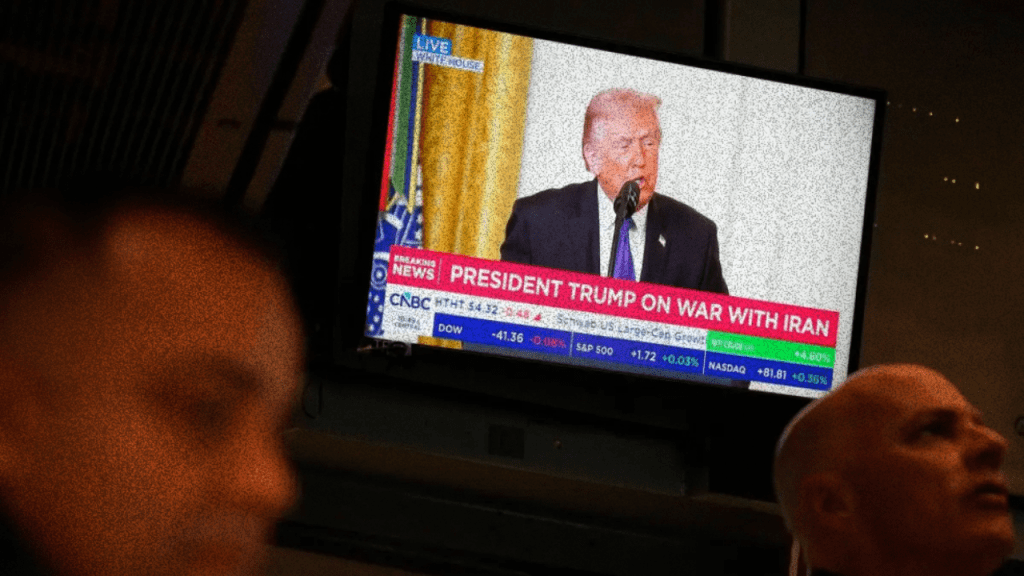
Donald Trump said it plainly: “A whole civilization will die tonight, never to be brought back again.” The statement was not buried in a classified directive or softened through diplomatic channels. It was issued publicly on Truth Social, timed to an 8 p.m. ET deadline, and paired with a specific operational demand — Iran must reopen the Strait of Hormuz and move toward a deal. The United States had already struck Kharg Island, Iran’s primary oil export terminal. The threat was not anticipatory. It was concurrent with live military action against bridges, railways, power infrastructure, and — earlier in the war — an elementary school that killed approximately 170 children.
This matters structurally. When a state issues a public ultimatum tied to an active military campaign against energy infrastructure, the statement functions as coercion whether or not the deadline produces compliance. The psychological instrument — mass civilian fear, global market alarm, the countdown clock — is itself the weapon. Trump’s statement was the policy delivery mechanism, not commentary on it. Framing it as bluster or hyperbole is an analytical error that serves the aggressor by making the threat appear less calculated than it was. Trump’s own words confirm the calculation: “I don’t want that to happen, but it probably will. We will find out tonight — one of the most important moments in the long and complex history of the world.”
The supporting signals were aligned before the deadline arrived. U.S. bombers had been staging for weeks. Israeli strikes had already hit Iranian transport and energy networks throughout the day — railway bridges, a highway bridge, a petrochemical plant, an airport, power transmission lines west of Tehran. Oil markets had surged past $100 per barrel. The whole architecture — military positioning, allied operations, market signaling, public ultimatum — was coordinated. What was unfolding was not a crisis stumbled into. It was a coercive campaign with energy market leverage as its explicit objective.
Hormuz Is the Capitalist Energy System’s Chokepoint
Approximately one-fifth of the world’s oil supply moves through the Strait of Hormuz — roughly 21 million barrels per day, or 21 percent of global petroleum liquids consumption. This is not a bilateral pressure point between Washington and Tehran. It is the structural chokepoint of the entire capitalist energy system. When Trump issued his ultimatum against Iran’s control of that passage, he was not threatening a regional adversary. He was activating a vulnerability that radiates immediately to every economy on the planet that runs on petroleum — which is all of them. The EIA has already confirmed that Gulf states collectively shut in an estimated 7.5 million barrels per day of crude production in March alone, with the disruption expected to worsen before it improves.
The coercive logic follows from the geography. The United States does not need the Strait of Hormuz the way Europe, East Asia, and South Asia do. American domestic production and its control over alternative supply routes give Washington asymmetric leverage in any confrontation centered on Hormuz. Threatening to destroy a civilization that sits astride that chokepoint is simultaneously a threat to Iran and a demonstration of power over every economy downstream of the disruption. The Gulf states, India, China, Japan, South Korea — none of them had a vote in this ultimatum, and all of them absorb the consequences. Iran’s IRGC has already responded in kind, warning it will respond outside the region and deprive the United States and its allies of oil and gas “for many years” if Washington crosses red lines. That counter-threat is not rhetorical either. It is the structural logic of asymmetric deterrence completing its circuit.
Iran’s Human Chains Were Solidarity and Strategy
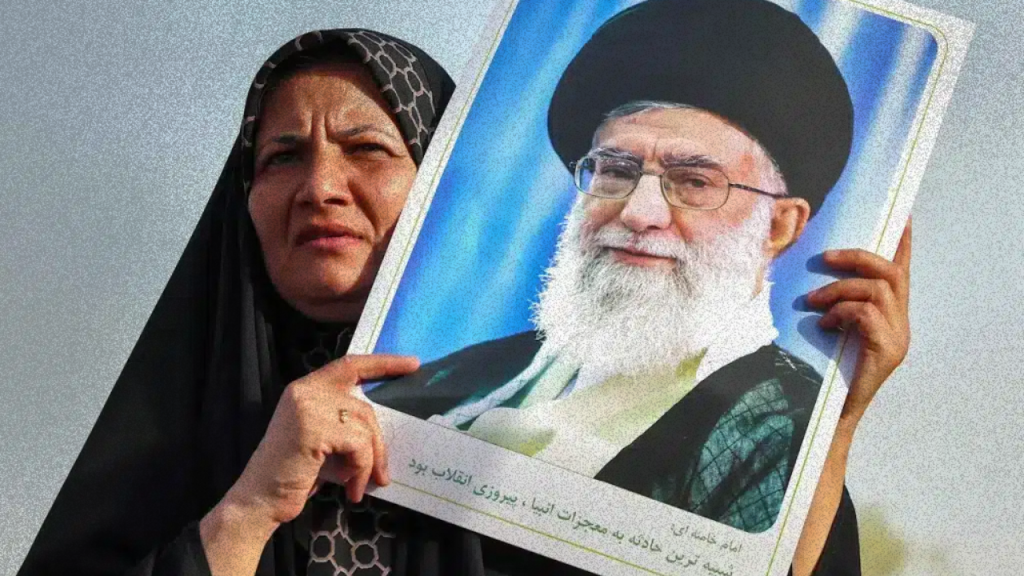
Iranian official Alireza Rahimi called on “young people, athletes, artists, students and university students and their professors” to form human chains around the country’s power plants. State media documented crowds at the Kazerun combined cycle power plant in Fars province. In Ahvaz, formations stretched across major bridges. In Bushehr, near the country’s nuclear facility, civilians gathered in dense formations. The IRGC and state television amplified the call in real time as strikes intensified throughout the day. These were not peripheral events. They were the Iranian state’s civilian-facing response to a military ultimatum, organized at speed under live bombardment.
Two things are simultaneously true about those images, and collapsing them into one destroys the analysis. The first is genuine collective solidarity — a population under existential threat choosing visible presence over dispersal, refusing to be rendered invisible as collateral damage. The second is explicit state strategy — officials directing civilians toward specific infrastructure targets because their physical presence introduced a deterrence variable that military systems cannot easily compute. Both are real. The gatherings did not emerge organically and then get claimed by the state; nor were they purely manufactured spectacle. They were a convergence: state direction meeting real human response, producing something that functioned politically regardless of the proportion of each element. That convergence is exactly what the information environment was designed to obscure.
Verification Failures Are Features of Ultimatum Speed
The information environment surrounding the crisis was deliberately accelerated. A statement condemning Trump’s threat was initially misattributed before being corrected to Pope Leo XIV, the newly elected pontiff who called the threat to destroy Iranian civilization “truly unacceptable” and affirmed that strikes on civilian infrastructure violate international law. A supposed Iranian curfew order circulated widely before verification established that the directive had originated with Kuwait’s Interior Ministry, which had ordered citizens to stay home as a regional precaution. Reports of bridge strikes blurred observation with inference, collapsing possibility into assumed inevitability before confirmation existed — then the confirmed strikes arrived and exceeded the speculation.
These are not isolated editorial failures. They cluster around the moment of maximum pressure — the countdown to the 8 p.m. deadline — and they share a common function: they accelerate the psychological impact of the threat. Speed and noise are operational features of coercive ultimatums. When claims spread faster than they can be verified, when curfews get attributed to the wrong country, when papal condemnations attach to the wrong person, the net effect is a fog in which the threat appears larger, more inevitable, and more globally endorsed than the verified facts support. As we have documented in how states deploy perception management as coercive infrastructure, the information environment is not a neutral transmission belt for facts. Under ultimatum pressure, it becomes part of the coercive apparatus itself.
Iran’s Regional Signals Turned Bilateral Into Systemic
Iran did not limit its response to its own territory. The IRGC warned explicitly that it will respond outside the region and deprive U.S. allies of oil and gas “for many years” if Washington crosses red lines on civilian infrastructure. Iran simultaneously signaled that Gulf energy facilities — Saudi pipelines, Emirati desalination plants — could be targeted if escalation continued, with Tehran noting that Gulf cities would be “uninhabitable without power or water.” That move was structurally significant. It pulled in actors who could not remain neutral because their economic lifelines were directly at stake. Saudi Arabia and the UAE are not peripheral to the global energy system — they are load-bearing pillars of it.
The ultimatum that Trump issued as a demonstration of overwhelming American power had, by the time Iran’s counter-signals were complete, activated a network of interdependencies that Washington does not fully control. Russia and China vetoed a UN Security Council resolution aimed at reopening the Strait just hours before the 8 p.m. deadline, removing the last multilateral off-ramp. Pakistan’s prime minister publicly asked Trump for a two-week extension. Global markets froze — hesitant to bet on whether Trump would follow through or call off the threat as he has in the past. The planetary scale of consequence had been established. What remained was the question of who, outside Iran, was prepared to act on it.
Absent US Mobilization Is a Structural Condition
Inside Iran, civilians gathered in visible collective action at the sites of likely destruction. Inside the United States, the response was diffuse, fragmented, and largely absent. Democrats in Congress denounced the threat as a potential war crime — House Minority Leader Hakeem Jeffries called it a statement that “shocks the conscience” — but organized street-level counter-pressure did not materialize at anything approaching the scale of the crisis. This disproportion is the political crisis inside the crisis, and it demands structural explanation rather than moral hand-wringing. The explanations are material: economic precarity that makes sustained disruption personally costly, political fatigue accumulated across a decade of protest cycles that produced insufficient systemic change, the erosion of mass organizations capable of rapid coordinated response, and a surveillance and repression apparatus that has raised the cost of visible dissent. The mass protest decade failed not because people stopped caring but because the organizational infrastructure required to translate outrage into disruption was systematically dismantled or never built.
The result is a specific political condition: a state that can threaten civilizational annihilation, publicly, tied to a live military campaign, and face no organized counter-pressure from its own population in real time. That condition is not incidental to American imperial capacity — it is constitutive of it. A state that fears domestic disruption modulates its foreign policy accordingly. A state that faces none can escalate without internal constraint. The human chains in Ahvaz and Bushehr were a response to exactly this asymmetry. Iranians used the only instrument available to them — their physical presence — because the political cost of American escalation was not being raised anywhere else.
Presence Confronts Abstraction — Observation Is Not Action
The structural picture resolves into a single image: civilians standing in front of power plants, attempting to physically deter destruction by making themselves visible; military systems preparing to deliver that destruction from altitudes and distances where those bodies do not register as obstacles; and a global audience processing the exchange through screens, reacting but not intervening. Presence confronts abstraction. Human chains confront ordnance delivery systems engineered specifically to bypass them. The technological gap between the two is not incidental — it is the material expression of the power asymmetry that the ultimatum was designed to demonstrate.
What this moment reveals is not simply a geopolitical crisis but the operating logic of contemporary imperial coercion. Threats are issued publicly because psychological impact is part of the strategic payload. Civilians become part of the battlefield not by accident but by design — positioned there either by the aggressor’s targeting choices or by the targeted state’s deterrence calculus. Information degrades faster than it can be verified because speed is a force multiplier for the party issuing ultimatums. And the distance between those directly exposed to violence and those observing it continues to widen, producing a global audience that mistakes interpretation for action and commentary for resistance. A deadline was issued. A threat was made. Civilians gathered in response. The consequences of what happens next extend far beyond the place where it began — and the question of who bears responsibility for those consequences cannot be answered by those who only watched.
Sources
- PBS NewsHour / AP — Trump warns “a whole civilization will die tonight,” April 7, 2026
- Al Jazeera — Iran war live: Trump says “whole civilisation will die,” April 7, 2026
- Al Jazeera — Iranians form human chains across bridges and at power plants, April 7, 2026
- AP — Pope Leo XIV calls Trump’s Iran threat “truly unacceptable,” April 2026

 Spark Solidarity