
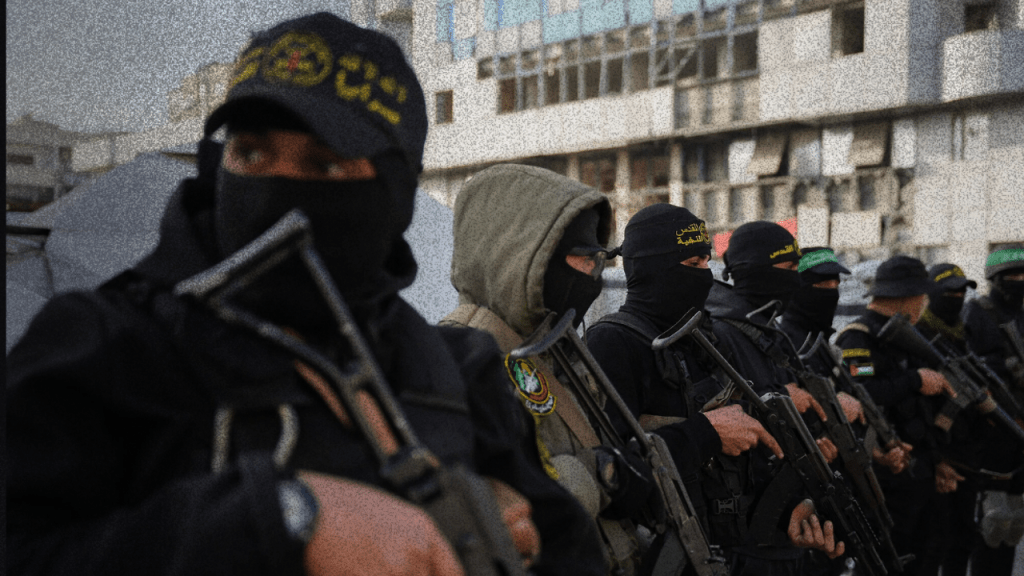
Gaza disarmament plan demands Palestinian weapons first, reconstruction second — a sequencing that does not resolve power imbalance but restructures it under new administrative architecture.
The Board of Peace plan for Gaza has been presented to international audiences as a pathway out of the conflict — a phased framework, technically elaborate, with UN Security Council endorsement via Resolution 2803 and the backing of regional partners. The presentation is doing a great deal of work. Strip it down to its operational logic and what remains is a sequencing problem that answers itself: Hamas disarms first, reconstruction follows, Israeli withdrawal comes last and only upon Israeli-verified completion of Palestinian obligations. The sequence is not a neutral design choice. It is the argument. Every other element of the plan — the International Stabilization Force, the technocratic Palestinian administrative body, the staged Israeli heavy-weapons withdrawal in days 16 through 40 — is scaffolding built around that load-bearing premise. The Board of Peace plan does not end the conflict. It reorganizes it, and the reorganization runs in one direction.
Disarmament First Is Not a Sequencing Choice — It Is the Entire Structure
The plan’s conditionality is explicit and directional. Al Jazeera’s reporting on the full plan text confirms that reconstruction will only be permitted in areas designated as demilitarized — meaning reconstruction begins only where disarmament has been completed and verified. The tunnel networks are dismantled. Security control transfers to an externally backed administrative body before any material reconstruction investment flows. This is front-loading by design — Palestinian obligations are specific, measurable, and time-bound, commencing in the plan’s earliest phase and completing as a precondition for everything that follows. What this sequencing produces is not a phased peace process but a ransom structure: compliance is extracted from the weaker party before the stronger party is required to deliver anything. Three Palestinian factions, including Islamic Jihad, publicly rejected the plan on exactly these grounds, with Palestinian analysts confirming to Al Jazeera that the plan amounts to a demand for the complete “political surrender” of Hamas. Their objection is structural, not rhetorical — the sequence determines who bears risk and who retains optionality. That asymmetry is not a flaw in the drafting. It is the plan’s operational core, and everything else builds from it.
Israeli Withdrawal Is Specified on Paper and Discretionary in Practice
The fact that Israeli withdrawal is technically staged and partially described in the plan’s text does not constitute a genuine counterweight to front-loaded Palestinian obligations. The plan’s second stage specifies Israeli removal of heavy weapons — artillery and tanks — from areas under its control between days 16 and 40. Full withdrawal follows upon, in the plan’s own language, “verification that Gaza is free of weaponry.” Al Jazeera noted a key stumbling block immediately: “whether Israel is truly prepared to withdraw from Gaza, fulfil its commitments and not attempt to spoil any deal, as it has in the past.” The verification committee is established by the Board of Peace’s own High Representative — not by a neutral party — and reconstruction materials including concrete, steel, fertilizers, and fuel remain subject to Israeli restriction until final verification is deemed complete. A withdrawal timeline conditioned on Israeli-controlled verification is not a binding commitment — it is a permission structure in which the party with structural incentives to defer compliance indefinitely holds the keys to its own obligations. Specifying withdrawal “upon verification” while controlling the verification process is not a constraint. It is discretion with better optics.
Paper Enforcement Is Not Enforcement When the Stronger Party Controls the Trigger
UNSC Resolution 2803 endorses the plan. The Board of Peace’s published framework includes regional guarantor language, with partner states guaranteeing Hamas compliance. An International Stabilization Force is authorized. These mechanisms exist. They do not, however, correct the structural problem identified in this article, because their activation is not automatic — it depends on political will from parties whose interests are not aligned with Palestinian self-determination and whose capacity to act is subject to the same geopolitical constraints that produced this plan in the first place. The United States holds veto power at the Security Council. Regional Arab partners have a documented record of treating Palestinian political agency as a threat to their own domestic stability. Gaza-based political analyst Wesam Afifa, who followed the Cairo meetings directly, confirmed that mediators have reduced the diplomatic process to the single condition of Palestinian disarmament — Israel is “granted a free hand to conduct security operations against any perceived threats” while Palestinians are asked to surrender weapons without concrete guarantees for reconstruction, a halt to military operations, or an Israeli withdrawal. Enforcement mechanisms that the dominant party can delay, defund, or veto through existing institutional architecture are not enforcement in any operative sense — they are the appearance of accountability without its function. This is consistent with the broader pattern this site has documented: the management of perception as a substitute for accountability, where institutional legitimacy is deployed to close off challenges rather than address them.
Disarmament Does Not Remove Weapons — It Removes the Capacity to Resist
Hamas leadership has been unambiguous about the political function of its arsenal. Khaled Meshaal told the Al Jazeera Forum in Doha that stripping weapons from an occupied people would turn them into “an easy victim to be eliminated” — framing arms retention not as militarism for its own sake but as the material basis for political leverage in a context where no other leverage mechanism exists. Without security guarantees, disarmament makes Palestinian factions vulnerable to Israeli strikes and rival factions simultaneously. The Arab Center DC locates Hamas’s entire political leverage in its arsenal. Successful disarmament cases — Northern Ireland, South Africa, Colombia — each involved a pathway to political legitimacy or power-sharing as a return on the risk of laying down arms. The Board of Peace plan explicitly excludes Hamas from governance. It demands disarmament while foreclosing the political alternative disarmament is supposed to make possible. What that structure produces is not transition to politics. It produces elimination of the capacity to resist, with no alternative capacity substituted in return. Decisions about movement, access, and security inside Gaza stop being negotiated and become imposed — because the mechanism that imposed costs on imposition has been removed. The loss of deterrence is not a side effect of the plan. It is one of its central outcomes.
Peace Processes Reflect the Distribution of Power at the Moment They Are Negotiated
There is a consistent historical pattern in asymmetric peace processes: agreements reached between parties with radically unequal power tend to formalize the existing distribution rather than correct it. This is not a coincidence or a failure of drafting — it is the predictable outcome when the stronger party controls the terms, the sequencing, the verification, and the enforcement architecture simultaneously. The Board of Peace plan fits this pattern precisely. It takes the power configuration produced by seventeen months of siege, bombardment, and infrastructure destruction and encodes it as the baseline from which Gaza’s future is administered. Stability is achieved through control of one party, not through mutual constraint — which means the underlying conflict dynamics do not resolve. They persist inside a restructured administrative form. This is what distinguishes power management from conflict resolution: the former achieves quiet through subordination; the latter addresses the conditions that produced the conflict. The plan does not address why Gaza was resisting. It addresses the capacity to resist. Understanding that distinction is the difference between taking the plan’s framing at face value and reading what it actually does. The same analytical lens applies wherever Western institutional frameworks are deployed as neutral arbiters in conflicts they are structurally party to — as documented in the political economy of how Western frameworks define legitimate versus illegitimate state power. The language of peace, deployed in service of power reorganization, is a technology of control — and this plan is its current operational form in Gaza.
Sources
- UN Security Council — Resolution 2803 press release, November 2025
- Al Jazeera — Details revealed of Board of Peace plan for Gaza disarmament, March 2026
- Al Jazeera — US seeks Hamas ‘political surrender’ in new Gaza plan, March 2026
- Al Jazeera — Hamas leader rejects disarmament while Israeli occupation of Gaza continues, February 2026
- Al Jazeera — Hamas armed wing says disarmament demands not acceptable, April 2026
- Arab Center DC — Hamas disarmament and the future of Gaza






 Spark Solidarity