
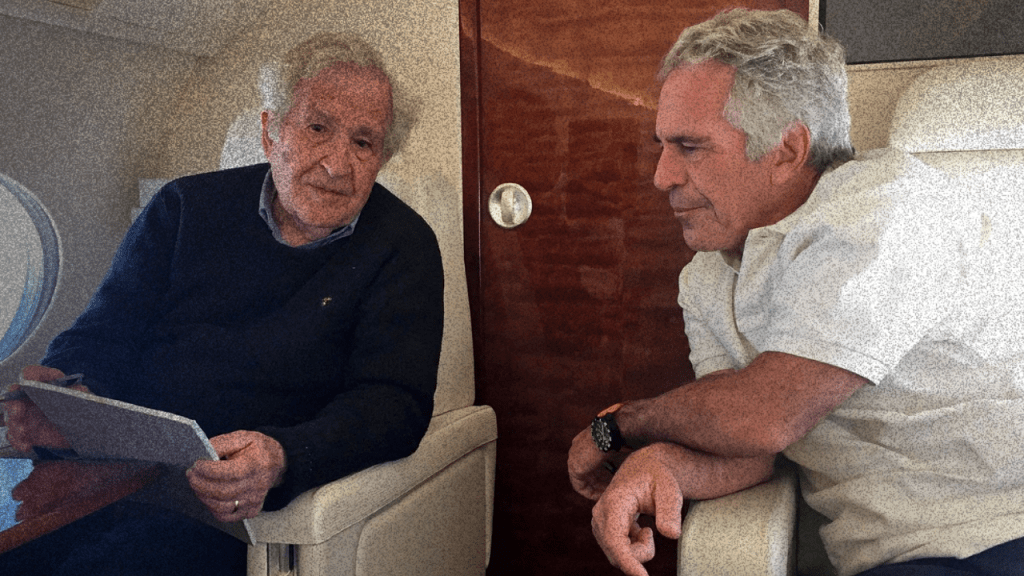
Chomsky Epstein emails don’t just expose a personal failing — they confirm that respectable left intellectualism functions as a permission structure that polices what the left is allowed to suspect.
In February 2019 — months after the Miami Herald published Julie Brown’s investigation tracking more than sixty women who said Epstein abused them — Jeffrey Epstein emailed Noam Chomsky asking for advice on his “putrid press.” Chomsky replied the same day. He called the coverage “the horrible way you are being treated,” framed the accusers as a product of “hysteria that has developed about abuse of women,” and described that hysteria as having reached the point where questioning an accusation had become “a crime worse than murder.” The advice: ignore it, don’t engage, manage it as background noise.
This wasn’t a private slip. It was the same intellectual posture Chomsky has performed in public for decades — applied, behind closed doors, to a convicted sex offender whose trafficking network was actively being documented in print. As has documented, the Epstein files reveal how elite networks manage exposure. But the Chomsky emails reveal something more specific: how that management gets intellectual cover from the left.
The Pattern Predates the Emails by Decades
On JFK, Chomsky’s move is consistent: in a 1993 interview he dismissed the assassination as generating enormous energy toward something of no general political interest — equivalent, in his framing, to a random killing in Hoboken. On 9/11, the same posture: empire is violent, people die constantly, why fixate on this particular event? It sounds like maturity. It sounds like someone handing you a sociology textbook and telling you to focus on structures.
What it actually does is evacuate politics from the moments where power visibly reorganizes itself in public — treating decisive events as interchangeable, as if what follows doesn’t matter, as if the aftermath isn’t the whole point. JFK was not a random death. The assassination coincided with the entrenchment of intelligence agency autonomy, the escalation of Vietnam, and the national security state’s effective emancipation from civilian oversight. September 11 functioned as a legal and psychological reset that made mass surveillance, permanent emergency, and endless war publicly acceptable. Treating either as just another body count isn’t materialism. It’s evasion dressed as rigor.
The Historical Record Makes Dismissal Untenable
The gatekeeping posture requires ignoring a documented record that makes such confidence impossible. COINTELPRO, MK-Ultra, Operation Condor, Iran-Contra. Operation Northwoods — the 1962 Joint Chiefs proposal carrying the signatures of the country’s entire top military leadership, proposing staged terrorist attacks on American soil to justify invading Cuba — is documented history, not speculation. The proposition that similar institutional behavior is inherently implausible isn’t skepticism. It’s selective amnesia.
When Chomsky insists certain suspicions about domestic political events are off-limits, he isn’t making an evidentiary argument. He’s drawing a political boundary and calling it intellectual hygiene. The same move he made privately with Epstein — reframing credible accusations as hysteria, advising silence over accountability — is the same move he makes publicly with anyone who wants to examine how power consolidates itself in specific, documented, destabilizing moments.
Gatekeeping Is a Function, Not a Flaw
The mechanism that enforces the boundary doesn’t suppress inquiry by making questions illegal. It makes them embarrassing. The real political sin, in this framework, isn’t being wrong — it’s being seen as unserious. Raising the wrong kind of question, noticing a rupturing event, wanting to trace how power consolidates itself through specific public moments: these get coded as conspiratorial thinking, as a failure of professional respectability. As the architecture of crisis narratives demonstrates, the goal is fear first, questions never — and the respectable left has spent decades enforcing the “never” end of that formula from within.
The result is a left that can describe systemic violence in the abstract but flinches and scolds the moment anyone tries to trace it through specific, destabilizing, documented events. That’s not dissent. That’s perception management with academic credentials.
The Epstein emails didn’t create that conclusion. They confirmed it — and made it impossible to look away from. The man who spent decades training people to feel embarrassed by their own suspicions was, in private, advising a sex trafficker on how to survive scrutiny by treating his accusers as hysterical. The intellectual posture and the personal conduct are not in contradiction. They are expressions of the same thing.
Sources
- Daily Wildcat — Epstein Files: UA Professors’ Relationship With Epstein
- TRT World — Chomsky Sympathized With Epstein Over ‘Horrible’ Press Treatment
- WBUR — Emails Show Epstein’s Close Connection With MIT’s Noam Chomsky
- NBC News — Noam Chomsky’s Wife Admits ‘Serious Errors in Judgment’
- 22november1963.org.uk — Noam Chomsky and the JFK Assassination
- Spark Solidarity — Epstein Files: What the Documents Reveal About Elite Power
- Spark Solidarity — Operation Northwoods and the Logic of Manufactured War
- Spark Solidarity — Architecture of Crisis: Fear First, Question Never





 Spark Solidarity