
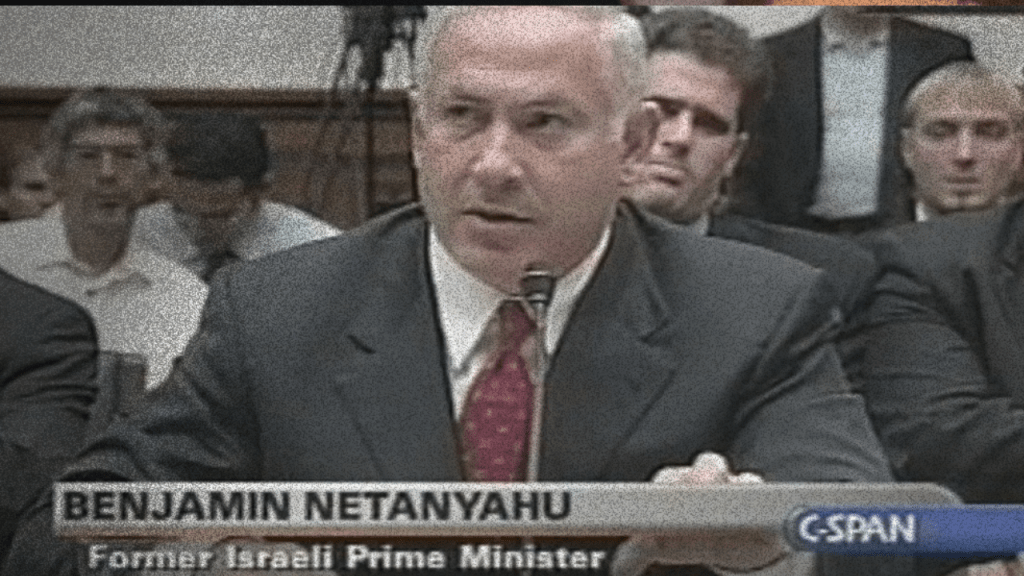
Netanyahu Iraq testimony in 2002 guaranteed removing Saddam would stabilize the region. The invasion produced mass death, state collapse, and expanded Iranian power. He now applies the same framework to Iran.
Netanyahu Guaranteed Iraq Would Stabilize the Region
On September 12, 2002, Benjamin Netanyahu testified before the U.S. House Committee on Government Reform as a private citizen. The congressional record documents his exact words: “If you take out Saddam, Saddam’s regime, I guarantee you that it will have enormous positive reverberations on the region.” He told Congress that people across the Middle East — particularly young Iranians — would see the removal as proof that the era of such regimes was finished. The testimony carried the weight of a former Israeli prime minister addressing the U.S. legislature thirteen months before the invasion, framed explicitly as expert regional analysis.
The guarantee was categorical. No hedging, no conditions, no acknowledgment of uncertainty. A congressman asked Netanyahu directly whether his prediction was “raw speculation.” He did not retreat. The testimony was part of the consent-manufacturing effort that produced congressional authorization for military force one month later. It provided international validation from an allied state figure who claimed specialized knowledge of Middle Eastern political dynamics — the kind of authoritative foreign endorsement that shifts the terms of domestic debate.
Iraq War Produced Mass Death and State Collapse
The invasion killed between 150,000 and over one million Iraqis depending on methodology. Population-based survey research published in The Lancet documented 151,000 violent deaths by June 2006 through direct interview methods. The Iraq Body Count project established a lower-bound civilian death count exceeding 200,000 through media reports and hospital records. The Opinion Research Business survey estimated 1,033,000 excess deaths by 2007. Every credible accounting mechanism confirms mass civilian death as a primary outcome of removing Saddam Hussein. The regional stability Netanyahu guaranteed was replaced by a humanitarian catastrophe that displaced millions and destabilized neighboring states.
The Iraqi state fractured along sectarian lines institutionalized through de-Baathification and the dissolution of the military and security apparatus. The resulting power vacuum produced armed militias, sectarian civil war, and conditions for Al-Qaeda in Iraq to establish territorial control. That organization evolved into ISIS, which by 2014 controlled territory across Iraq and Syria and required a multinational military coalition to contain. Academic research in Security Studies establishes the 2003 invasion and its mismanaged occupation as the causal origin of ISIS’s territorial expansion. The positive reverberations Netanyahu guaranteed produced the Islamic State.
Iranian Influence Expanded Into the Power Vacuum
Saddam Hussein’s Iraq had functioned as a structural barrier against Iranian regional influence — the two states had fought a bloody eight-year war from 1980 to 1988. His removal eliminated that barrier permanently. Iran developed political relationships with Iraqi Shia parties that had been operating in exile in Tehran, funded militia networks, and provided military support when ISIS advanced in 2014. The Wilson Center documented three pivotal junctures at which Iran capitalized on the post-invasion environment: the 2003 invasion itself, the 2011 U.S. troop withdrawal, and the ISIS crisis of 2014 — each one expanding Iranian strategic depth in ways impossible under the previous order.
By 2014, Iranian lawmaker Ali Reza Zakani claimed Iran controlled four Arab capitals — Baghdad, Beirut, Damascus, and Sanaa. The claim was propagandistic in framing but reflected observable influence expansion into spaces created by regional state collapse. Iraq’s political system became structurally intertwined with Iranian strategic interests in ways impossible under Saddam. The United States, Gulf state governments lamented, had served Iraq to Iran on a silver platter. This is the structural opposite of what Netanyahu guaranteed Congress would happen.
The Guarantee Failed By Every Measurable Outcome
Netanyahu predicted stability. The invasion produced mass death and state failure. He predicted the delegitimization of authoritarian regional regimes. The invasion strengthened Iranian governance and created conditions for ISIS. He predicted positive reverberations across the region. The invasion generated refugee flows, sectarian civil war, and a humanitarian catastrophe that destabilized Syria, Lebanon, and Jordan for decades. Every empirical outcome contradicts the September 2002 guarantee.
The contradiction carries no political consequence for Netanyahu. He faced no accountability for the failed prediction. He retained institutional recognition as an authority on Middle Eastern security. The apparatus that platformed his 2002 testimony continues to platform his current analysis. When he returned to Congress in 2015 to argue against the Iran nuclear deal, the same legislative chambers received him with the same deference. His advice was catastrophically wrong on Iraq, Responsible Statecraft concluded, and the structural conditions that allowed him to give that advice remained entirely intact.
Netanyahu Now Applies Identical Logic to Iran
Operation Epic Fury began February 28, 2026 as joint U.S.-Israeli strikes against Iranian targets. Netanyahu framed the operation using the same strategic logic from 2002: removing the threatening regime will stabilize the region, prevent catastrophic outcomes, and produce positive reverberations among populations living under authoritarian rule. He told reporters that without the strikes the world would have faced a nuclear holocaust — positioning Iran as the existential threat Saddam was claimed to be in 2002.
The framework is structurally identical across both campaigns. Identify the adversary regime. Claim specialized knowledge of regional dynamics. Guarantee that military action will produce stabilizing outcomes. Warn that inaction guarantees catastrophe. The 2002 consent-manufacturing apparatus for Iraq is being reassembled for Iran with the same guarantor making the same categorical claims. Whether the Iraq guarantee was sincere or cynical is less relevant than what it demonstrates about how such guarantees function: they provide rhetorical cover for predetermined military action, not falsifiable predictions about regional outcomes. When they fail, no mechanism exists to impose accountability or disqualify the guarantor.
The Institutional Apparatus That Enabled Iraq Remains Intact
Congress platformed Netanyahu’s Iraq guarantee in 2002. The same institutional channels remain open in 2026. Think tanks, media outlets, and foreign policy journals that promoted the Iraq invasion now promote Iran targeting with the same personnel and analytical frameworks. The experts who supported regime change in Iraq face no professional consequences and retain institutional positions. The post-9/11 security apparatus that justified Iraq continues to justify new interventions through the same logic: identify the threat, claim urgency, guarantee outcomes, suppress dissent as enemy sympathy.
Netanyahu’s 2002 testimony is not a historical curiosity. It is a documented case study in how guarantees operate within imperial consent manufacturing. The guarantee does not need to be accurate. It needs to be authoritative enough to move a legislature and a public toward predetermined military action. When the guarantee fails — when the reverberations are mass death rather than regional flowering — the guarantor is not disqualified. He is invited back. The cycle repeats with new targets, the same structural logic, and the same absence of accountability for the last guarantee’s catastrophic failure.
Sources
- U.S. Government Publishing Office — House Committee on Government Reform, Conflict with Iraq: An Israeli Perspective, September 12, 2002
- C-SPAN — Netanyahu 2002: “I guarantee you,” video clip
- The Lancet — Mortality after the 2003 invasion of Iraq, 2006
- Security Studies — The Strategic Logic of the Islamic State
- Wilson Center — Iran’s Role in Iraq, Part 1
- Responsible Statecraft — Bibi’s bullying visits to Congress never end well, July 2024




 Spark Solidarity