
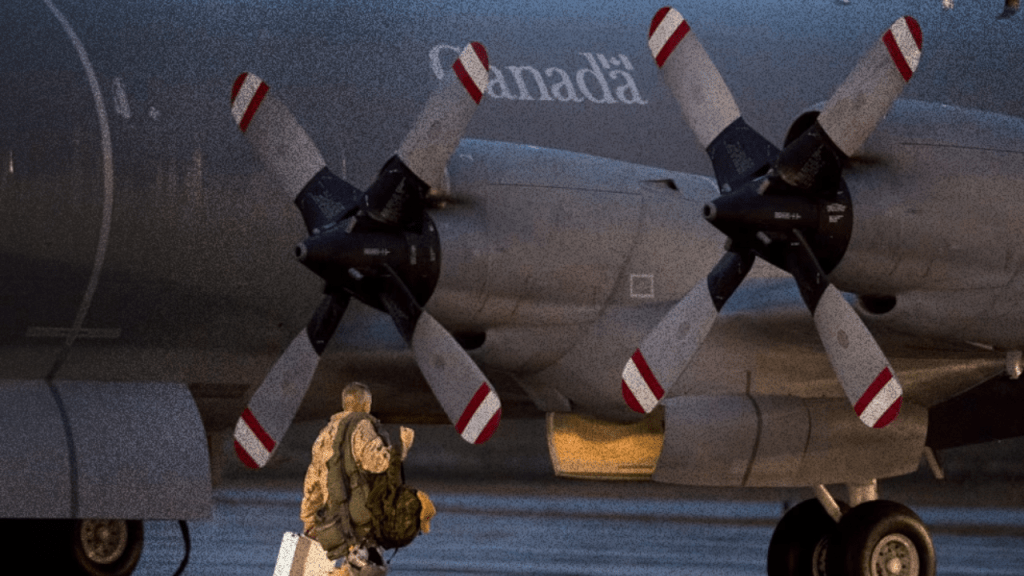
Canada U.S. bombing missions to the Middle East run through Canadian airspace under NORAD agreements that require no parliamentary vote and generate no public debate.
The Bombers Cross Canada Every Night
B-2 Spirit bombers lift off from Whiteman Air Force Base in Missouri bound for the Persian Gulf. Hours later they hang over eastern Canada while KC-135 Stratotankers transfer fuel mid-air over Nova Scotia and Newfoundland. No parliamentary debate precedes these operations. No minister stands to justify Canadian participation. The bomber continues to its target. Canada claims it is not involved.
Flight tracking data analyzed by The Globe and Mail confirmed near-daily refuelling operations over Canadian airspace from March 12 onward, primarily over Nova Scotia and Newfoundland, indicating a sustained corridor rather than an isolated event. A transport aircraft also landed in Gander, Newfoundland en route to Saudi Arabia — the first confirmed use of Canadian territory as part of the logistical chain directly supporting Middle East operations. Mark Gagnon, a cable technician in Moose Factory who recorded aircraft overhead and posted the footage, said plainly: “He started a war and he’s expecting everyone to help him.”
Seven B-2s flew 37-hour, 7,000-mile nonstop missions to the Middle East supported by dozens of midair refuelling aircraft. The direct route from Missouri to the Persian Gulf crosses central Canada and the Hudson-James Bay region, shortening bomber flight times by hours and simplifying tanker logistics. Canadian airspace is not incidental to these missions. It is the route.
NORAD Agreements Eliminate the Need for Permission
The United States does not seek case-by-case approval to move military aircraft through Canadian airspace. Under NORAD and bilateral agreements incorporated into Canada’s Aeronautics Act, U.S. military flights require notification, not authorization. Global Affairs Canada confirmed this arrangement in March 2026, noting that Canadian military aircraft receive the same reciprocal access to U.S. airspace.
The framework was constructed for continental defence. It functions just as effectively for power projection. The structure diffuses responsibility before it can be assigned. Canada does not approve the mission. Canada does not reject the mission. The mission simply happens. Defence Minister David McGuinty stated on March 2 that “Canada was not consulted, did not participate and has no plans to participate in these operations.” The statement is technically accurate in that Canada has not deployed forces. It obscures the material reality. Remove Canadian airspace from the operational calculus and the missions become longer, more complex, more exposed. The distinction between direct and indirect involvement collapses when the operation cannot function the same way without you. Continental integration makes sovereignty a paper category. Operationally, the border does not constrain U.S. military planning.
Operational Details Remain Classified by Design
The existence of refuelling operations has been confirmed. The specifics remain shielded. Flight paths are classified. Timing is classified. Frequency is classified. A NORAD expert quoted by The Globe and Mail explained that U.S. aircraft “need to give notification to Canadian sources. They’d have to register their flight paths, and these would be classified.”
Between March 14 and March 20, Flightradar24 data revealed six additional cases of multiple KC-135 tankers conducting loitering patterns over Newfoundland and Labrador and Nova Scotia, with repeated instances of transponders being switched off during refuelling windows. An aviation expert quoted in The Globe’s analysis noted: “It’s only when they get to the position where they are doing classified military operations that they turn them off.” The forty-minute blackouts are not anomalies. They are the operational signature of classified combat-support missions conducted over Canadian territory with Canadian knowledge and without Canadian debate.
Classification serves a political function. If the public could see the full pattern — the scale, the frequency, the coordination required — it would become harder to maintain the fiction of non-participation. So operations are described as routine while details remain classified. The system operates in two registers: normalized internally, obscured externally.
Northern Canada Offers Geography Without Friction
Northern Canada is not empty space. It is functional space. The polar route is the shortest path between the continental United States and the Middle East. But efficiency alone does not explain its sustained use. What matters equally is the absence of interruption — sparse population, limited media presence, no immediate constituency watching the sky and demanding answers about what passes overhead.
This transforms geography into infrastructure. Not built, but utilized. Not acknowledged, but essential. The corridor exists because it can exist without being seen. Historical precedent extends back decades. During Operation Chrome Dome from 1961 to 1968, U.S. strategic bombers carrying nuclear weapons flew continuous patrols that traversed the Canadian Arctic, Alaska, and Greenland. Canadian airspace has been integrated into U.S. war planning across multiple generations of conflict. What has changed is the target. The structure remains identical.
No Parliamentary Debate Has Occurred
Conservative defence critic James Bezan called for public debate in the House of Commons in March 2026, stating it “should be up to Parliament itself to say yea or nay on whether or not we’re ever going to be deploying our troops into a conflict.” His call concerned potential future Canadian military deployment — not the ongoing use of Canadian airspace for U.S. bombing missions already underway. That has received no parliamentary debate.
A Canadian defence expert quoted by The Globe and Mail explained the arrangement plainly: “Their desire always in the Canada-U.S. defence relationship in North America is to keep it, as the term goes, off the radar, as quiet as possible. Because of our military agreements with the United States, we’re tied into this whether we like it or not.” The system is designed to prevent the question from reaching the floor. When every individual action is classified as routine, the system those actions form becomes unquestioned. Participation becomes automatic because the agreements that enable it predate the conflicts they support.
War Is Distributed Across Allied Territory
Modern war is not contained within borders. It is assembled across networks of infrastructure, agreements, and territories that extend far beyond the battlefield. North America functions as a platform. Airspace, bases, command structures, and logistics are integrated to the point where national distinctions become operationally irrelevant. The United States projects force. Allies provide the conditions that make projection more efficient. Responsibility distributes in the same way — no single action appears decisive, no single actor appears fully accountable.
Canada does not need to declare involvement when involvement is built into the route itself. The bombers leave at night. They cross northern Canada. They refuel in airspace that does not appear in public debate. They continue toward a conflict Canada claims no part in. Nothing about this requires secrecy in the conventional sense. There is no hidden document. There is no dramatic revelation. The system is visible in fragments — acknowledged in passing, understood in pieces. What keeps it intact is not concealment but structure. The question is no longer whether Canada is part of the operation. The question is why the operation is designed so Canada never has to say so.
Sources
- The Globe and Mail — U.S. military aircraft using Canadian airspace to refuel en route to Middle East, March 23, 2026
- Axios Kansas City — Whiteman B-2 bombers strike Iran, B-21 funding grows, March 5, 2026
- CBC News — Canada could be called on to help defend Gulf states, says top military commander, March 5, 2026



 Spark Solidarity