
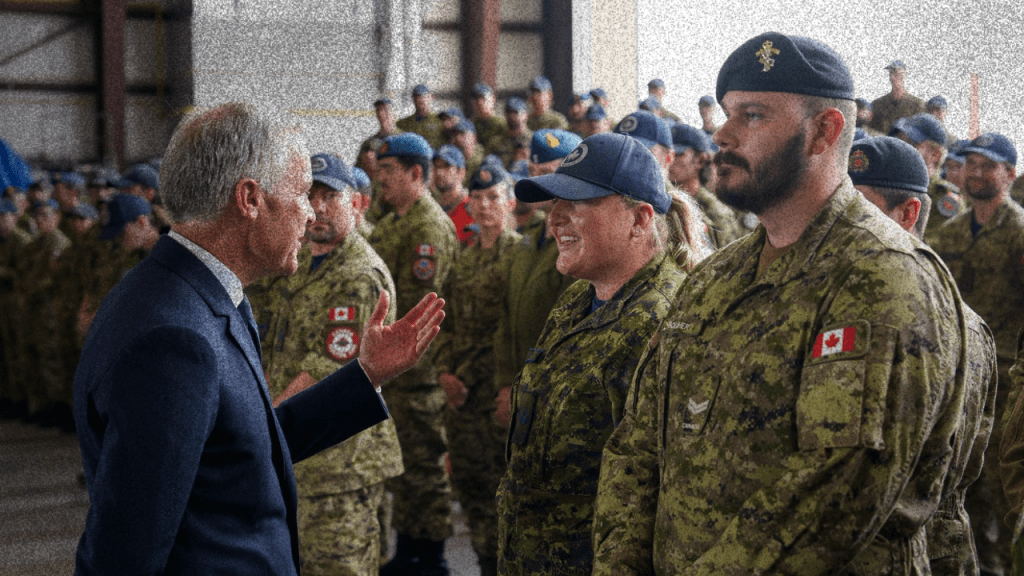
Canada Iran war opposition reached 74% by mid-March 2026. Carney had already refused to rule out military participation. Public will and state trajectory run on separate tracks.
Carney Kept the Door Open in Canberra
On March 5, 2026, standing alongside Australian Prime Minister Anthony Albanese in Canberra, Mark Carney told reporters he could not “categorically rule out” Canadian military involvement in the U.S.-Israel war on Iran. His exact words: “One can never categorically rule out participation. We will stand by our allies.” This came hours after he called the U.S.-Israeli strikes on Iran “inconsistent with international law.” The contradiction resolved itself through alliance obligations. Legal concerns became footnotes. The framework that binds Canada to Washington’s military trajectory had already absorbed the critique.
Twelve days later, an Angus Reid Institute poll published March 17 found three-quarters of Canadians opposed to military involvement in the conflict. The number — 74% — became a headline. The gap between public opposition and state trajectory became the actual story. Passive polling opposition doesn’t translate into policy constraint when the mechanisms that produce war operate outside the parliamentary theatre where public opinion gets performed.
Alliance Obligations Function as Consent Laundering
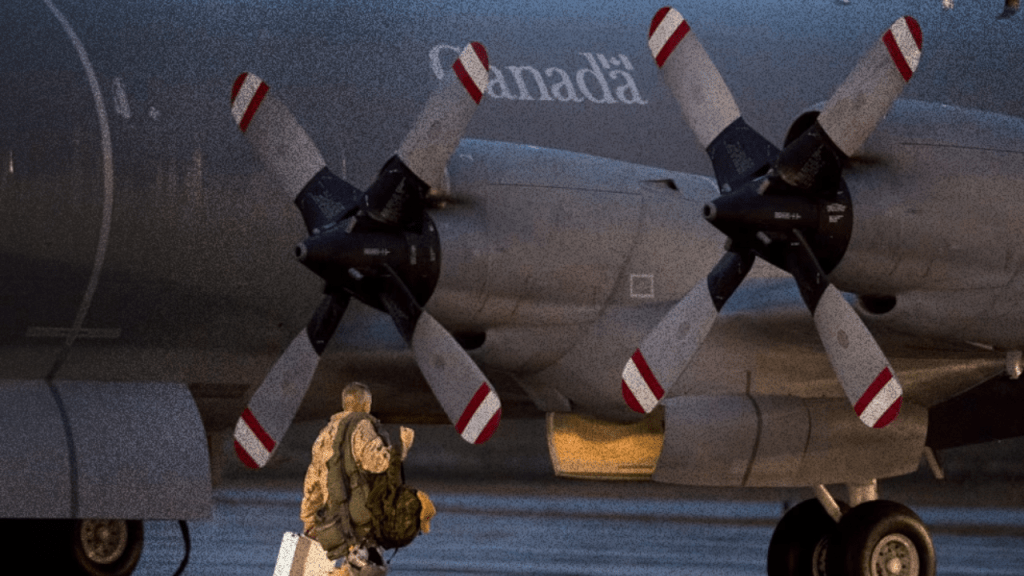
Carney invoked alliance obligations without naming them. The framework includes Five Eyes intelligence sharing, NATO interoperability standards, NORAD continental defence integration, and forward-deployed Canadian Forces already embedded in U.S. Central Command operations across the Persian Gulf. These aren’t theoretical commitments. Canadian soldiers were present at Gulf bases when Iranian strikes hit those installations in early March 2026 and were assigned “other duties” outside the direct Iran campaign while on U.S. exchange. The targeting established direct Iranian military engagement with Canadian positions, collapsing the rhetorical distance between U.S. wars and Canadian “support missions.”
Chief of Defence Staff General Jennie Carignan stated Canada “may be called on to help defend Persian Gulf states from Iran’s strikes.” Both framings — Carney’s and Carignan’s — treat alliance obligations as binding prior to parliamentary authorization. The House of Commons held a four-hour debate on March 9. The war trajectory continued. Parliament became the site where opposition gets voiced and then structurally bypassed. The decision architecture exists in alliance coordination bodies where public opinion registers as noise.
Passive Opposition Produces No Friction
Seventy-four percent opposition means most Canadians, when asked by pollsters, said no to war. It doesn’t mean organized refusal. It doesn’t mean disruption of military logistics. It doesn’t mean shutdowns of recruitment centres or blockades of munitions shipments. Passive opposition — the kind expressed through polling, petition platforms, and parliamentary procedure — gets absorbed without producing policy constraint. Liberal democracies excel at this absorption. The public opposes the war. The government notes the concern. Alliance obligations proceed. The gap between stated public will and state action becomes normalized as the cost of international credibility.
The Angus Reid poll found 10% of Canadians supported military involvement. That minority holds no electoral advantage but controls the policy levers through institutional position. Defence ministers, military brass, intelligence coordination bodies, and diplomatic back-channels operate in a material structure where alliance commitments outweigh polling numbers. Public opposition becomes a communications problem, not a constraint. The solution is better messaging, not policy reversal. Carney’s Canberra statement performed this logic in real time. He acknowledged legal concerns about U.S.-Israeli strikes. He refused to rule out Canadian participation. The contradiction resolved through alliance primacy.
The Threat Construction Runs Through Domestic Incidents
Canadian officials framed Iranian strikes on Gulf bases as proof of threat escalation requiring defensive response. The framing inverts causality. Canadian forces deployed to U.S. Central Command bases become the mechanism through which distant conflicts become Canadian national security emergencies. The threat isn’t Iranian aggression against Canada. The threat is the alliance framework that positions Canadian soldiers as tripwires for Washington’s wars. When those bases get targeted, the targeting becomes evidence of Iranian hostility toward Canada rather than evidence of Canadian complicity in U.S. military positioning.
This threat construction accelerates through domestic incidents framed as Iranian influence operations. The weaponized diaspora narrative treats Iranian-Canadian communities as potential fifth columns. Sleeper cell warnings from intelligence officials create ambient paranoia. The combination produces domestic securitization that justifies foreign military engagement. Public opposition to war gets reframed as failure to grasp the Iranian threat already present on Canadian soil. The gap between 74% polling opposition and state war trajectory gets explained through security clearance asymmetry — officials know things the public doesn’t. Trust the alliance. Trust the intelligence assessments. The structure requires passive trust as the precondition for continued operation.
Parliament Debates After Decisions Get Made
The House of Commons held its Iran war debate on March 9 — seven days after Canadian positions came under Iranian missile fire, four days after Carney refused to rule out participation in Canberra. The sequence matters. Parliamentary debate happened after the material facts of Canadian involvement were established through troop deployments, intelligence sharing, and alliance coordination. The debate became ceremonial. MPs voiced constituent concerns. The government noted the input. No mechanisms existed to constrain the executive from proceeding through alliance channels already operating outside parliamentary oversight.
This isn’t a failure of Canadian democracy. This is Canadian democracy functioning as designed. Public opinion gets registered. Debate happens. Policy proceeds through executive and alliance structures insulated from direct democratic constraint. The 74% opposition number becomes a data point in future historical accounts. It demonstrates Canadians were skeptical. It produces no friction in the decision architecture that converted skepticism into continued military coordination with Washington. The gap between public will and state action isn’t a bug. It’s the load-bearing feature that allows liberal democracies to wage unpopular wars while maintaining domestic legitimacy through the performance of debate and concern.
Sources
- Al Jazeera — Canada PM Carney says unable to rule out military role in Iran war, March 5, 2026
- Angus Reid Institute — Canadians reject military role in Iran by seven-to-one margin, March 17, 2026
- CBC News — Canada could be called on to help defend Gulf states, says top military commander, March 5, 2026
- Spark Solidarity — Weaponized Diaspora and the Witnesses Empire Needs, February 28, 2026


 Spark Solidarity