Cuba protests sanctions destabilization follows six decades of U.S. economic warfare designed to create the conditions Western media calls regime failure.
March 14 Morón Protests Followed Trump Oil Blockade
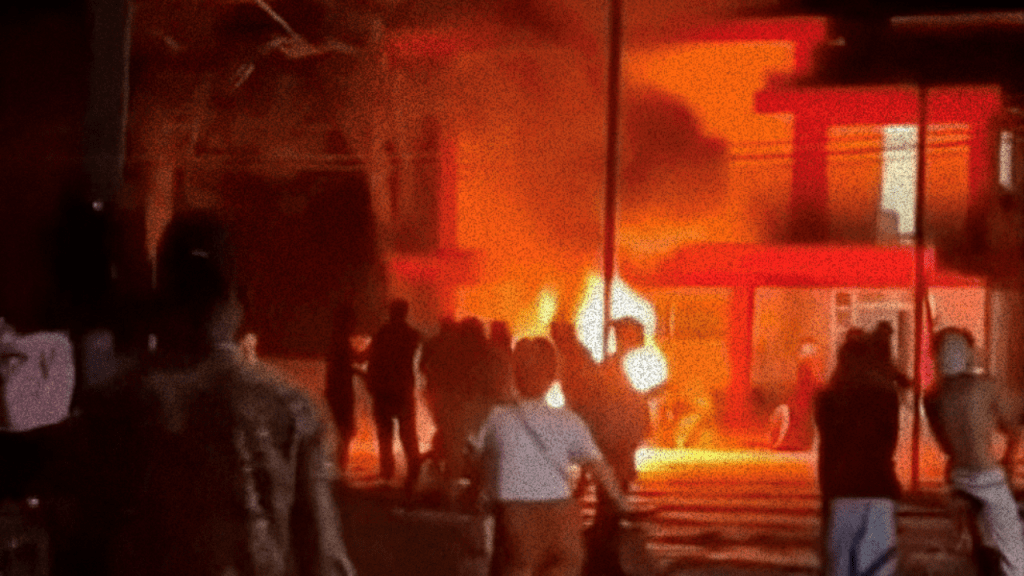
On March 14, 2026, protesters in Morón attacked and partially destroyed the municipal Communist Party office amid fuel shortages and power cuts. Cuban authorities arrested five people for what the government called vandalism. Western outlets reported the event as evidence of spontaneous popular anger against the Cuban government. The material conditions driving the protest are not mysterious. Cuban President Miguel Díaz-Canel had confirmed the week prior that no petroleum shipments had arrived in Cuba for three months. This did not occur because Cuba stopped paying for oil. It occurred because the United States cut it off.
In January 2026, the Trump administration captured Venezuelan President Nicolás Maduro and severed Cuban oil shipments from Venezuela — Cuba’s primary supplier. On January 29, Trump signed Executive Order 14380, declaring a national emergency with respect to Cuba and establishing a tariff mechanism against any country supplying Cuba with oil. Mexico, which had become Cuba’s largest remaining supplier, suspended deliveries. By March, Cuba’s national electrical grid had collapsed entirely three times — the third blackout, on March 16, left 11 million people in darkness. The number of protests documented across the island rose from 30 in January to 130 in the first half of March alone.
Sanctions Produce Scarcity, Then Scarcity Gets Framed as Regime Failure
The U.S. embargo against Cuba has been in continuous force for 64 years. President Kennedy imposed it on February 3, 1962. The stated purpose has varied — punishing Castro, promoting democracy, protecting human rights — but the mechanism remains constant. Cut off Cuba’s access to international markets, foreign investment, fuel, medicine, and food imports. Create conditions of deprivation severe enough to produce internal pressure for regime change. Then present the deprivation as evidence the Cuban government cannot govern.
Trump’s January 29 executive order was an escalation within an existing system. Previous sanctions restricted Cuba’s ability to purchase oil on international markets. The 2026 order went further: it threatened economic penalties against any country that supplied Cuba with oil, whether directly or indirectly. Legal analysis confirmed the order effectively launched an oil blockade by imposing tariffs on third-country suppliers. UN human rights experts condemned it as “a serious violation of international law” and described it as “an extreme form of unilateral economic coercion.” The UN Secretary-General warned in early February that Cuba could “collapse” if its oil needs were not met. The UN General Assembly has voted against the U.S. embargo nearly every year since 1992 — the most recent vote was 187 to 2, with only the United States and Israel opposed.
The Iran Model Applied to Cuba for Six Decades
Cuba represents the longest-running application of a strategy the U.S. deployed against Iran with renewed intensity after 2018. Treasury Secretary Scott Bessent stated in January 2025 that Trump’s maximum pressure sanctions seek to “collapse” Iran’s economy by cutting off oil exports. The mechanism is explicit: drive exports to zero, starve the government of revenue, produce widespread economic misery, then frame the misery as evidence the government has failed its people. NPR reported in 2019 that the campaign against Iran was aimed at driving oil exports to zero through secondary sanctions that penalized any country purchasing Iranian oil.
The Cuban embargo predates the Iran sanctions by nearly two decades, but the logic is identical. The difference is duration. Iran has faced comprehensive sanctions since 2010. Cuba has faced them since 1962. Both countries experience fuel shortages, power outages, medicine shortages, and food scarcity. Both experience protests driven by material deprivation. Both are then described in Western media as regimes losing legitimacy because they cannot provide for their populations. The sanctions themselves disappear from the frame or appear as background context rather than primary cause. This is not a defense of either government. It is an account of causality.
Engineered Scarcity Becomes Evidence of Socialist Failure
Western media coverage of the Morón protests was not uniformly dishonest. Al Jazeera reported that conditions “continue to deteriorate under severe restrictions from the United States meant to squeeze the economy.” NBC News stated the protests were “triggered by worsening blackouts that have been exacerbated by a U.S. oil blockade.” These are accurate descriptions. The problem is structural. The architecture of the story still places Cuban government failure at the center and U.S. policy at the margins. The blockade “exacerbates” blackouts rather than causing them. The restrictions “squeeze” the economy rather than strangling it.
The March 14 protests fit within a documented pattern that has run continuously since the Bay of Pigs invasion. Sanctions create scarcity. Scarcity produces protests. Protests are framed as organic expressions of popular discontent with socialism. The framing justifies further sanctions or direct intervention. The sequence has run in Nicaragua throughout the 1980s, in Iraq between 1990 and 2003, and is running now in Venezuela, Iran, Syria, and Cuba simultaneously. When a government is systematically prevented from importing fuel, that government will experience fuel shortages. When fuel shortages cause power outages, and power outages disrupt food distribution and medical services, the population will experience hardship and eventually protest. The protests are real. The hardship is real. The causal sequence is also real, and it originates in Washington — not Havana.
The U.S. government does not hide its intentions. Rep. Carlos Giménez, announcing support for the January 2026 executive order, explicitly acknowledged the measures “may temporarily worsen conditions for the Cuban people” but argued they were necessary to increase pressure toward regime change. The embargo exists to create conditions severe enough to produce that outcome. The March 14 protests are one more data point in a strategy that has been running for 64 years. They are not evidence of Cuban government failure. They are evidence that economic warfare works exactly as designed.
Sources
- Al Jazeera — Protests erupt in Cuba as U.S. restrictions spark food, energy shortages, March 14, 2026
- NBC News — Protesters in Cuba attack Communist Party office in rare riot over blackouts, March 14, 2026
- White House — Executive Order 14380: Addressing Threats to the United States by the Government of Cuba, January 29, 2026
- Greenberg Traurig — U.S. Declares National Emergency on Cuba and Announces Tariff Framework Targeting Oil Suppliers, 2026
- OHCHR — UN experts condemn U.S. executive order imposing fuel blockade on Cuba, February 2026
- CNN — Cuba is going dark under U.S. pressure, March 18, 2026
- U.S. State Department — The Cuban Embargo, 1962
- Geopolitical Economy Report — Top U.S. government officials boast they are trying to “collapse” Iran’s economy, January 2025
- NPR — How U.S. Sanctions On Iran Work (And How Iran Responds), 2019

 Spark Solidarity