
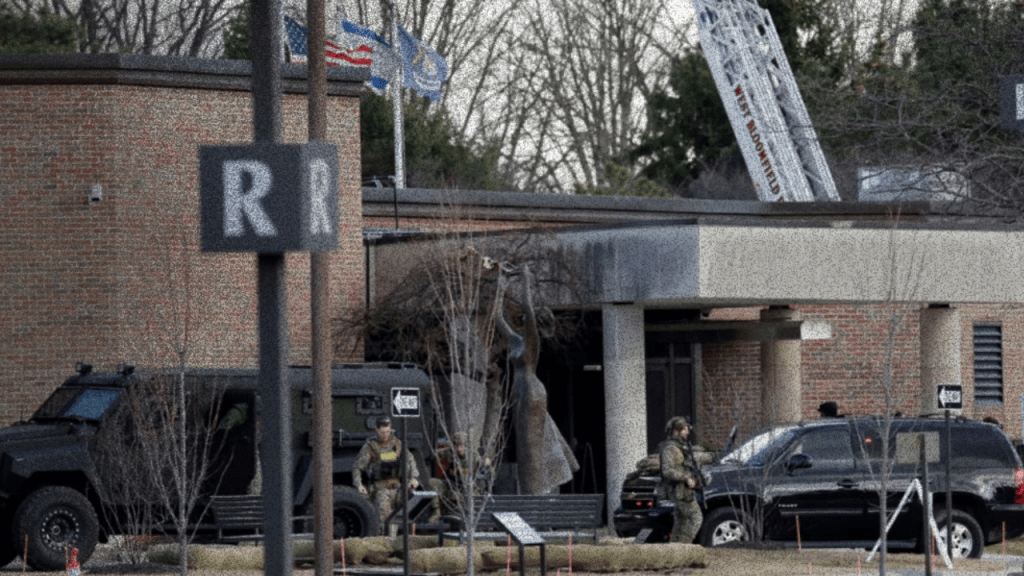
West Bloomfield synagogue attack framed as Iranian terror before investigation finished. Same playbook that sold Iraq and Afghanistan wars now targeting Iran.
The Attack Gets Weaponized Before the Investigation Concludes
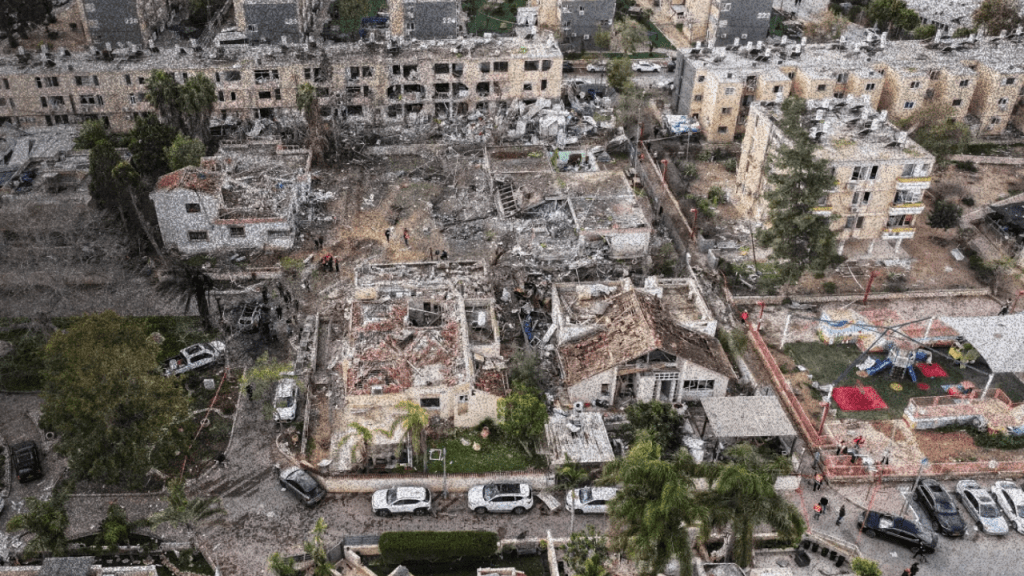
March 12, 2026. Temple Israel, West Bloomfield, Michigan. Friday afternoon, with 140 children in the early childhood center. Ayman Mohamad Ghazali, 41, a naturalized U.S. citizen born in Lebanon, rams his Ford F-150 through the front doors and drives it down the hallway toward classrooms. Security engages him immediately. One guard is struck by the vehicle. Ghazali exchanges fire with officers, then shoots himself in the head. He is the only fatality. The FBI calls it “a targeted act of violence against the Jewish community.” Thirty hours in, the special agent in charge publicly declines to speculate on motive: “We’re letting the facts and evidence lead where we go.”
Social media does not wait. Within hours, the narrative is already forming: Lebanese-born attacker, family ties to Hezbollah, active U.S.-Iran war as backdrop. The Iran connection gets emphasized before the investigation produces evidence supporting it. By the time investigators conclude their work, public opinion will have already formed around what the attack means — regardless of what evidence actually establishes.
The Iran Angle Gets Pushed Before Facts Are Established
The facts known in the first 48 hours: Ghazali had lost four family members — two brothers and two of their children — in an Israeli airstrike on Mashgharah, Lebanon on March 5. His brothers Kassim, a soccer coach, and Ibrahim, a school bus driver, had been eating their Ramadan fast-breaking meal with their children when the strike hit. Hours before the attack, Ghazali called his ex-wife and told her to “send money overseas.” She called police after hanging up, fearing he was suicidal. He had been in the U.S. since 2011. The FBI confirmed he was flagged in government databases for contacts with suspected Hezbollah members — but was not believed to be a member himself.
On March 15, the Israeli Defense Forces posted to social media claiming that Ibrahim Ghazali had been a commander in Hezbollah’s Badr unit, responsible for missile operations. The IDF said it had used “cross referencing” to reach this conclusion but provided no details on verification methodology. The FBI declined to comment on the IDF’s statement, citing the ongoing investigation. Hezbollah denied the claim entirely, with an official telling the New York Times that neither Ibrahim nor his family were affiliated with the group. Two governments with opposing interests in the narrative have now staked out incompatible positions. The FBI — the agency actually conducting the investigation — has said nothing to resolve them.
This is the structure of narrative production in real time. The IDF has no investigative jurisdiction in a domestic U.S. terrorism case. What it has is a narrative role: supply the foreign connection before U.S. investigators establish one, shape the interpretive frame while the facts are still fluid. The speed matters. The Iran-Hezbollah angle circulates and consolidates before the investigation concludes. The contested nature of the IDF’s claim — denied by Hezbollah, unconfirmed by the FBI — gets buried in the pace of coverage.
This Is the Iraq Playbook Applied to Iran
The U.S. is in active military conflict with Iran as of February 28, 2026. Strikes have hit Iranian nuclear infrastructure. Iran has retaliated with ballistic missiles. The American public remains unconvinced about escalation. The domestic threat narrative is the mechanism for that persuasion: establish that Iranian-linked actors are conducting attacks inside the United States, use those attacks to justify expanded surveillance, expanded law enforcement powers, and expanded military action abroad.
The pattern is not new. Iraq required WMD claims and al-Qaeda connections that did not exist. Afghanistan required framing the Taliban as an imminent threat to U.S. cities. Iran requires framing individual acts of violence as tentacles of Tehran’s reach into American communities. The West Bloomfield attack was real and violent. It targeted a Jewish community at prayer with children present. Those facts do not automatically connect to Iranian state strategy. Ghazali was a man whose family had just been killed in an airstrike. He called his ex-wife and told her to take care of her family in Lebanon. He waited in the parking lot for two hours. This is the profile of grief-driven violence — not the profile of a coordinated state-sponsored operation. Those are structurally different categories. The narrative collapses that distinction deliberately.
The narrative construction happens before the facts settle because the facts are not the point. The point is manufacturing consent for escalation. The War on Terror infrastructure was never dismantled. It needed a new target. The West Bloomfield attack, whatever its actual causes, is being made to serve that function.
The First Domino Is Always Domestic Fear
You cannot sell a war to a population that does not feel threatened. Regional conflicts remain abstract. Domestic terror becomes visceral. The mechanism is predictable: take an incident of violence, emphasize the details that connect to the designated enemy, de-emphasize or ignore the details that complicate the narrative, and let the public connect the dots. The dots always lead to the conclusion the state wanted from the beginning.
West Bloomfield establishes the precedent. The next attack gets framed the same way. Then the next. Each one reinforces the pattern until the pattern becomes common sense: Iran is not just a geopolitical adversary, Iran is a threat in your neighborhood. That is why your community needs more surveillance, more police presence, more military intervention abroad to keep you safe at home. The investigation will produce findings. Those findings may or may not support the narrative already circulating. By then, the narrative will have done its work.
The war manufactures the conditions that justify more war. An airstrike kills a family in Lebanon during Ramadan. A man in Michigan, shattered by grief, drives a truck into a synagogue. The state that authorized the airstrike then uses the attack to demand expanded powers to protect the public from Iran. The loop closes. The institutions running it remain constant. The script does not change.
Sources
- Detroit News — Temple Israel shooting, March 12, 2026
- CNN — Temple Israel attack: What we know, March 14, 2026
- PBS NewsHour — Lebanese official: attacker lost family in Israeli airstrike, March 13, 2026
- Detroit News — Attacker died self-inflicted gunshot, FBI says, March 13, 2026
- CNN — IDF says attacker’s brother was Hezbollah commander, March 15, 2026
- MS NOW — Hezbollah disputes connection to Michigan synagogue attack, March 15, 2026
- NPR — FBI takes over Michigan synagogue attack investigation, March 12, 2026




 Spark Solidarity