
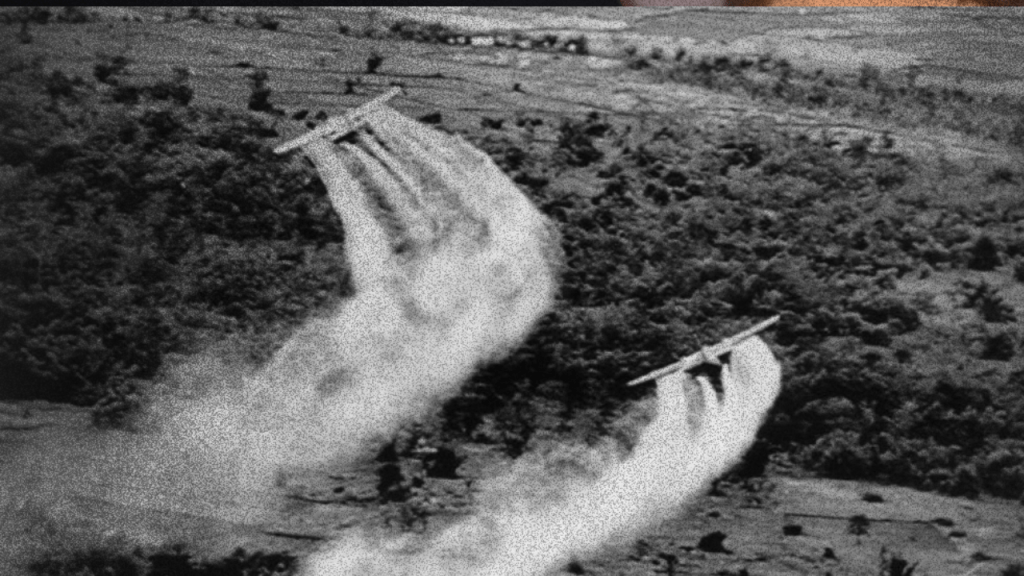
Weather modification military history isn’t a fringe topic — the U.S. government weaponized rain during the Vietnam War, and the world’s response confirmed exactly what that meant.
Mention weather modification in almost any setting and the reaction is immediate. People either laugh it off or group it with whatever the latest viral conspiracy happens to be. The topic is treated as unserious by default.
That reaction only works if the premise is false. It isn’t.
Governments Already Modify Weather
Weather modification is not hypothetical. It is an established field with decades of research and real-world deployment. The most common form is cloud seeding — aircraft or ground-based systems dispersing particles such as silver iodide into clouds to encourage precipitation. It doesn’t create storms out of nothing. It works by enhancing conditions that already exist, nudging moisture into rain or snow under the right circumstances.
This is not fringe science. Multiple countries run cloud seeding programs today for water management, agriculture, and drought mitigation. China operates one of the largest weather modification systems in the world. The United Arab Emirates has invested heavily in similar efforts to address water scarcity. Several U.S. states run their own programs. Results are modest and inconsistent — studies typically estimate precipitation increases in the range of 0 to 20 percent under favorable conditions. But that’s not the point. The point is that humans are already intervening in atmospheric processes as a matter of policy. The idea that weather is completely untouched or beyond influence is factually incorrect.
It Was Already Used as a Weapon
The most important break in the conversation comes from history.
During the Vietnam War, the United States ran a classified program known as Operation Popeye. The goal was to extend the monsoon season over key supply routes used by North Vietnamese forces along the Ho Chi Minh Trail. More rain meant more mud, more landslides, more disruption to the movement of troops and materials. The military’s internal slogan was “make mud, not war.”
Starting March 20, 1967, and running through every rainy season until July 1972, U.S. aircraft flew 2,602 cloud-seeding sorties over Cambodia, Laos, and Vietnam, dispersing silver iodide and lead iodide into storm systems. The program was operated out of Thailand, officially logged as weather reconnaissance missions, and kept secret from Congress — including from the Secretary of Defense, Melvin Laird, who had categorically denied to Congress that any such program existed. It was sponsored, according to declassified records, by Secretary of State Henry Kissinger and the CIA.
Reconnaissance reports confirmed that artificially induced rainfall extended the monsoon season in targeted areas by 30 to 45 days, producing mudslides, flooded supply routes, and disrupted convoys. The annual cost was roughly $3.6 million — about $23 million in today’s dollars. An internal assessment concluded that results were “certainly limited” and “fundamentally unverifiable,” but the program ran for five years regardless.
The operation remained secret until investigative journalist Jack Anderson broke the story in March 1971. The program’s existence then entered the public record through the Pentagon Papers and a 1972 New York Times report. Congressional hearings followed in 1974. Senator Claiborne Pell, upon learning the full scope of what had been done, asked the question that still hasn’t been answered: “The thing that concerns me is not rainmaking per se, but when you open Pandora’s box, what comes out with it?”
At roughly the same time, Project Stormfury — a separate program running from 1962 to 1983 — attempted to weaken hurricanes by seeding their cloud structures to disrupt storm intensity. It ultimately failed to produce reliable results. But it ran for over two decades, funded by major state institutions, operating on the explicit assumption that weather systems could be influenced for strategic ends. Even in failure, it establishes something critical: the investment, the intent, and the institutional appetite were all real.
They Didn’t Ban the Science. They Regulated It.
The global response to Operation Popeye’s exposure was not denial. It was regulation.
In 1977, the Environmental Modification Convention (ENMOD) was opened for signature, entering into force in 1978. It prohibits the hostile use of environmental modification techniques that could cause widespread or long-lasting damage. Today it has 78 state parties, including the United States, China, Russia, and the United Kingdom.
The wording is precise and the precision is revealing. ENMOD bans hostile use. It does not ban the technology itself. That distinction reveals how governments actually understood the issue. Environmental modification was real enough to require international limits. It was dangerous enough to be classified as a potential weapon. But it was also considered legitimate enough to continue under peaceful applications. The tools were never abandoned. They were reframed.
What ENMOD actually accomplished was codifying the assumption that this category of capability exists and must be managed — not eliminated. Legal scholars at West Point have noted that ENMOD’s threshold for violation is ambiguously high, meaning significant atmospheric interventions may fall below the treaty’s enforcement trigger even if their effects are substantial. The convention is less a hard prohibition than a marker of legitimacy — a line drawn to signal that the technology is real, serious, and politically sensitive enough to require international attention.
What the Dismissal Actually Does
Discussion of weather modification routinely collapses into two extremes. On one side, everything is dismissed as conspiracy. On the other, everything is exaggerated into total control. Both positions avoid the actual issue.
One of the most effective tactics used to shut down the conversation is association — grouping documented programs like cloud seeding and Operation Popeye together with unrelated and unsupported claims, so the entire subject becomes easier to ignore. This is a classic fallacy. It replaces analysis with categorization. And it is very convenient for institutions that would prefer the documented record not be examined too closely.
The reality is more uncomfortable. Some forms of weather and atmospheric intervention are real, documented, and ongoing. The U.S. government weaponized rain. The international community responded by writing a treaty. That treaty is still in force. And the research never stopped.
The question isn’t whether atmospheric intervention is possible. The record answers that. The question is what it means that this capability exists, who currently holds it, and where it goes from here.
Sources
- Wikipedia — Operation Popeye
- Popular Science — With Operation Popeye, the U.S. government made weather an instrument of war
- U.S. State Department — Project Popeye declassified memorandum, Foreign Relations of the United States 1964–68
- Sierra Hotel Aeronautics — Operation POPEYE: Weaponizing the Weather in Vietnam
- Wikipedia — Environmental Modification Convention (ENMOD)
- UN Office for Disarmament Affairs — ENMOD Convention
- Lieber Institute West Point — ENMOD: Dead Letter or Environmental Lifeline?
- Geoengineering Monitor — Stratospheric Aerosol Injection



 Spark Solidarity