
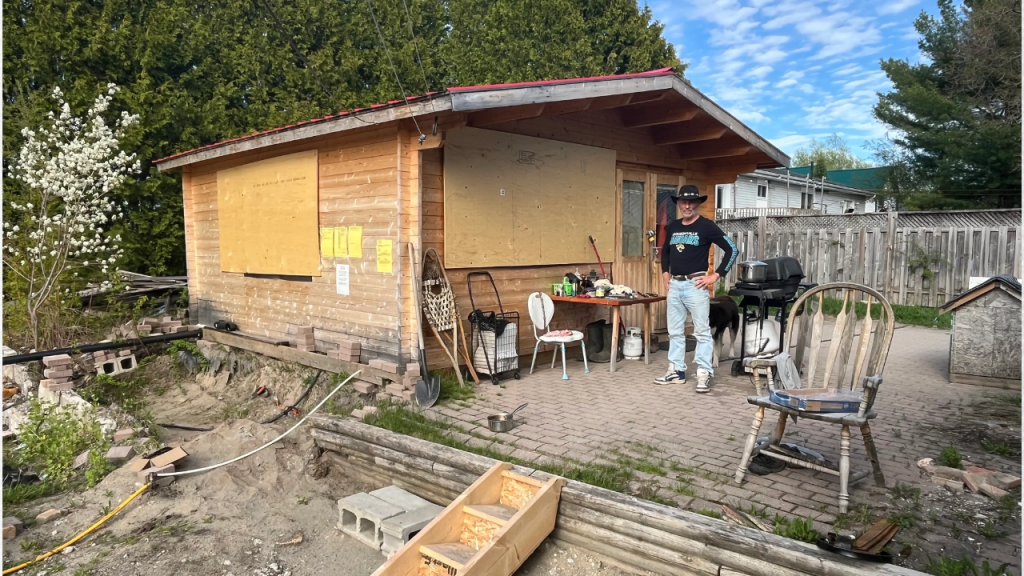
Ontario tiny home eviction: John Ridge’s 250-square-foot shed was larger than the provincial code minimum. West Nipissing removed him from it anyway.
On May 14, 2026, the Municipality of West Nipissing removed John Ridge from the 250-square-foot shed he had built for himself on his own land in Cache Bay after fire destroyed the previous house on the property in 2022. He had lived there for three years without incident. He has seizures, and the compact space suits his condition. He has a husky mix named Smoke.
The town’s stated grounds for removing him were code violation: the structure was permitted as a shed, not a residence, and did not meet the municipality’s minimum dwelling size of seventy square metres, or roughly 754 square feet.
Two facts about that minimum matter. The first is that Ontario’s own building code, at the provincial level, permits residential dwellings as small as 17.5 square metres — 188 square feet — in open-concept designs. Ridge’s shed, at 250 square feet, was larger than what the province considers a legal home.
The second fact is that West Nipissing’s own council had voted twenty-one months earlier to reform the bylaw that produced the minimum. They evicted him under the unchanged rule anyway, while the review they had approved was still in progress.
The Bylaw the Council Had Already Voted to Review
In September 2024, West Nipissing Councillor Kaitlynn Nicol brought a motion to amend the municipality’s Bylaw 2014-45 to permit tiny homes in residential zones. The current minimum, she noted, was 754 square feet. Residents had approached council asking for the amendment. The proposal aligned, Nicol wrote, with environmental and energy-use goals.
Council agreed. Councillor Georges Pharand, endorsing the motion, observed that Ontario’s provincial building code already permitted homes as small as 188 square feet in open-concept designs and suggested West Nipissing bring its own bylaw into line. “If people want to live in a tiny home,” Pharand said, “I don’t see why we should be standing in their way.” Staff were instructed to prepare additional information for a future meeting. The municipality’s official plan was under review at the time, and the tiny-home reform was flagged as one of the items to be prioritized.
That review remained ongoing when Ridge was evicted twenty-one months later. Mayor Kathleen Thorne-Rochon posted on Facebook four days after the eviction, without naming him, that the municipality was “legally obligated to enforce the Ontario Building Code to protect public safety, ensure fire protection, structural integrity and accessibility.” The post did not mention that the council had voted to revise the bylaw at issue, or that the review of Bylaw 2014-45 was still in progress, or that provincial code permitted units smaller than the one Ridge had built.
What Ridge Says Happened in Between
In a public response to the local Tribune’s coverage of his eviction, Ridge outlined a version of events the municipality has not disputed. He paid the back taxes owed on the property when he took possession in 2022, paid the fee to reactivate a waterline the town’s records did not know existed, and has never missed a water or tax bill since. He says the town’s front desk staff can confirm this and that he has the receipts.
He describes the arrival of the Chief Building Inspector “without ID and an attitude of NO! No suggestions, no advice, no help.” He contacted his ward councillor about the treatment; the councillor was initially responsive and then stopped answering. He emailed the other councillors and the staff members who had signed enforcement letters, inviting them to visit the property so he could walk them through what he was doing. He got no response.
He describes being told, at a meeting with the municipality, that someone familiar with the tiny-home certification process would be visiting his property to assess whether the structure could be brought into compliance with the new bylaws that were being drafted. That visit did not happen. According to Ridge, the person assigned to it backed out, and he learned this only on the day of eviction. He would have found someone else, he said, if the town had informed him earlier.
Ridge’s sharpest observation concerns the town’s own actions on the property. When he purchased the land in 2022, he says, the drain was operational; the drain is now capped. Someone capped it during the enforcement process. Restoring the drain, he notes, will fall to the municipality if the courts require it — meaning the resource cost being charged to his account, as a burden on public funds, was in some substantial part generated by the town’s own enforcement operation.
The Provincial Frame Around the Municipal Enforcement
The frame around West Nipissing’s decision is the provincial framework it exists within, and that framework has been an unbroken sequence of promises about small-format and affordable housing that the government has not delivered on and now internally concedes will not be delivered on. In 2022 Premier Doug Ford’s Progressive Conservatives were re-elected on the pledge to build 1.5 million new homes by 2031. A handwritten note from the Ministry of Municipal Affairs and Housing, dated between October and December 2024 and obtained by Global News, reads: “1.5 million homes not reach target, more context.”
Finance Minister Peter Bethlenfalvy has since called the 1.5-million figure a “soft target.” Housing Minister Rob Flack has stopped repeating it. The province’s own housing tracker, which was supposed to display quarterly progress against the target, has not been updated since 2024. The most recent Ontario budget projects 64,800 housing starts for 2026 — roughly thirty-seven per cent of the pace the 1.5-million target would require.
Meanwhile the number of homeless residents has grown. The Association of Municipalities of Ontario recorded more than eighty thousand homeless people in the province in 2024. The current figure, as tracked earlier this session’s reporting on Bill 6, has passed 81,500 and continues to rise. House prices and rents are both higher today than when Ford took office in 2018. Ontario is now building fewer homes per capita than several other provinces, including British Columbia.
That is the environment inside which West Nipissing evicted a disabled man from a 250-square-foot self-built home for exceeding the shed permit under which it had been erected. The province, having promised to make room for exactly this form of low-cost dwelling, has instead produced a legal framework in which the municipality answers to the Ontario Building Code Act — enforcement obligation intact — while the promised loosening of what that Code will permit remains unfinished and, on internal evidence, is being quietly abandoned.
The Enforcement Is the Product
The West Nipissing case is instructive because it is not a story about a municipality unaware of the affordability crisis or unaware of the tiny-home movement. It is a story about a municipality that had already recognized the problem in council, had already voted to revise the bylaw at issue, was in the middle of the revision process, and evicted a disabled resident under the unchanged version of the bylaw during the review.
What that sequence produces is not accidental. It is the ordinary functioning of a system that generates homelessness as a byproduct of code enforcement, and then treats each resulting homeless person as a separate individual failure of compliance rather than as evidence of the pattern. The bylaw remains on the books. The review continues. Each person removed from housing under the pending-reform framework is folded into a homelessness count that the province then cites as evidence that more construction of the approved kind is needed.
The approved kind will not come. The province has now admitted internally that it will not come. And the housing that is already there — small, self-built, adequate to the needs of a disabled man and his dog — is being removed from the market by the same municipalities that will spend the next legislative cycle debating why there is not enough housing.
The Arithmetic
One hundred and eighty-eight square feet is the minimum residential dwelling size in Ontario provincial building code. Two hundred and fifty square feet is the size of Ridge’s shed. Seven hundred and fifty-four square feet is West Nipissing’s minimum.
Sixty-four thousand, eight hundred is the number of housing starts Ontario is projecting for 2026. One hundred and seventy-five thousand is the annual pace required to meet Ford’s 2022 promise. Eighty-one thousand, five hundred and fifteen is the current AMO count of homeless Ontarians. One is the number of self-built, code-compliant, occupied homes the Municipality of West Nipissing removed from the market on May 14, 2026.
Ridge is the case study. The pattern is the municipal system’s ability to move faster on enforcement than on the reforms it has already agreed are necessary. Under any accounting, the town’s action added one person to the homelessness count the province is failing to reduce, in a season in which every housing metric the government publishes moves in the wrong direction.




 Spark Solidarity