Niagara police D-Fend: seizing a drone in flight engages the Criminal Code, and the exemption permitting it names the RCMP, not municipal forces.
The Niagara Regional Police Service Board has approved roughly $534,650 for a counter-drone system built by D-Fend Solutions, an Israeli firm whose flagship product does not detect drones so much as capture them. EnforceAir performs what the industry calls radio-frequency cyber-takeover: it identifies an aircraft, seizes control of the link between the drone and its operator, and flies it down to a location of the operator’s choosing — the police operator, not the pilot’s.
There is a difficulty with a municipal police force owning that capability in Canada, and it is not a question of policy preference. It is a question of whether the law permits it at all.
What the Criminal Code says about seizing a control link
Canadian aviation lawyers have been clear for years that counter-drone technology sits awkwardly with Canadian statute. Detection is straightforward and almost certainly lawful. Interference is not. The three common categories of counter-drone measure — jamming, physical disruption, and software exploitation — are each constrained, and software exploitation is the most constrained of the three.
Taking control of a drone by exploiting its control link engages sections 342.1 and 342.2 of the Criminal Code, which cover the unauthorized use of a computer and the possession of a device designed to obtain unauthorized use of a computer system. A drone’s flight controller is a computer. Overriding it without the owner’s consent is, on the plain reading of those provisions, an offence.
Jamming is separately restricted under the Radiocommunication Act. There is an exemption, and the exemption is instructive. The Radiocommunication Act Exemption Order for jammers, in force since July 2019, permits officers of the Royal Canadian Mounted Police to install, use, possess, manufacture or import jamming equipment where their duties require it, for purposes including national security, public safety and the investigation of offences. Officers must notify the Minister of Industry before use and keep records of every deployment.
The exemption names the RCMP. It does not name municipal police services, and no equivalent order appears to exist for them.
The federal government spent 2026 tightening this
The gap has not gone unnoticed in Ottawa. In March 2026 the federal government amended the Aeronautics Act specifically to strengthen its authority to interdict drones posing security risks — a federal power, granted to federal actors, in response to a documented problem with unauthorized flights over military and civil infrastructure.
The RCMP runs a national Counter Drone Program whose stated mandate is operational support in critical airspace locations. For the 2026 World Cup, the RCMP holds the venue airspace mission across the Canadian host cities, with Ottawa committing up to $145 million to security for the Toronto and Vancouver events.
What municipal forces have done in the same period is instructive by contrast. Toronto police, dealing with repeated unauthorized flights over Rogers Centre during the Blue Jays’ October 2025 playoff run, used detection technology to locate the aircraft and then charged the operators — two pilots of sub-249-gram drones. Detect, identify, locate the human being, lay charges. At no point did a municipal service take control of an aircraft in flight, because the tools that would let them do so are the ones the statute restricts.
Niagara has bought the restricted tool. Asked about the system’s capabilities and legal basis, the force told The Pointer that because the matter related to policing techniques it could not discuss deployment methods or operational use, and offered the general assurance that any technology it uses is subject to applicable legislation and oversight. Which legislation authorizes a municipal service to seize control of an aircraft in flight was not specified.
Who built it, and what they’ve said about it
D-Fend was founded in Ra’anana in 2016 by three veterans of the Israeli military. On June 1, 2026, Motorola Solutions announced it would acquire the company for $1.5 billion, describing its technology as capable of overriding and redirecting drone communications. D-Fend operates in more than thirty countries and expects $185 million in revenue this year.
The company’s role in the war on Gaza does not require inference from founder biographies. It is documented in the Israeli business press, in the words of the chief executive. In a letter sent in October 2023 and reported by Calcalist, chairman and CEO Zohar Halachmi wrote that his employees were repairing EnforceAir systems so they could be loaned to Israel’s Ministry of Defence for the purpose of the war effort.
In the same letter he warned that there was a real risk the malfunctions would return — the units going to the Israeli military were among those that had failed and been returned by the United States.
Niagara awarded the contract single-source, without competition. The board’s own procurement policy restricts single-source awards to defined circumstances: no equivalent product available, exclusive supplier rights, compatibility requirements, or an absence of reasonable alternatives. Canadian firms including Dominion Dynamics and Sapper Labs produce counter-drone systems, though Canada does not currently manufacture domestic RF cyber-takeover technology — which may be the argument, but nobody has made it publicly.
The record the board edited
None of the above would be public knowledge had the board not drawn attention to it. As The Pointer reported on June 10 — an investigation worth reading in full, and the source for the procurement record described here — the supplier’s name appeared in the published agenda for the board’s May 28 meeting and in the minutes of its April 23 meeting. Both documents were subsequently altered. The company name was removed, and the description of the technology was softened from “counter-unmanned aircraft” to “unmanned aircraft system.”
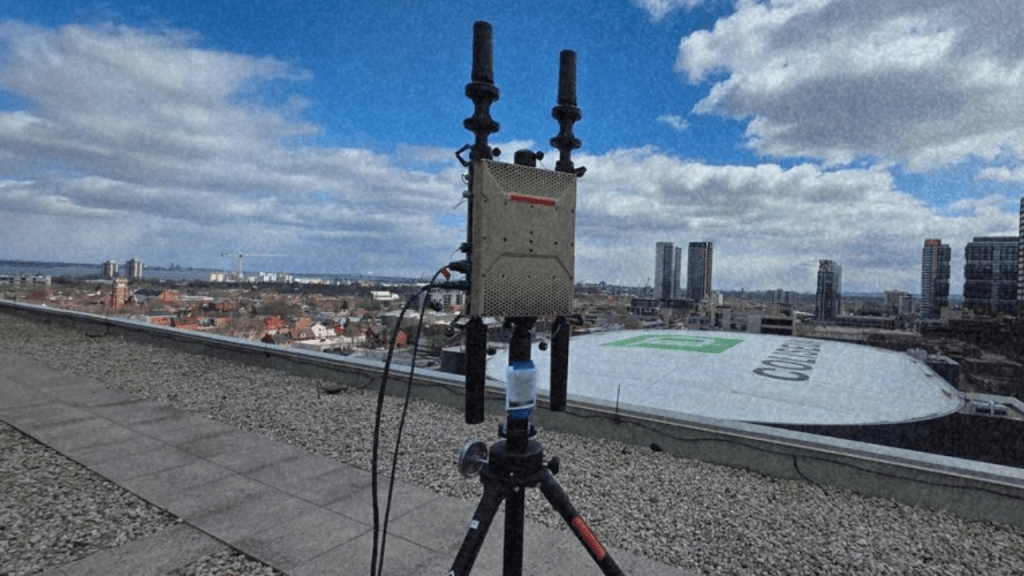
The Pointer’s reporting also established that the force had been running D-Fend equipment on the roof of its headquarters in the summer of 2024, tracking hundreds of drone flights within a two-kilometre radius, roughly two years before the board voted to buy it. And it set the purchase against the same budget cycle’s $473,611 reduction to a program supporting injured employees and the deferral of body-worn cameras that nearly 2,800 residents had endorsed in public consultation.
A board confident in its procurement does not edit a published agenda. The alteration is a statement, made in the form of an action, that somebody expected the public to object to what the record plainly said and judged it easier to change the record.
The question that has to be answered first
The debate this purchase deserves is about whether a Canadian city should route half a million dollars to a company whose systems have been loaned to a military conducting what a United Nations Commission of Inquiry concluded in September 2025 was genocide, and what Amnesty International had reached the same conclusion about a year earlier. That debate is worth having in public, and the board’s editing of its own record was designed to prevent it.
But there is a prior question, and it is narrower and harder to deflect. Cyber-takeover of an aircraft’s control link engages the Criminal Code. The exemption permitting this class of interference names a federal police force. The federal government spent March 2026 strengthening federal interdiction powers. Every comparable municipal operation in the country has stopped at detection and charges.
Before Niagara residents are asked to weigh the ethics of the supplier, they are entitled to know which statute their police service believes authorizes it to take control of an aircraft over their heads, and what happens to the liability if one comes down in a residential street. The board has not answered that. It has not been asked to, in public, because the name of the company was taken off the page.
Sources
- Counter-Drone Technology: Is It Legal In Canada? — legal analysis of jamming, software exploitation and physical disruption; Criminal Code ss. 342.1 and 342.2; the Radiocommunication Act Exemption Order for RCMP jammers
- CBC News — the March 2026 Aeronautics Act amendments strengthening federal interdiction authority, and DND’s counter-UAV deployments with Transport Canada and the RCMP
- Royal Canadian Mounted Police — Counter Drone Program; the mandate to provide operational support in critical airspace locations
- DroneXL — Toronto police detection-and-charge operations at Rogers Centre and the World Cup Fan Festival; the RCMP’s venue airspace mission
- The Pointer — the altered agenda and minutes, the 2024 rooftop deployment, the budget context, and the force’s response
- Calcalist — CEO Zohar Halachmi’s October 2023 letter on EnforceAir units loaned to the Israeli Ministry of Defence, and the malfunction history of units returned by the United States
- Motorola Solutions — the $1.5 billion acquisition of D-Fend, June 1 2026
- DroneXL — how EnforceAir works: hijacking the control link, isolating the target, and landing it
- UN Independent International Commission of Inquiry on the Occupied Palestinian Territory — September 2025 finding
- Amnesty International — 2024 report on Gaza