North Bay NATO jet training is expanding with six Leonardo M-346s, and a project being sold as airport investment is also a military buildout.
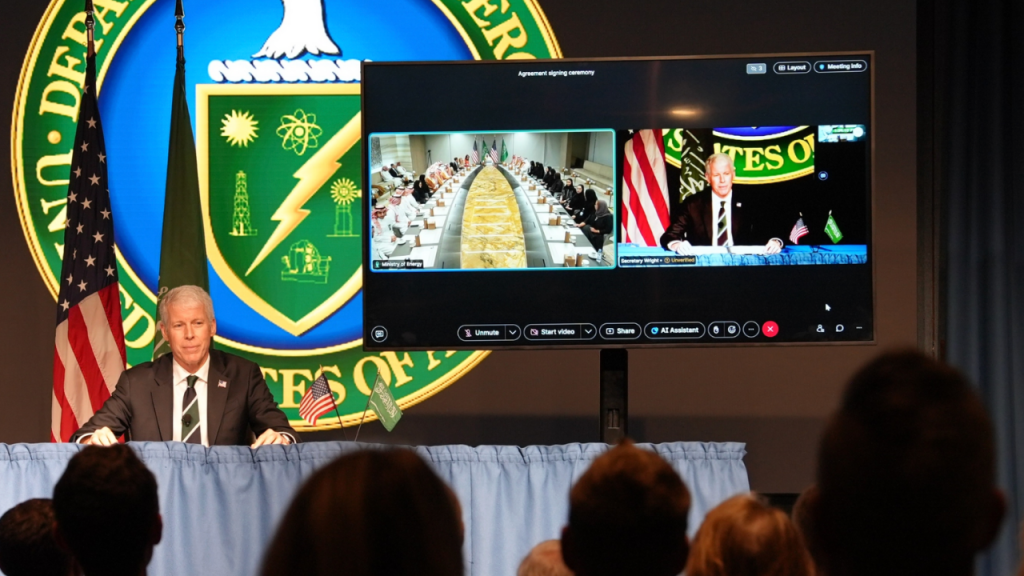
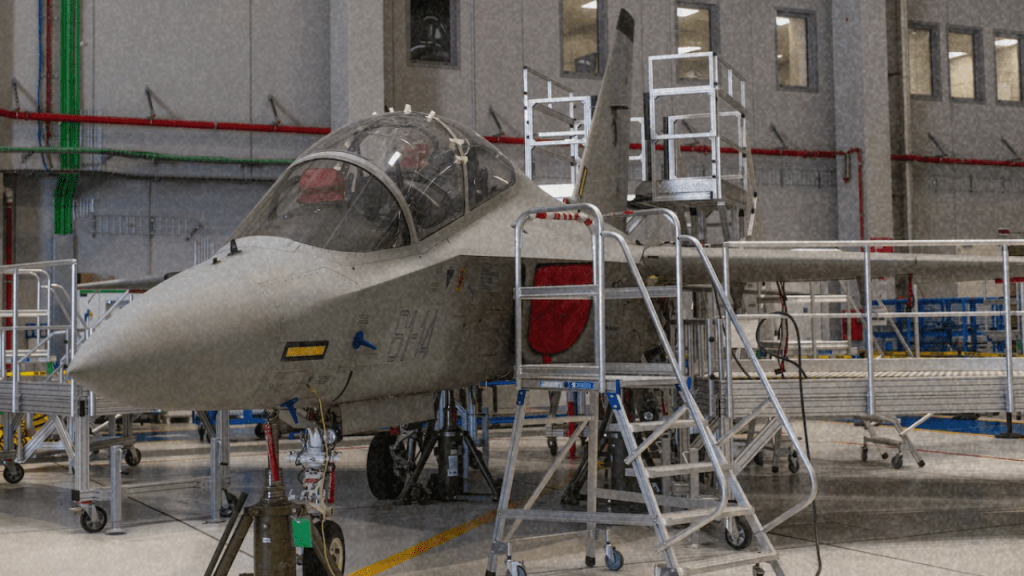
On May 26, 2026, at Leonardo’s Venegono Superiore facility in northern Italy, the executive chairman of an Ontario private aerospace training company signed a contract for six Italian-built advanced jet trainers, with options for six more, to be based at Jack Garland Airport in North Bay. The aircraft — Leonardo M-346 T Block 20s — are expected to enter service in 2029. Leonardo’s announcement described the deal as supporting the expansion of NATO and Allied tactical fighter pilot training at the International Tactical Training Centre. BayToday ran the story locally as aviation investment.
Those framings — defence contract from one side, airport development from the other — describe the same transaction. The contract value has not been disclosed. North Bay residents are being asked to register the second framing while the first is happening above their heads.
What the trainers are for
The M-346 is not a teaching aircraft for civilian pilots. It is a lead-in fighter trainer — the platform on which student pilots transition from basic flight to fourth-, fifth-, and future-generation combat aircraft. Leonardo says ITPS Canada is acquiring it to meet tactical training demand from more than ten air forces globally, and that ITPS has trained personnel from over 29 air arms in its 25-year history. The aircraft will join an existing ITTC fleet composed primarily of modernised L-39s alongside Hawker Hunter T.7s and L-29s — Soviet- and British-era jets refit for Western tactical instruction.
The platform’s service record includes two fatal training accidents in the past four years. On March 16, 2022, an M-346 destined for an export customer crashed into Monte Legnone near Como during a pre-delivery flight from Leonardo’s Venegono site; both pilots ejected, and an outsourced British civilian instructor pilot was killed. On July 12, 2024, a Polish Air Force M-346 Bielik crashed during an airshow rehearsal at Gdynia Babie Doły, killing Major Robert Jeł, deputy squadron commander of the Polish M-346 Demo Team. Poland suspended all M-346 flight operations pending investigation.
The geography it slots into
Jack Garland Airport sits inside an existing military geography. The Royal Canadian Air Force’s 22 Wing North Bay, also known as the Canadian Air Defence Sector, operates from North Bay and provides surveillance, identification, control, and warning for the aerospace defence of Canada and North America through NORAD. The wing includes a permanent United States Air Force detachment. The M-346 contract arrives at a base already integrated into continental air defence — not a regional airport being added to the network for the first time.
In July 2025, an ITTC public notice told residents to expect “increased air traffic” over a two-week period as the centre conducted routine training with its existing L-39 fleet. Daylight hours only, the notice said. That was the temporary ramp on the current aircraft. Six M-346s arriving in 2029, with options for six more, is a fleet expansion, not a deployment. The published numbers it sits on top of — sortie rates, flight hours, training routes, altitudes near residential corridors — have not been disclosed in advance.
The carbon arithmetic
The federal government tracks Department of National Defence aviation emissions through the Treasury Board Secretariat’s annual greenhouse-gas inventory. In fiscal 2024–25, DND’s national safety and security fleet emitted 522 kilotonnes of carbon dioxide equivalent — 80% of it from aircraft. Across the entire federal national safety and security fleet, aircraft alone accounted for 430 kilotonnes that year, down from 480 in 2005–06: a 10.4% reduction over twenty years. Federal real-property emissions fell 43% in the same period. Conventional fleet emissions fell 35%. Military aviation is the slowest-decarbonizing segment of federal operations by a significant margin.
The Treasury Board figure does not break out emissions for individual airfields or training operations. A private aerospace training company is adding tactical fighter training capacity at an airport already integrated into continental air defence, and the federal inventory will not capture the project’s contribution until it is operational. No project-level emissions estimate has been published in advance. The single trajectory available to the public — the one showing aircraft as the slowest-decarbonizing federal asset class — is the trajectory the M-346 fleet will join.
Who has authority on the ground
ITPS Canada is not a Canadian Armed Forces unit. It is a private training company that describes its own activities as targeted tactical and military training for Canadian and international customers. The accountability path differs accordingly: the federal government did not announce a new NATO base in North Bay; a private contractor announced an aircraft purchase. The political result is similar — expanded NATO fighter-pilot training capacity on Canadian soil — but the avenues for parliamentary review, municipal consultation, and Indigenous consent are not the same as they would be for a publicly-announced base expansion.
The land is Anishinabek territory. City of North Bay situates itself on the traditional territory of the Nipissing and Dokis First Nations, with Aboriginal and treaty rights recognized under the Robinson Huron Treaty. Nipissing First Nation’s land base spans more than 30 kilometres between North Bay and West Nipissing.
In a 2025 Anishinabek News report, NFN’s lands director discussed traditional-territory water and fish testing for PFAS — a category of contaminants associated with aviation firefighting foams and military airfield runoff — emphasizing that the Nation has to care for areas beyond its own land base. Cumulative environmental impacts from expanded military aviation reach Indigenous territory through air, water, and ground. Consultation that begins after the procurement decision is structurally different from consultation that begins before it.
What the announcement left out
The May 26 announcement named the aircraft, the manufacturer, the timeline, and the training mission. It did not name the contract value, the sortie rates, the training routes, the altitude profiles, or the hours of operation over North Bay. It did not publish a project-level greenhouse-gas estimate, a noise contour map, or an environmental assessment covering fuel storage, de-icing materials, and PFAS risk.
The record of consultation with Nipissing and Dokis First Nations before the procurement was announced is not public. Whether affected Indigenous nations were informed in advance of the decision or after is not stated in any published material. Which air forces beyond the current ten will train at North Bay under expanded capacity has not been disclosed. Whether any of those forces are subject to Canadian military-export human-rights conditions is not stated.
A private company announcement is not a public review. The 2029 service-entry date gives a four-year window in which these questions could be answered before the aircraft arrive. Whether they will be answered — or whether the answers will arrive with the jets — depends on who asks them and whether any level of government is required to respond.
How military expansion arrives
The M-346 contract does not arrive in isolation. Canada’s Future Fighter Capability Project plans to purchase 88 advanced fighter aircraft to meet international obligations and NORAD and NATO commitments — a procurement Reuters reported in 2026 was still under review in parts. Fighter aircraft do not arrive alone: they require pilots, training airframes, simulators, runways, fuel systems, weapons integration, maintenance contracts, and decades of upgrade pathways. The ITTC expansion is one node in that wider ecosystem.
The May 26 announcement documents the path through which Canadian military infrastructure expands in 2026 — private procurement contracts signed at Italian aerospace facilities, announced as airport development in Canadian regional news, operationalised at a base already running NORAD continental air defence. The contract’s dollar value has not been disclosed. The options-for-six-more clause has not been priced. The 2029 service-entry date arrives after the next federal election cycle. By the time Jack Garland Airport’s training routes, sortie schedules, and operating hours are publicly mapped, the six aircraft will be in service and the option for six more will already be exercised or not.