The Bandera problem is not propaganda. It is a state-backed memory project that turns fascist collaborators, ethnic cleansers, and wartime nationalists into civic heroes while Western governments pretend not to see what Ukraine has made official.
There is a name that appears in nearly every Western conversation about Ukraine’s far-right problem and is almost immediately dismissed. Stepan Bandera was complicated, the script goes. The Organization of Ukrainian Nationalists did terrible things, but Russia uses Bandera as propaganda, so engaging the history seriously becomes equivalent to doing Putin’s work.
That is not analysis. It is avoidance. The Bandera problem is not a Russian invention. It is a real feature of Ukrainian memory politics, sharpened after 2014, protected by law, inscribed into public space, and normalized by Western governments that made a political decision not to look too closely at the nationalist tradition being rehabilitated inside an allied state.
The issue is not frozen in the past. In June 2026, Reuters reported that Ukraine’s decision to rename a special forces unit after the Ukrainian Insurgent Army, or UPA, revived tensions with Poland over the Volhynia massacres, in which roughly 100,000 Poles were killed. Le Monde reported the same week that Zelenskyy’s rehabilitation of controversial nationalist figures had sparked anger in Israel and Poland.
That is the current context. Not Soviet archive dust. Not Kremlin mythology. Not an obscure debate between historians. Ukraine’s wartime state continues to elevate a nationalist genealogy that includes organizations tied to fascist collaboration, ethnic cleansing, and antisemitic violence. Western media largely treats this as an unfortunate complication rather than a central fact about the political order it has spent years sanctifying.
Bandera was not just complicated
Stepan Bandera was born in 1909 in Galicia, then part of Austria-Hungary, later incorporated into Poland. He became leader of the radical wing of the Organization of Ukrainian Nationalists, the OUN-B, in 1940. His defenders usually describe him as an independence fighter who opposed Poland, Nazi Germany, and the Soviet Union at different points in his life. That description contains facts. It also removes the ideology from the biography.
The OUN was not simply a national liberation movement. It was an ultranationalist formation committed to ethnic exclusivity, authoritarian politics, anti-communism, anti-Polish violence, and antisemitism. Ukrainians had real grievances against Polish and Soviet rule. Those grievances do not sanitize the political project OUN-B built from them.
Grzegorz Rossoliński-Liebe’s biography Stepan Bandera: The Life and Afterlife of a Ukrainian Nationalist documents Bandera’s role in building a cultic and fascistic nationalist politics before and after the war. A declassified U.S. intelligence history preserved in the CIA Reading Room described Bandera as having earned a fierce reputation for a wartime “reign of terror.”
The narrow defense of Bandera is that he was imprisoned by the Nazis in Sachsenhausen from 1941 to 1944 and therefore was not in direct operational command during the worst OUN-UPA atrocities. That point is true as far as it goes. It does not exonerate the movement he led, the ideology he helped build, or the postwar cult that treated him as the embodiment of Ukrainian national will.
A political tradition does not become innocent because its leader was absent from some of its crimes. The question is not whether Bandera personally signed every order. The question is why a state would later choose this tradition, this organization, and this lineage as a foundation for national honour.
Volhynia is not a footnote
The massacres of Poles in Volhynia and Eastern Galicia were not incidental violence on the margins of war. They were a mass campaign against civilians. In 2025, the Guardian reported on renewed Polish-Ukrainian efforts around exhumations and described the massacre of an estimated 100,000 Poles by Ukrainian nationalists between 1943 and 1945. Reuters used the same figure in its 2026 reporting on the UPA unit-name controversy.
Polish memory treats Volhynia as genocide. Ukrainian nationalist memory often treats the UPA primarily as anti-Soviet resistance. That conflict over naming is not semantic for the families of the dead. It is the difference between recognition and erasure.
The strongest version of the Ukrainian nationalist defense is that the UPA fought multiple enemies under brutal occupation conditions and that Soviet power later manipulated the record for its own purposes. That still does not answer the central fact. Polish civilians were systematically targeted and killed by Ukrainian nationalist forces. A national memory framework that honours the UPA without centering those victims is not historical complexity. It is selective remembrance.
The same is true of Holocaust history. OUN factions and Ukrainian nationalist formations operated in a Nazi occupation environment where collaboration, participation, opportunism, antisemitic violence, and later conflict with Germany all coexisted. The existence of later conflict between Bandera’s movement and Nazi Germany does not erase earlier collaboration or ideological affinity.
The victims are not historical debris to be swept away because their deaths complicate a contemporary alliance. They are the test of whether the memory politics being constructed is honest or merely useful.
The United States protected him after the war
Bandera’s postwar life reveals another part of the story Western audiences rarely hear. After the Second World War, he lived in Munich and remained active in anti-Soviet nationalist politics. Soviet authorities wanted him. Western intelligence services saw him as useful.
The Wilson Center’s account of Operation ANYFACE describes how the U.S. Army’s Counter Intelligence Corps shielded Bandera from Soviet intelligence. The same Cold War logic that integrated former fascists, collaborators, and nationalist militants into Western anti-Soviet networks also made Bandera’s history a manageable inconvenience.
That is the American epilogue to the Bandera story. A man associated with a violent ultranationalist movement became valuable because he was anti-Soviet. The hierarchy was clear. Anti-communist usefulness could soften, obscure, or suspend accountability.
Bandera was assassinated by a KGB agent in Munich in 1959. His death turned him further into a martyr figure for parts of the Ukrainian nationalist diaspora. In the Cold War West, that martyrdom was easier to integrate than the history of the movement he represented.
This matters because the West did not discover the Bandera problem in 2022. Western intelligence structures helped preserve the political network that kept his memory alive. The later rehabilitation of Bandera did not emerge from nowhere. It grew inside a Cold War inheritance that had already taught Ukrainian nationalist organizations which parts of their history could be made useful and which parts could be buried.
The state made memory into law
Bandera was always controversial inside Ukraine. His support was strongest in the west and weakest in the east and south. The issue was never that all Ukrainians worshipped him. The issue is that after 2014, the Ukrainian state gave official force to a particular nationalist memory project.
In April 2015, Ukraine’s parliament passed a package of decommunization laws. One of them, Law 2538-1, recognized a long list of organizations and individuals as fighters for Ukrainian independence in the 20th century. That list included the OUN and UPA. The law did more than honour them. Its Article 6 created liability for public insult against those recognized as independence fighters, and critics warned that it effectively legislated history.
Even the standard public overview of the laws records the central problem: the legislation honoured organizations and individuals recognized as having participated in the mass murder of Jews, Poles, and Communists during the Holocaust in Ukraine and the massacres in Volhynia, while raising serious free-speech concerns.
Al Jazeera reported in 2015 that Ukraine’s anti-communist laws stirred controversy, and critics argued that the package moved beyond removing Soviet symbols into the enforcement of a new nationalist narrative. The concern was not that Ukraine had no right to confront Soviet crimes. The concern was that the state was replacing one mandatory history with another, while legally protecting figures tied to mass violence.
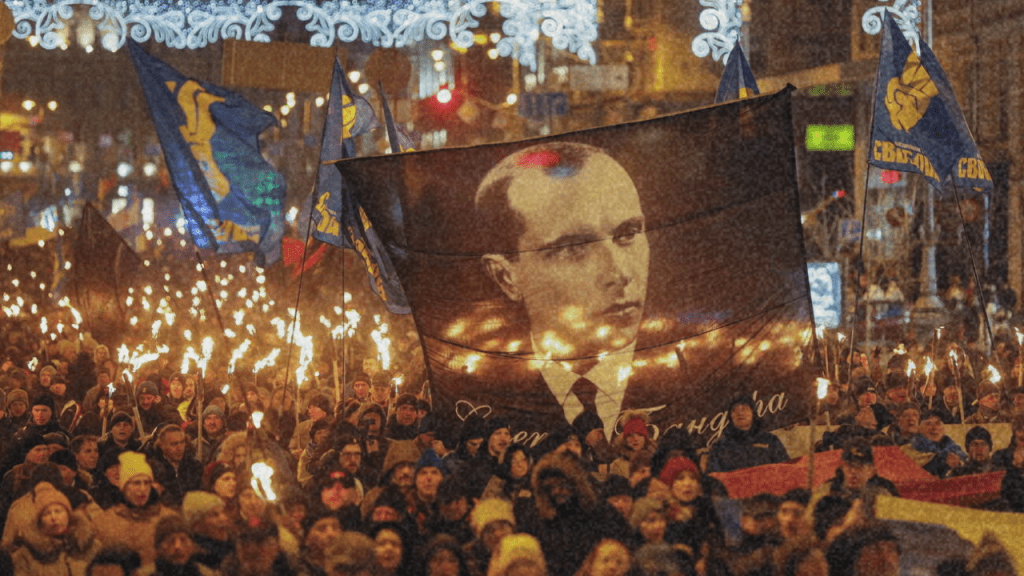
That is the crucial post-Maidan shift. The Bandera question stopped being only a regional memory conflict. It became part of state policy. The OUN and UPA were folded into official national honour. Public challenge to that honour became legally risky. Streets and avenues were renamed in ways that imposed a nationalist genealogy over divided public memory.
This was not accidental. It was a state project. A government that came to power after a Western-backed uprising did not merely remove Soviet symbols. It installed a new civic pantheon, and that pantheon included men and organizations whose history runs through fascist collaboration and mass atrocity.
Street names are political power
Memory politics is not symbolic in the shallow sense. Naming a major urban avenue after Bandera is not just a gesture. It marks public space with a state-approved lineage of national legitimacy.
Kyiv’s Moskovsky Prospekt was renamed Stepan Bandera Avenue in 2016. The Kharkiv Human Rights Protection Group called the renaming divisive and ill-timed, noting the controversy around Bandera and the timing near the anniversary of the Volhynia massacres. For Poles, Jews, leftists, eastern Ukrainians, and anyone whose family history does not fit the nationalist script, the message was obvious: the state had chosen whose memory would occupy the street.
The broader decommunization process renamed tens of thousands of places, removing Soviet references and replacing many with Ukrainian nationalist names. Some of that process reflected a legitimate desire to escape Soviet imperial symbolism. But the inclusion of OUN and UPA figures turned decommunization into something else: not only the rejection of Soviet power, but the rehabilitation of a violent nationalist tradition as civic inheritance.
That distinction matters. A country can remove monuments to Stalinism without honouring fascist-adjacent nationalist figures. Ukraine’s post-2014 memory politics too often treated those as the only two choices.
The result was ideological compression. Soviet crimes became the only official horror. Anti-Soviet nationalism became the default moral alternative. The victims of that nationalism were pushed into the margins because their existence disrupted the neat replacement story.
Western silence made this possible
The existence of Russian propaganda has become the all-purpose excuse for Western silence. But propaganda does not work by inventing everything from nothing. It works by seizing on real contradictions, stripping them of context, and turning them into weapons. The answer is not denial. The answer is to tell the truth more precisely than the propagandist can.
Western governments and media institutions largely chose the opposite. They treated Bandera and the OUN-UPA legacy as an embarrassment to be minimized because the broader geopolitical alignment mattered more. Ukraine had become the forward edge of confrontation with Russia. Its nationalist mythology became strategically inconvenient to examine.
This is how laundering works. It does not require enthusiastic praise for Bandera in Washington, Ottawa, London, or Brussels. It requires selective attention. It requires treating state-backed rehabilitation as a minor domestic matter. It requires pretending that memory laws, street renamings, military-unit names, and official commemorations are marginal when they would be treated as major scandals if the geopolitical alignment were different.
The hypocrisy is not subtle. Western liberalism claims to oppose fascist rehabilitation. It claims to defend Holocaust memory. It claims to honour victims of ethnic cleansing. But when Ukrainian nationalist memory became useful inside the anti-Russian bloc, the standards changed. Suddenly context mattered. Suddenly complexity mattered. Suddenly victims had to wait.
That is the real scandal. Not that Moscow talks about Bandera, but that the West decided the history was only a problem because Moscow noticed.
The victims are not talking points
The most obscene feature of the discourse is how quickly victims disappear. The Poles killed in Volhynia become a Russian talking point. Jews murdered in western Ukraine become a complication to be bracketed. Ukrainians who rejected Banderaite nationalism become invisible because they disrupt the simple story of national unity.
The 2025 Polish-Ukrainian agreement to allow exhumations was treated as a diplomatic breakthrough because the dispute had remained unresolved for so long. Reuters later reported that Poland buried the remains of 42 Poles killed by Ukrainian nationalist insurgents in the former village of Puzniki, part of a reconciliation process around victims who had remained in unmarked graves for decades.
That is what the Bandera problem looks like from below: families waiting generations for exhumation, identification, burial, and acknowledgment while states argue over which memories are politically useful.
If the dead matter only when they embarrass an enemy, they do not matter at all. A serious anti-imperialism cannot operate that way. It cannot condemn Nazi rehabilitation in one context and minimize it in another because the geopolitical alignment is inconvenient.
The point is not to hand memory over to another state’s propaganda machine. The point is to refuse the entire structure that turns victims into instruments. The Poles killed in Volhynia do not belong to Moscow. Jewish victims of nationalist collaboration do not belong to Western public relations. Anti-fascist memory does not belong to NATO. The dead have their own claim, and that claim begins with refusing to turn their killers into heroes.
What the Bandera problem reveals
The Bandera problem reveals the bargain Western liberalism made with Ukrainian nationalism after 2014. The same governments and media institutions that claim to oppose fascist rehabilitation accepted it when it became useful against Russia. The victims of OUN and UPA violence became secondary to the needs of wartime alignment.
Ukraine’s state-memory project did not merely honour anti-Soviet resistance. It elevated a nationalist genealogy that included organizations responsible for mass atrocities, wrote legal protection for that genealogy into public life, and imposed parts of it onto streets, institutions, and military symbolism.
That matters because national memory is not decorative. It teaches a society who counts as a hero, who counts as a victim, who can be grieved, and whose suffering has to be subordinated to the state’s preferred story.
Russia did not invent the Bandera problem. Russia exploited it. Western governments did not create all of this history. They helped make it untouchable by treating scrutiny as disloyalty to the alliance.
Those distinctions are not optional. They are the difference between analysis and allegiance.
Sources
- Reuters – “Ukrainian foreign minister calls for dialogue with Poland over army unit name,” June 3, 2026; Ukraine’s naming of a special forces unit after the UPA, Polish anger, Volhynia massacre context.
- Le Monde – “Zelensky’s rehabilitation of controversial figures in Ukrainian nationalism sparks anger in Israel and Poland,” June 4, 2026; Israeli and Polish concern over nationalist rehabilitation, Andriy Melnyk reburial, UPA unit naming.
- CIA Reading Room – “Cold War Allies,” declassified U.S. intelligence history; OSS description of Bandera’s wartime reputation and U.S. intelligence context.
- Grzegorz Rossoliński-Liebe, Stepan Bandera: The Life and Afterlife of a Ukrainian Nationalist: Fascism, Genocide, and Cult (ibidem-Verlag, 2014); Bandera biography, OUN-B ideology, fascism, cult formation, and postwar memory.
- Jared McBride, “Peasants into Perpetrators: The OUN-UPA and the Ethnic Cleansing of Volhynia, 1943–1944,” Slavic Review 75, no. 3 (2016): 630–654; ethnic cleansing campaign in Volhynia.
- The Guardian – “Poland hails breakthrough with Ukraine over second world war Volhynia atrocity,” January 16, 2025; Polish-Ukrainian exhumation agreement and estimate of 100,000 Polish victims.
- Reuters – “Poland buries wartime remains in western Ukraine as part of reconciliation,” September 6, 2025; burial of 42 Poles killed by Ukrainian nationalist insurgents in Puzniki, Volhynia reconciliation process.
- Wilson Center – “Operation ANYFACE: How the US Army Shielded a Ukrainian Nationalist from Soviet Intelligence”; U.S. Army Counter Intelligence Corps protection of Bandera after the Second World War.
- Al Jazeera – “Ukraine’s Anti-Communist Laws Stir Controversy,” June 1, 2015; controversy around Ukraine’s 2015 memory and decommunization laws.
- Ukrainian decommunization laws – public overview; 2015 memory laws, OUN/UPA recognition, Article 6 controversy, free-speech concerns, and mass renaming figures. Used only as public orientation, not primary authority.
- Kharkiv Human Rights Protection Group – “Divisive & Ill-Timed Renaming of Kyiv Street after Controversial Nationalist Leader,” July 2016; Kyiv’s Bandera Avenue renaming and memory-politics criticism.
- Geneva Solutions – “Who was Stepan Bandera, Ukraine’s controversial nationalist figure?” June 30, 2022; Bandera’s divided reception in Ukraine and contemporary memory conflict.