The NDP launders its reputation on problems it helped create — performing outrage in opposition over harms its confidence votes enabled.
The New Democratic Party has a problem its leadership does not name out loud: the party’s political identity depends on the existence of working-class harms it has, in office, helped enable. When the NDP held the balance of power through its supply-and-confidence agreement with Justin Trudeau’s Liberals from March 2022 to September 2024, the harms it could have stopped went unstopped. When the NDP is in opposition, as it is now under Mark Carney’s government, those same harms become the material for press conferences and private member’s bills. The cycle is the laundering operation. The grievance is the product.
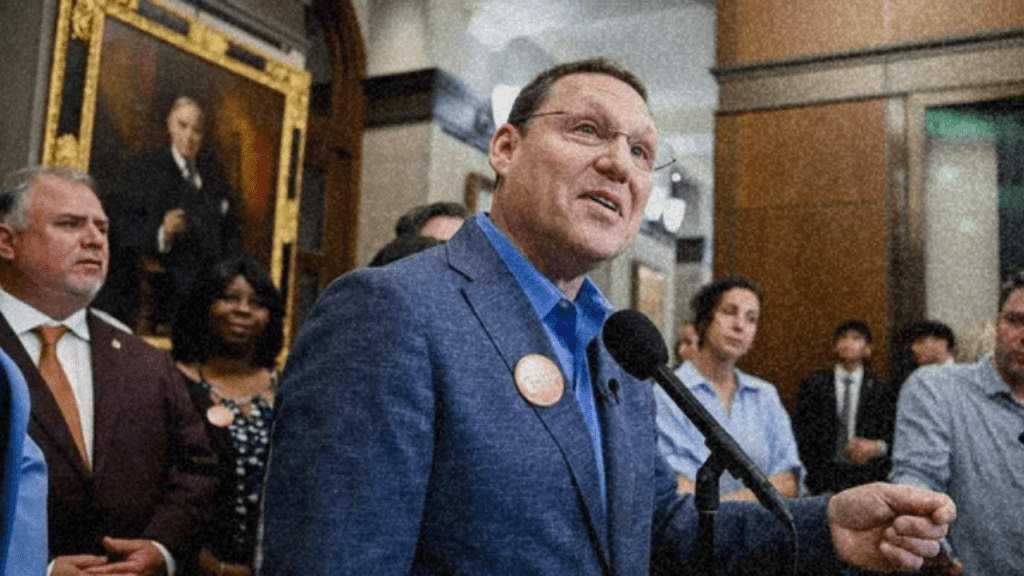
On Wednesday, May 27, 2026, Avi Lewis held a press conference in the Foyer of the House of Commons with NDP MP Leah Gazan and labour leaders. The occasion was Gazan’s private member’s bill, C-247, which proposes to repeal Section 107 of the Canada Labour Code — the clause that gives the Labour Minister authority to order striking workers back to the job. The bill was set to be debated that evening. Lewis warned of a “hot summer” of labour action if the Carney government weakens the right to strike in the consultations it had just concluded.
Later that evening, Lewis put the case more squarely: workers had fought and died for the right to strike, and his party would not allow this government to take Canada backwards. It is a true sentence. The right to strike is constitutionally protected in Canada because workers fought for it. The Saskatchewan Federation of Labour took the Sask Party government to the Supreme Court in 2015 and won. The International Court of Justice affirmed the right under ILO convention on May 21, six days before Lewis spoke. None of this is in dispute.
What is in dispute is which government Lewis means by “this government.” Section 107 was used eight times since June 2024, by the Canadian Labour Congress count: Air Canada flight attendants, Canada Post workers, CN rail crews, CPKC rail crews, BC port workers, Quebec port workers, and others. Every one of those orders was issued by the Trudeau Liberal government, during the supply-and-confidence agreement the NDP signed in March 2022 and held until September 2024. The clause Lewis is now demanding be repealed was used to break strike after strike under an arrangement his party guaranteed.
The leverage that was never used
The supply-and-confidence deal gave the NDP the only kind of power minority parliament produces: the threat to bring down the government. The Trudeau Liberals could not pass a budget or survive a confidence vote without NDP support. The NDP could have made Section 107 a confidence issue any time the minister picked up the pen. They did not. The minister picked up the pen eight times. Every time, the supply held. The party now standing in front of cameras demanding the section be repealed is the party that watched it being used and kept that government in power.
Natasha Stea, an Air Canada flight attendant representative, was at the press conference. She described what Section 107 produces at the bargaining table: “Our CEO told the whole world that he was not ready to prepare for an eventual strike or anything because he didn’t have to, because he had 107. So why are they coming to the tables? It is one-sided.” That is the clause’s operational consequence. The employer does not bargain in good faith because the minister will end the strike. CUPE has warned repeated federal intervention encourages employers to rely on government rather than the bargaining table.
Carney won the April 2025 election. The NDP lost most of its seats and Jagmeet Singh his leadership. The new arrangement, with Carney’s Liberals as the government and the NDP as opposition, is the relationship that allows Lewis to call for Section 107’s repeal now. The clause has not changed. Its history has not changed. What has changed is which party is in a position to be embarrassed by it. The NDP’s position on the right to strike has tracked the seat they occupy in the chamber, not any underlying principle.
The Carney consultations
The reason a section unused for years before 2024 is suddenly the subject of repeal legislation is what the Carney government is doing with the rest of the labour code. Consultations concluded Monday, May 25, 2026 — a “lightning round,” in the framing of the National Union of Public and General Employees, “quietly announced,” conducted invite-only with days for response. The consultation documents reportedly contain what CBC describes as items on corporate Canada’s wish list: more workplaces designated essential, altered bargaining and strike-notice timelines, a new “special mediator” with investigation powers.
The political problem the NDP now faces is that the consultations would not be possible without two prior years of normalizing federal intervention in strikes. Section 107 used eight times made government intervention in collective bargaining the new operating expectation. Carney is consulting on writing that expectation into the architecture of the labour code itself. The path from the back-to-work orders the NDP did not block to the consultations the NDP is now warning about runs through a single document — the supply-and-confidence agreement — that the NDP signed and held.
The pattern, in the rooms next door
The same operation produced the supply-and-confidence deal’s social-program deliverables. The Canadian Dental Care Plan was announced as the flagship win of the partnership; the contract to administer it went to Sun Life for an estimated $746 million, with the private insurer contractually responsible for processing claims and applying eligibility criteria. Health Canada’s own figures show about half are denied when pre-authorization is required for complex procedures. The dentist confirms necessity; the insurer denies; the patient is told only that the plan criteria were not met. The gatekeeping was placed with the company collecting the contract.
Pharmacare was the other social-program deliverable. The NDP campaigned on universal, single-payer, public coverage of prescription drugs — the program the 2019 Hoskins report had recommended. The Pharmacare Act passed in 2024 covers diabetes medication and contraception only. The “first phase” language is doing the same work the CDCP’s “first phase” language did. The bill’s structure makes expansion a province-by-province fight against private plans the law has grandfathered in. The demand was universal coverage; what passed was a means-tested, market-preserving scaffold that performs the demand without delivering it.
The launder also extends past the deal’s social programs. In the spring of 2024, with mounting evidence that Canadian components were being used in the assault on Gaza, the NDP introduced a motion to halt arms exports to Israel. The motion was diluted in negotiation and defeated. The Liberals announced an end to “new” permits while existing permits continued, including the largest active ones. The NDP claimed a moral victory. Components kept moving. The mechanism is the relationship between the parties, not any single decision either makes.
Why a change of NDP leader changes nothing
Avi Lewis became NDP leader on March 29, 2026, on a campaign promising renewal — a Canadian Green New Deal, public options for groceries and banking and telecoms. His platform includes expanding the public system to incorporate dental, vision, and mental health. The proposal does not abolish the CDCP architecture. It expands it. Lewis is the third generation of his family in NDP leadership, presented as the outsider candidate, which is what insurgency looks like inside a party that selects for it.
The character critique of his predecessor — Jagmeet Singh, the leader the party shed in 2025 — was accurate as far as it went. But the machine does not run on any leader’s vanity. It runs on the cycle. The NDP needs the Liberals to keep producing harms it can denounce, because the denouncing restores its working-class credibility for the next confidence agreement. Lewis is the current operator of the cycle, not its inheritor. His first motion as leader, on surveillance pricing, conceded the Liberals would have their majority by the vote. It produced a press conference.
Every first phase is a locked door
The argument that the NDP fought what it could and lost what it could not is the argument that produces the launder again next session. The supply-and-confidence deal was the leverage. The leverage was not used. The clauses the deal produced — the procurement contract, the means-tested formulary, the diluted motion, the unused statute now suddenly repeal-worthy — are not failures of the deal. They are the deal. A program built around means tests, private-insurer administration, opt-in provincial participation, and back-to-work powers reserved for the minister is a program designed to absorb the demand for what it does not deliver.
Lewis spoke a true sentence. Workers have fought and died for the right to strike. Some fought and died while his party voted confidence in the government breaking strikes with Section 107. The contradiction is not a hypocrisy. It is what the party sells. The grievance is the product. The constituency the NDP is rebuilding is the one whose harms its last confidence agreement enabled. Components keep moving. The minister still has 107. The press conferences work because the public has not been offered a politics that names the operation.
Sources
- NDP press release — NDP, labour leaders defend right to strike ahead of Parliament debate (May 27 2026); Bill C-247 to repeal Section 107
- paNOW / Canadian Press — Avi Lewis press conference, “hot summer” warning, Section 107 used 8 times since June 2024, Natasha Stea quote (May 27 2026)
- CBC News — Unions warn Carney government considering sweeping changes to labour law including right to strike (May 23 2026)
- NUPGE — ICJ ruling on the right to strike, lightning-round consultation framing (May 2026)
- CUPE — Right to strike must be protected; warning against Americanization of labour law (May 2026)
- Government of Canada — Making dental care more affordable in Canada (Dec 11 2023); Sun Life contract $746,698,598.22, 5+5 year term
- Canadian Affairs / Health Canada — about half of complex CDCP pre-authorizations denied (July 2025)
- Avi Lewis — biography, 2026 NDP leadership platform, dental/vision/mental health expansion
- Spark Solidarity — Jagmeet Singh and the illusion of opposition
- Spark Solidarity — Social democracy is imperial management, not socialist transition
- Spark Solidarity — Don’t just vote for Palestine, organize to fight Zionism