
Bolivia’s general strike against the Paz government is testing the Western media filter — the same country, the same arrests, opposite coverage to 2019.
There is an unofficial rule that governs political coverage in the West, and it is consistent enough to function almost like a law. When a protest movement aligns with U.S. geopolitical interests, it receives saturation coverage, emotional framing, celebrity amplification, NGO support, and endless discussion of democracy and human rights. When a movement threatens Western corporate or geopolitical interests, the coverage shrinks, disappears, or arrives distorted beyond recognition.
A protest in a country Washington has targeted can dominate headlines for months when it serves a regime-change objective. The newspapers discover moral urgency, the panels fill with think-tank experts, the politicians tweet solidarity, the celebrities post the hashtag, the language of freedom becomes deafening. But when workers, peasants, miners, or Indigenous organizations mobilise against privatisation, foreign extraction, or a Western-aligned government, the silence is extraordinary. That silence is not an accident. It is the system working as designed.
Modern media institutions are embedded in the same economic and geopolitical structures they claim merely to observe. They operate inside a worldview that treats U.S. global dominance as normal, legitimate, and basically benevolent, and so movements that reinforce that worldview get amplified while movements that challenge it get marginalised. The point is not that Western media invents every protest from scratch. The point is subtler and more important: media visibility is itself a form of political infrastructure. What gets covered is what becomes internationally real, and what stays invisible is treated as if it never happened.
What Bolivia actually shows
Bolivia is usually offered as the clean illustration of this argument, and in one respect it is. When Evo Morales and the Movement Toward Socialism took power in 2006, the country underwent a real transformation.
Morales, the first Indigenous president in Bolivian history, nationalised the oil and gas industry, used the revenue to cut poverty sharply, expanded Indigenous political representation, and asserted state control over resources in a country sitting on some of the world’s largest lithium and gas reserves. From an anti-imperialist perspective, this was the dangerous example: a resource-rich Global South nation reclaiming wealth that foreign capital had long extracted.
The media thesis holds up best at the moment of his fall. In 2019, Morales pursued a contested fourth term, the election was disputed, and after weeks of unrest he resigned and left the country. Western coverage during that crisis ran hot in the language of democratic emergency, and the engine of the narrative was an Organization of American States claim of electoral fraud, built on a gap between preliminary and final results.
Subsequent analyses argued that the gap was statistically explainable and that the OAS assessment was flawed and political. By then the framing had already done its work. The interim government that followed presided over what observers described as a deadly period of repression, and the MAS returned to power in 2020 under Morales’s former finance minister, Luis Arce — a sequence that, to anti-imperialists, looked like a coup that didn’t take.
But honesty about Bolivia requires following the story past the point where it flatters the argument. The MAS did not just survive 2019; it then collapsed on its own. By 2025, with inflation at a forty-year high, gas exports plummeting, and fuel scarce, the party’s official presidential candidate drew roughly three percent of the vote. A centrist, Rodrigo Paz, won the October 2025 runoff and formed Bolivia’s first non-MAS government in nearly two decades.
The gas nationalisation that the sovereignty story celebrates is now widely blamed for driving out investment and leaving the country a marginal exporter. And Morales himself, barred from running by the constitutional court, is today facing an arrest warrant and an accusation that he abused a teenage girl during his presidency — a charge that remains an allegation, unproven and unresolved, but one that cannot be left out of any honest account of where the figure now stands.
None of that refutes the media argument. It refines it. The thesis was never that Morales is a hero or that the MAS deserved to win forever; it is that coverage volume tracks geopolitical alignment rather than democratic substance.
Bolivia confirms the narrow claim — the world heard far more about the 2019 “democratic crisis” than about the structural project it interrupted — while also demonstrating the discipline the argument requires of itself. An ignored movement is not automatically virtuous, and a fallen one is not automatically a martyr. The honest version of anti-imperialist media criticism has to hold both, or it becomes the mirror image of the thing it criticises.
The same country, under the other government
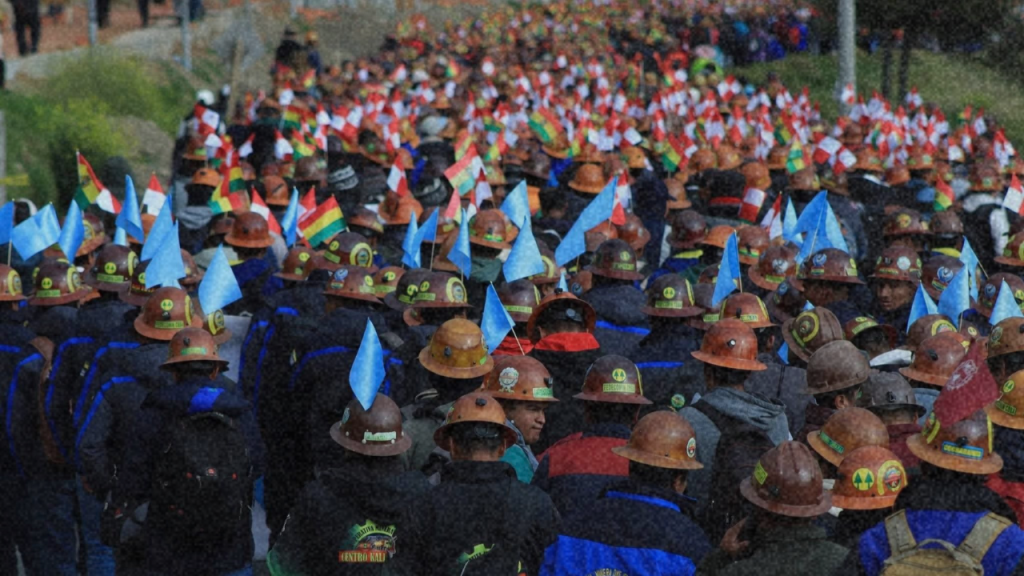
The cleanest test of the thesis is what happens in the same country when the political direction reverses. On May 1, 2026, the Central Obrera Boliviana — the country’s main labour federation — declared an indefinite general strike against the centre-right Paz government, with the resignation of the president as its first demand. More than seventy unions joined. Miners, teachers, peasants, transport workers, healthcare workers and Indigenous organisations followed. Within weeks the capital was under siege.
On May 18, security forces deployed twenty-five hundred police and one thousand military personnel against the marches into La Paz. Four protesters were killed and a hundred and twenty-seven were detained that day alone. On May 19, the state attorney general issued arrest warrants for COB executive-secretary Mario Argollo and twenty-four other union leaders on charges that included public incitement, criminal association, terrorism, and financing terrorism. A general strike, charged as terrorism.
Around the repression, the international response sorted itself with the clarity the media thesis predicts. Washington called the mobilisation a coup. Secretary of State Marco Rubio said the United States would not allow criminals and drug traffickers to overthrow democratically elected leaders in the hemisphere. Deputy Secretary of State Christopher Landau phoned Paz to express solidarity. The U.S. embassy in La Paz closed for the week. Argentina’s Javier Milei flew in two C-130 Hercules military transports carrying what the government described as humanitarian aid.
Colombia’s Gustavo Petro was the only regional leader to side with the protesters, calling the mobilisation a “struggle for Latin American dignity” and labelling Paz a puppet of the United States. Bolivia expelled the Colombian ambassador within forty-eight hours; Bogotá expelled its Bolivian counterpart in turn. The lone left government in the region paid an immediate diplomatic price for breaking ranks. The other eight Latin American governments aligning behind Paz issued a joint statement against “actions oriented at destabilising democratic order.”
The Bolivian senate then voted to overturn limits on martial law as the crackdown deepened. Coverage of the COB strike in the English-language Western press has been comparatively muted and framed around violence, criminality, and Morales — the figure most legible to North American readers — rather than around the labour federation that called the strike. The fullest reporting has come from People’s Dispatch, TeleSur, Common Dreams, and a scatter of socialist outlets, with Al Jazeera carrying the international wire coverage closer to the ground.
The journalist Mark Ames put the asymmetry in one line. If Bolivia were still under a socialist government targeted by Washington, the Western media, NGO, and human-rights apparatus would activate against the same arrests, the same deployments, the same charges. Because it’s capitalism doing the repressing, crickets. The same country, the same machinery of detentions and terrorism charges, run by a government Washington supports rather than one it opposes, and the global volume drops to a hum.
That is the test the thesis required. The 2019 case could be dismissed as anti-imperialist projection onto a complicated election. The 2026 case is a documented general strike against an austerity program — a labour federation calling a national stoppage, four deaths in police clashes, terrorism charges against the union leadership, the U.S. State Department defending the government, the regional left punished for solidarity — and the global coverage tracks the geopolitics, not the events.
Why this asymmetry is structural
None of this requires anyone in a newsroom to be lying. The pattern is built into the conditions that produce coverage. Corporate media institutions emerge from capitalist ownership structures; their advertisers, elite networks, and background assumptions shape what registers as reasonable politics. A miners’ mobilisation demanding resource nationalisation threatens powerful economic interests directly. An NGO-backed protest demanding electoral reform inside a geopolitical rival can be absorbed comfortably into the same discourse. One challenges global capital at the structural level. The other can coexist with it. That difference, more than any democratic judgment, predicts which one the cameras find.
The NGO layer reinforces the same effect. Networks of Western-funded foundations, development agencies, and democracy-promotion bodies operate across the Global South under a banner of political neutrality, and most activists inside them are not operatives. The point is structural, not personal. Funding shapes incentives, institutional support shapes messaging, and media access shapes legitimacy. Movements that frame themselves in liberal-democratic language acceptable to Western institutions receive disproportionate amplification. Movements rooted in anti-capitalism, Indigenous sovereignty, or resource nationalism do not. The safest opposition — the kind that travels furthest — is the kind that does not fundamentally threaten global capital.
This is why class composition does the work that moral evaluation cannot. Who is mobilising, what they are demanding, who benefits materially, who funds the surrounding infrastructure, which institutions amplify them and which stay silent — these are the variables that determine visibility, and visibility is itself a form of political power.
The revolutions we are allowed to see
The modern information system does not only tell people what to think. It tells them what exists. A movement amplified constantly comes to feel historically important before anyone examines it closely. A movement ignored consistently becomes politically invisible no matter how many people fill its streets. The question worth asking of any media system is not only what it says but what it systematically leaves out, because the absence carries meaning.
If miners, workers, peasants, and Indigenous organisations mobilise against neoliberalism and almost no one in the West ever hears of it, that silence is not editorial accident. It marks the outer edge of what audiences inside an imperial system are permitted to regard as real. The Bolivian case is the proof and the warning at once: the same country, the same machinery of repression, two different governments, two utterly different volumes of attention. The most consequential revolution, in the end, is rarely the loudest one. Sometimes it is the one ordinary people were never meant to see at all.
Sources
- PBS NewsHour — Morales nationalised oil and gas, cut poverty; contested 2019 fourth-term bid and ouster; barred by the constitutional court
- The New Republic — the 2019 OAS fraud claim later argued to be “flawed” and political; MAS returned under Arce in 2020
- Modern Diplomacy — Bolivia’s 2025 election; MAS official ticket near 3%; Rodrigo Paz and the first non-MAS government in ~20 years
- Mining.com — gas exports plummeted, inflation at a 40-year high; Morales barred and calling for null voting
- Americas Market Intelligence — the 2006 hydrocarbons nationalisation blamed for driving out investment and the gas-export decline
- Al Jazeera — May 2026 unrest: miners clash with riot police demanding Paz resign; Morales’s 190km march; arrest warrant and abuse allegation
- Popular Resistance / Struggle-La Lucha — COB indefinite general strike from May 2026; first demand Paz resignation; 70+ unions joined; Law 1720 land question
- TeleSur English — arrest warrant for COB executive-secretary Mario Argollo on terrorism and public-incitement charges; 4 protesters killed; 57 detained
- Common Dreams — terrorism, criminal association, financing terrorism charges; arrest order for Justino Apaza Callisaya of FEJUVE; Drop Site News documents
- World Socialist Web Site — May 18 deployment of 2,500 police and 1,000 military; 4 killed and 127 detained that day; arrest warrants for Argollo and 24 union leaders
- ABC News / AP — Rubio “criminals and drug traffickers” coup framing; Petro “struggle for Latin American dignity”; U.S. Embassy La Paz closure
- People’s Dispatch — Bolivia expels Colombian ambassador; Bogotá retaliates; cabinet reshuffle; Petro–Paz diplomatic rift
- Solace Global — COB “open-ended” strike from May 5; UK FCDO travel warning May 15; broader civil-society participation; Washington “coup d’état” framing
- Common Dreams — Bolivian senate overturns limits on martial law amid the mass uprising
- Mark Ames (@MarkAmesExiled) — on the asymmetry: Western media-NGO-human rights networks activate against socialist governments, fall silent under capitalist repression




 Spark Solidarity