
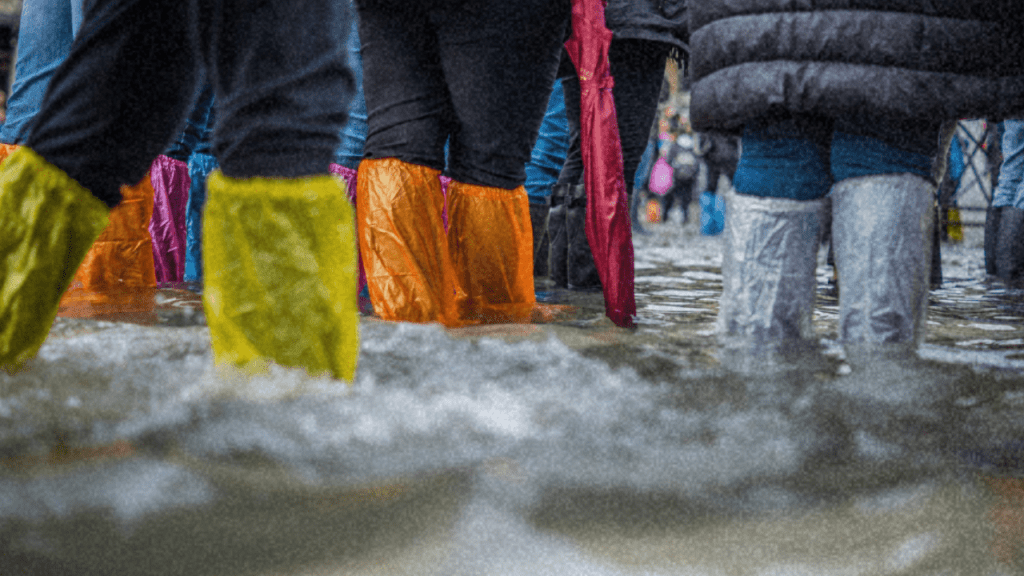
Disaster collectivism is what people do when institutions fail them — and once you know the pattern, you can see it forming in every disaster, in real time.
Britain hit thirty-five degrees Celsius this week, its hottest May day on record. London Underground trains ran at thirty-four. South Western Railway warned of heat-related signalling faults and track defects across its entire network. Water supply failed for hundreds of homes in Kent and Sussex. At least five people died, including children drowning in lakes and reservoirs they had gone to for relief. In France, seven more heat-related deaths were reported, including a fifty-three-year-old man who collapsed at a running event in Paris.
Across South Asia, the larger event has been running since May 1. India and Pakistan are sitting under forty-six-degree afternoons and record-warm nights — the deadlier variable, because the body cannot cool down — and regional power grids are under what meteorologists are calling unprecedented strain. The death toll is not yet public, but the historical baseline from comparable events runs into the thousands. Western coverage has fixated on the British numbers because they are the British numbers; the South Asian event is larger, deadlier, and earlier, and most people reading this in English have heard considerably less about it.
On the other side of the same hemisphere, on the same week, snow is falling on Interstate 80 near Soda Springs, California. A Caltrans webcam caught it on a tractor-trailer in the last week of May. The weekend forecast puts light snow across the Quebec-Maine border and into the higher elevations of New England. Four institutional systems, three weather vectors, one underlying fact: the infrastructure was built for conditions that no longer hold.
In each case, the same structure repeats. The institution responsible for keeping a basic function running — moving people, delivering water, supplying power, clearing the road — meets a load it was warned about and fails along its weakest seam. The seam is rarely random. It is wherever the budget was cut, the contract was rigged, the maintenance was deferred, or the design was built for a climate that has already moved on.
And in the gap between when the institution stops working and when the institution is repaired, somebody else carries the function. A neighbour with a generator. A train crew improvising at a platform. A volunteer running water to construction workers. A trucker who pulls over to help dig out the cab in front of him. That is not goodwill in the abstract. It is a specific, repeating, observable response to a specific, repeating, observable kind of failure.
This is the pattern that Rebecca Solnit called disaster collectivism, and it is what the rest of this piece is about: not as a metaphor or a sentiment, but as a method — something that has happened reliably enough, in enough disasters, that we can describe its shape and recognise it when it is forming. The Toronto snow-clearing collapse that the rest of this piece works through in detail is one extended case. Once you have the shape, you can find it in the next one yourself.
This is not an exception to normal social behaviour. It is normal social behaviour, made briefly visible because the infrastructure that usually obscures it has broken down. Climate change is not making the pattern less relevant. It is making it more frequent, more geographically widespread, and more politically legible.
Toronto’s snow-clearing collapse is worth the detail not because the storms were exceptional, but because the institutional failure was exceptionally well-documented — by the city’s own mayor, its own auditor general, and its own internal audit division, all of whom used the word failure without qualification.
What the city did
The story does not begin with a single storm. It begins in 2021, when Toronto restructured its snow-clearing into a ten-year, multi-zone contract system. The city’s auditor general found the procurement rushed and lacking transparency, with winning bidders far less experienced than the firms that had done the work before.
After the first winter, contractors had accumulated some thirteen million dollars in fines for starting work late — and rather than collect them, an unnamed senior city official successfully advocated cutting the penalty from two hundred dollars a minute to ten. Ten dollars a minute is not a deterrent for a contractor billing at scale. It is a rounding error, and making it one was a choice.
The consequences arrived on schedule. When a major storm paralysed the city, the snow-clearing system that had been hollowed out in advance performed exactly as a hollowed-out system performs. A 2026 forensic audit by KPMG, ordered after the worst of the storms, found a fifty-six-million-dollar budgeting blunder and a series of events that highlighted fraud and misconduct risk: conflict-of-interest rules waived so that city staff could work for one of the main snow-clearing companies, and the limit on how much work contractors could subcontract raised from a quarter to half, gutting an anti-bid-rigging safeguard the auditor general had specifically recommended.
The transit side failed in parallel. During storms the TTC shut down dozens of bus stops, and Line 6, the new Finch West LRT — a three-point-seven-billion-dollar line serving some of the city’s most transit-dependent, lowest-income, least car-accessible neighbourhoods — collapsed in its very first winter of public service.
In January 2026, weeks after it opened, the line went down twice in a single day, the second outage lasting nearly fourteen and a half hours, with snow-clearing crews unable to keep the yard and the alignment functional. The mayor called the broader response a failure. The city manager confirmed it. The auditor general found potential fraud. The internal audit division found systemic gaps in the major-storm plan. These are not opposition politicians. They are the institution describing itself.
The reports landed months after the storms, generated coverage for a day, and disappeared. The people who needed the sidewalks cleared, the bus stops open, and Wheel-Trans running experienced the failure in real time, in the cold, without the option of waiting for a committee to confirm in writing what they already knew in their bodies.
What people did
While the contractors failed to perform and the stops sat buried, people with shovels cleared them. By accounts that circulated afterward, a small group — transit workers, riders, neighbours who understood that a buried stop is the difference between someone making it home and someone not — went out into the storm and cleared dozens of stops in a single night, with no announcement, no official coordination, and no city contract.
The specific tally is the kind of detail that spreads faster than it can be verified, but the phenomenon behind it is not in doubt: across these storms, Torontonians dug out the stops and walkways the institution had failed to maintain, because they were there and they understood what was at stake.
This is what Solnit documents. Not heroism in the dramatic sense, not self-sacrifice or exceptional courage, but the ordinary collective competence that emerges when people face a problem that affects them directly and stop waiting for someone else to solve it. The people willing to pick up the shovel are not performing solidarity. They are enacting it, materially, in the specific place where it is needed. The political content of the act is not in its ideology. It is in its existence. The shovel is in the snow. The stop is clear. Someone gets home who otherwise would not have.
Why institutions fail first
The failure was not primarily one of competence. It was structural — the predictable outcome of decisions made in advance about whom the city’s institutions actually serve. The penalty was cut to a level that made non-performance economically rational. The contracts went to less-experienced bidders through a process flagged for fraud risk at multiple points. None of that is an accident of bad weather. It is the design of a system optimised for the people who profit from the contracts rather than the people who depend on the service.
Solnit’s account of institutional failure in disaster is not, at its core, about incompetence. It is about whose interests institutions are organised to serve, and how visible that organisation becomes when ordinary functioning breaks down. TTC service cuts during a storm fall on the people who depend on the TTC: those without cars, who cannot work from home, who live where transit-dependent communities are concentrated.
The contractor failure falls on the people who use the sidewalks, again disproportionately those who cannot get around any other way. Institutions fail the people who need them most, first — and the people who need them most are the ones who organise first in response, because they are the ones who cannot wait.
Mutual aid is not charity
The language of mutual aid entered common usage over the last decade, accelerated by Occupy Sandy after the 2012 hurricane and by the COVID-19 networks that formed across North American cities in the spring of 2020.
Occupy Sandy mobilised roughly sixty thousand volunteers, served twenty thousand meals a day, and ran neighbourhood relief hubs that reached hard-hit areas like the Rockaways where the official response was largely absent — drawing quiet praise from the city, the National Guard, and the Department of Homeland Security itself. One organiser’s contrast became the movement’s signature: the federal agency down the street handed people a sheet telling them to call a number, while the relief hub simply helped them on arrival.
In the process, the term has been partly domesticated, reframed in some quarters as a kind of charity — voluntary giving from those who have more to those who have less — which is precisely the wrong frame. Mutual aid is not charity. It is a material relation in which people meet each other’s needs through direct exchange, without the intermediary of the state or the market, because the state and the market are not meeting those needs. Charity preserves the structure that produces the need; mutual aid builds what could replace it.
The food bank does not challenge food insecurity. The warming centre does not challenge housing precarity. They are necessary responses to conditions that should not exist, but they do not alter the conditions. Mutual aid, in Solnit’s framing, does something different: it builds social infrastructure — relationships, organisational capacity, trust, practical knowledge about solving problems together — that persists after the disaster and becomes the material basis for sustained political organisation.
The people who shovelled the stops know each other now. They know who shows up, and they know what the city will and will not do. That knowledge is political in the way a cleared sidewalk is political: in what it makes possible.
The subsidy question
The standard institutional response to disaster, when there is one, is the subsidy: the gas-tax relief, the emergency payment, the infrastructure fund. These are not without value; people need money when they have been harmed or displaced. The objection is not to the payment but to the analysis embedded in it — the assumption that the problem is a market failure correctable through targeted transfers, rather than a structural failure in whom the institutions serve.
The gas-tax relief goes to the person who can afford to drive. The emergency payment moves through the same bureaucratic channels that took months to deploy during COVID and still failed to reach the most precarious workers in time. Money flows through existing channels, which means it flows toward the people those channels were built to serve.
Mutual aid builds the parallel infrastructure — and not as an alternative to demanding that institutions work. The demand that the TTC maintain its stops, that contracts be awarded competently and enforced seriously, that Wheel-Trans run during storms, is legitimate and necessary. But the demand and the shovel are not in contradiction.
The demand made by people who have already shown they can solve the problem themselves carries a different weight than the demand of people still waiting for the institution to function. The cleared stop is not a concession to institutional failure. It is a demonstration of collective capacity that precedes the demand and gives it material force.
What climate change changes
Solnit’s book appeared in 2009, and the disasters she documented — the 1906 San Francisco earthquake, the 1917 Halifax explosion, the 1985 Mexico City earthquake, Hurricane Katrina — were exceptional in a specific sense. They were unexpected, and they were episodic: a rupture, then a recovery, then a return to something like the prior normal.
That structure is what every institutional response is built around, from the emergency declaration to the relief fund to the post-event review. The whole apparatus assumes there is a normal to go back to. What climate change is doing is removing the normal, and the clearest evidence is coming from the people whose job is to forecast the exceptions.
Mike Flannigan has spent decades forecasting Canadian fire seasons, and his working assumption was always that bad years were the exception — some summers burn, most do not. He has stopped believing it. After three consecutive punishing seasons, including the 2023 burns of more than fourteen million hectares, and with 2026 opening in drought and forecast to run hot, he has called this year a test of reality — telling reporters he now believes that at a national scale most years are going to be bad fire years.
That is not a louder version of the old warning. It is the forecaster abandoning the category of the average year, and when the average year goes, the model that says “respond to the exception and recover” has nothing left to recover toward.
The Atlantic hurricane outlook shows the same gap opening from the other side. NOAA’s 2026 forecast is for a below-average season by the count, because El Niño tends to suppress Atlantic storm formation — and yet abnormally warm ocean water makes it more likely that at least one very large, destructive storm forms regardless. Fewer storms, more destructive force packed into the ones that come.
And this is happening while the United States’ federal disaster agency is in open disarray, having recently skipped the very forecast briefing it once treated as routine. The hazard is not simply growing; the institutions built to absorb it are decaying at the same time, so the distance between what arrives and what can respond widens from both ends at once.
Follow that widening gap up the scale and it leads, at the largest end, to the Atlantic Meridional Overturning Circulation — the system of ocean currents that carries tropical heat north and is the reason Europe is far warmer than its latitude should allow.
Scientists are now modelling what happens if it collapses, and the finding is counterintuitive: in those models, global warming does not cancel out the regional cooling. A weakened AMOC could leave one-in-ten London winters approaching minus twenty degrees, push Oslo far lower, and spread winter sea ice down to the coasts of northwest Europe — a continent cooling sharply even as the planet warms around it.
This is a risk, not a schedule, and it matters to state it that way. The IPCC still rates a full collapse this century as low-probability, and the estimates for when it might happen range across decades. But the concern is no longer purely theoretical: a separate 2026 study found that the abrupt northward drift of the Gulf Stream expected to precede such a collapse is already detectable in the ocean record going back to 1965. The early-warning indicator, in other words, may already be moving.
What ties that distant scenario back to a buried Toronto bus stop is a single idea: the mismatch between what the climate is doing and what the institutions were built to handle. A city’s snow-clearing system was built for the storms of a milder past, and it failed.
Europe’s housing, heating, agriculture, and power grids were all built for a Gulf-Stream-warmed climate, and a cold-shifted continent would break them in the same way, only across borders and all at once — crop failure, energy demand no grid was sized for, institutional collapse compounding faster than any committee report can track. The snowstorm is that mismatch in miniature and legible. The AMOC scenario is the same mismatch at the scale of a continent. Neither fits the episodic model, because neither is an episode.
And that is the thread running through all of it. The communities living through these events are not experiencing interruptions to a stable normal. They are living the arrival of a new one, faster than the institutions serving them can adapt and, given whom those institutions are built to serve, perhaps faster than they ever will. The response organised around the exceptional event — declare the emergency, disburse the fund, file the review, wait for things to settle — has no answer for conditions that do not settle.
This is why the networks built during the pandemic, the storms, and the floods matter beyond the crises that produced them. They are not emergency measures. They are the beginning of a parallel infrastructure built by the people who cannot afford to wait, in the conditions the institution’s failure is increasingly producing.
Solnit’s argument is that disaster reveals what is latent in human social organisation — that the collectivism which emerges is not an aberration but an expression of how people already are, made visible because the structures that usually suppress it have broken down. Climate change is manufacturing more of those moments of visibility. The only open question is what gets built inside them.
Sources
- Rebecca Solnit — A Paradise Built in Hell: The Extraordinary Communities That Arise in Disaster (Viking, 2009)
- Toronto Today — Lack of snow removal blamed for “failure”; AG found procurement rushed, fines cut $200→$10/minute
- The Trillium — Forensic audit reveals $56M blunder; fraud and misconduct risk areas, waived conflict rules, weakened anti-bid-rigging limits
- CBC News — City lowered key liquidated-damages clause for snow-clearing contractors
- CBC News — TTC Line 6 down twice in one day, second outage nearly 14.5 hours (January 2026)
- Global News — Finch West LRT buried during testing as city crews dumped snow on the tracks; line opened December 2025
- THE CITY — Ten years on, Occupy Sandy redefined disaster response (60,000 volunteers; reached where official response was absent)
- Resilience.org — After the Flood: lessons from Occupy Sandy; “mutual aid, not charity”; quiet praise from City, National Guard, DHS
- TTCriders — accessibility and the TTC snow plan
- Canada’s National Observer — 2026 wildfire outlook; Mike Flannigan’s “litmus test” and “new reality” for Canadian fire seasons
- NPR — 2026 Atlantic hurricane forecast: below-average by number but warm water raises destructive potential; FEMA in turmoil
- Carbon Brief — modelled AMOC collapse could trigger profound cooling in northern Europe even amid global warming (van Westen et al.)
- Rhiannon Firth — Disaster Anarchy: Mutual Aid and Radical Action (Pluto Press, 2022)
- CNN — Europe’s deadly, early heatwave smashing records; UK 34.8°C/35.1°C at Kew Gardens, France hottest May day on record, 7+ heat-related deaths
- Wikipedia — May 2026 UK heatwave; water supply disruption in Kent/Sussex, South Western Railway heat-related speed restrictions and signalling faults, London Underground at 34°C
- Wikipedia — 2026 European heatwaves; 10-15°C above normal across Western Europe, records broken in UK, France, Spain, Germany, Ireland
- Wikipedia — Weather of 2026; South Asia heatwave May 1-present, 46°C+ in India and Pakistan, record nighttime temperatures, unprecedented strain on regional power grids
- AccuWeather (May 26, 2026) — Caltrans District 3 webcam, late-May snow on I-80 near Soda Springs, California
- Max Velocity WX / ECMWFIFS model output (May 26, 2026) — light snow forecast for Quebec-Maine border and higher elevations of New England, May 30–June 1 weekend


 Spark Solidarity