
For seventy years, the question was whether something was in the sky. The better question is who built the conditions under which nobody can say for certain.
On May 8, 2026, the Pentagon — now rebranded the Department of War — began posting decades of declassified files to a dedicated government website under a new program acronym, PURSUE, the Presidential Unsealings and Reporting System for UAP Encounters. UAP — unidentified anomalous phenomena — is the government’s current term for what used to be called UFOs. The first batch held more than 160 files describing over 400 incidents, ranging from the 1940s to last year.
President Trump had teased “very interesting documents” in the weeks before and told the public to “decide for themselves.” What the trove actually contained was mostly grainy infrared sensor footage, indiscernible points of light, and decades of old eyewitness reports. NBC News, covering the release, noted plainly that the files showed no sign of any government contact with beings from other planets. The state released the spectacle and withheld the interpretation.
That withholding is not an oversight. It is the design. Into the gap where an explanation should be, two ready-made stories rushed.
The first came from RT, the Russian state broadcaster, which pushed a post to millions of feeds: “ALIEN FLOATS MIDAIR.” It paired a 2015 amateur clip with a grayscale military sensor frame, tracking brackets locked onto a luminous, vaguely humanoid blob. A smear of light on a targeting screen became, by way of a headline, a visitor from another world.
The second came from a Wall Street Journal opinion piece, in which the investigative reporter Jeffrey Scott Shapiro argued that the famous sightings are earthly and dangerous — that foreign adversaries, and quite possibly the United States itself, are fielding technology designed to confuse pilots and the instruments they rely on. Cosmic visitor on one channel; secret superweapon on the other.
Those two frames have something in common. One sells wonder, the other sells fear. Both are thrilling. And both quietly skip past the least glamorous possibility — that the sky over an ordinary country is now crowded with machines and programs the public was never told about, run by institutions that prefer not to explain themselves. The two loud answers crowd out the quiet one.
The way the release itself was built makes the point. NBC observed that PURSUE was modeled on the Justice Department’s rollout of the Epstein files — a release widely criticized for dumping paperwork already in the public record, redacting heavily, omitting documents inexplicably, and attaching no official interpretation to any of it. Apply that template to UAP and the effect is the same: hand the public raw, ambiguous material framed as a great mystery, decline to explain it, and let everyone sort the fragments into whichever box their instincts already prefer. The structure is the message.
This is happening in a real and pressured moment. The Pentagon’s dedicated anomaly office has now logged more than two thousand cases. A wave of unexplained drones crossed New Jersey and several neighboring states in late 2024 with no clean attribution. State legislatures are drafting their own UAP bills. The public demand for “disclosure” is genuine. So is the fog around it.
This is not an argument that aliens are real, and not an argument that they are fake. The two answers on offer — visitor or hoax, miracle or nothing — function as a trap. They are the only two boxes the public is handed. The documented reality sits in a third box that neither frame will name: an atmosphere that has quietly become a managed, militarized, sensor-saturated technological environment. That third box is the real story, and it begins with what is not in dispute at all.
The state already weaponized the sky
Before any inference, before any interpretation, there is the plain record. The United States has weaponized the atmosphere, and it lied to Congress about doing so. This is not contested and not speculative. It is declassified history.
Operation Popeye was a covert cloud-seeding program the U.S. ran from 1967 to 1972. “Cloud seeding” means dispersing a substance — usually silver iodide — into clouds to make water droplets clump together and fall as rain. Popeye used it as a weapon: the goal was to extend the monsoon over the Ho Chi Minh Trail, the supply route running through Laos and Vietnam, in order to soften the roads, trigger landslides, and bog down the movement of supplies. The crews flying it used an internal slogan: “make mud, not war.” It was operational for five years.
The damning part is not that the program existed. It is the cover that surrounded it. While Popeye was actively flying missions, the Secretary of Defense told Congress, flatly, that no program to modify the weather as a weapon existed at all. A real capability, paired with a denial under oath.
Once you know the state has both the will to weaponize the sky and the reflex to lie to its own lawmakers about it, the useful question is no longer whether such programs exist. It becomes how far they have advanced since, and who is now in a position to confirm anything.
This is established scholarship, not forum lore. The researcher Rebecca Pincus documented the Defense Department’s weather-control ambitions in the academic journal War & Society, working from the declassified files. The record is in the open for anyone willing to read it.
Popeye was not the only such effort, and the second one carries a lesson the first does not. From 1962 to 1983 the United States ran Project Stormfury, a joint Navy and Commerce Department program that tried to weaken hurricanes by flying aircraft directly into them and seeding the eyewall — the ring of fierce storms around the calm center — with silver iodide. For years it seemed to work. Seeded storms weakened. Eyewalls broke apart and reformed at a wider, weaker radius. Wind speeds dropped. The program ran on that apparent success for two decades.
Then, officially, the science took it apart. Researchers reported that hurricanes do not contain enough supercooled water — water still liquid below freezing — for the seeding to do anything, and that unseeded hurricanes underwent the same eyewall changes Stormfury had claimed as its victories. The conclusion handed down was that the “successes” had been natural cycles all along, and in 1983 the program was closed as a failure.
That official verdict deserves the same skepticism being applied to everything else, because of who delivered it and why they might. A finding of failure is the cleanest cover a program can have. “We tried, it didn’t work, we shut it down” ends inquiry, releases no capability, and invites no further questions — and the institutions issuing that verdict were the same ones that would benefit from it being believed.
This is not an exotic suspicion. It is a documented pattern across capitalism: the tobacco industry ran internal research it then buried, the fossil-fuel majors understood climate science decades before they admitted it, pharmaceutical firms have concealed unfavorable and favorable trial data alike when disclosure cut against their interest. Declaring a line of research a dead end, while quietly retaining what was learned, is a standard maneuver, not a conspiracy theory.
And here the unprovability cuts both ways. The atmosphere never lets anyone run the experiment cleanly — you can never observe the same storm both seeded and unseeded, so no one can prove the seeding worked. But by the identical logic, no one can prove it did not.
“We demonstrated it fails” is a claim the atmosphere cannot actually support either. So the public was told a program failed by the only party in a position to say, a party with every incentive to say exactly that regardless of what it had found. That is not proof the program worked. It is something more useful: a reason to stop taking the failure at face value.
Programs like these did not stay secret, and they did not stay American. The Cuban leader Fidel Castro alleged that Stormfury was an attempt to weaponize hurricanes and steer them against the island — a charge the United States denied.
Castro’s suspicion was warranted, and it captures the logic the programs themselves had set loose. Once one state demonstrably manipulates the atmosphere and lies to its own legislature about it, every rival has reason to assume the worst and to build a capability of its own, if only to understand and counter what others might be doing.
And that is what happened. Weather modification spread until it became a routine instrument of statecraft rather than an exotic secret. China began experimental weather engineering in 1958 — driven not by any reaction to American programs but by its own chronic drought across the north — and built what is now, by most measures, the world’s largest program.
It employs tens of thousands of people who fire silver-iodide rockets and artillery shells into the clouds, including a campaign to clear the skies for the 2008 Beijing Olympics, with a 2020 plan to extend coverage across more than half the country’s land area.
Russia, India, and dozens of other states run atmospheric programs too. The takeaway is not a single hidden hand orchestrating the weather from one room. It is that atmospheric intervention became contested ground, worked by many programs at once — and that each new program was built on the foundations the earlier ones laid. That cumulative, stage-by-stage development is the part the public never sees clearly, and it is also what makes the whole field so easy to hide.
Cloud seeding is real, archaic, and unprovable
Move from the Cold War to the present and the technology has not stopped — it has changed shape. The clearest current example is the United Arab Emirates, which faces some of the planet’s most extreme heat and chronic water scarcity. The UAE has spent more than fifteen million dollars on rain-enhancement research and flown well over a hundred cloud-seeding missions in a single year. This is open, funded, ongoing state activity, not a rumor.
The method has moved on, and the gap between what it now is and what the public imagines it to be is itself important. Classic seeding fires silver iodide into a cloud as a kind of scaffold for water to gather on. The newer approach, developed for the UAE by atmospheric physicists at the University of Reading in Britain, abandons chemistry for electricity: custom drones fly into clouds and deliver an electrical charge that nudges droplets to merge and fall as rain.
Researchers describe this drone-borne electrification openly as the latest step beyond crude particulate seeding. The popular mental picture of “cloud seeding” — a plane sprinkling chemicals from above — is already a full generation out of date. The real technology is quieter, more precise, and harder to recognize from the ground.
And the same thread that surfaced in Stormfury surfaces again here. By the atmospheric scientists’ own admission, you cannot prove that any given rainfall was caused by the intervention. As one researcher put it, the atmosphere never permits a controlled experiment: you can never say what would have happened if you had not seeded, because there is only one sky and it only runs once. The science is real, the spending is real, the flights are real — and the causation is, by the nature of the system, unprovable.
This unprovability is not a mere technicality to be dismissed; it is the very soil in which the entire mythology takes root. When a technology is real but its effects cannot be cleanly isolated, a permanent gap opens between what is occurring and what can be proven, and belief inevitably rushes into that void. Crucially, the belief does not drift aimlessly; it is immediately and forcibly sorted into the pre-existing categories the surrounding culture has already built. That sorting, and the way these technologies stack across generations, is the deepest part of how this entire field has stayed concealed.
How the technology hides in its own history
These technologies do not appear all at once. They develop in stages, and each stage is built on the one before it — a process worth understanding because the layering itself is what does the hiding.
The lineage is traceable. The theoretical foundation runs back more than a century to figures like Nikola Tesla, who worked on the wireless transmission of energy and the electrical properties of the atmosphere long before anyone could build at scale. On that groundwork came the postwar generation of hands-on programs — cloud seeding, the barium releases, Operation Popeye, Project Stormfury — crude, physical, chemical attempts to act on the sky.
And on the foundations those programs laid came the present generation: the electrical charging of clouds, autonomous drones, electromagnetic and sensor systems, far more precise and far less visible than dumping silver iodide from a B-17. Each layer presupposes the last. The drone electrifying a cloud over Dubai is not unrelated to Stormfury; it is Stormfury’s descendant, several theoretical generations on.
This staged development is not just how the technology advances. It is how it is concealed: because each stage builds on the last, the state can “reveal” an older capability as though it were news, while the current frontier stays completely dark. When a government or a newspaper now admits that cloud seeding is real, or that drones can coax rain, the public experiences a small thrill of disclosure — so that’s what they were doing.
But the program being unveiled is twenty, thirty, fifty years into its development. The admission is real and the relief is genuine, and both are misdirection: you are being shown the foundation precisely so you do not look at the floors built on top of it. A truth from decades ago, released today, functions as the most effective possible cover for whatever is current.
This is why the convergence of these systems is not quite the accident of “separate programs that happen to share a sky.” It is closer to a single developmental line — many branches, no central control room, but a real lineage in which the later, hidden stages depend on and grow out of the earlier, disclosed ones. It reframes every “revelation” the state offers: the question is never only what is being shown, but what generation of the technology the showing is meant to conceal.
The binary is the trap
The central argument is not about ice crystals or chemicals. It is about how a conversation gets shaped so that certain questions become impossible to ask out loud — a matter of mechanism more than of objects.
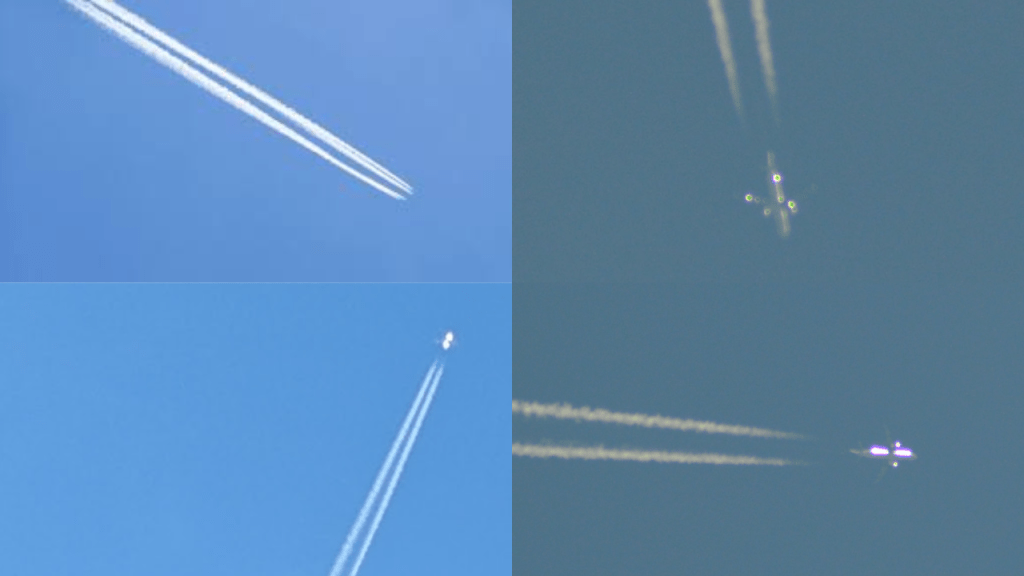
The public conversation about atmospheric activity has been forced into a binary — two options, nothing between them. Either the streaks overhead are ordinary condensation trails and nothing more, or they are a secret poison-spraying operation. “Contrail” or “chemtrail.” Mundane or insane. You may pick exactly one.
One specific claim is false, and precision about it matters: there is no covert program using high-altitude jet contrails to spray poison on the general population. Those persistent white lines behind airliners at thirty-five thousand feet are condensation — ice crystals forming around engine exhaust in cold, humid air, behaving exactly as the physics predicts. That specific picture is settled, and it is not the open question.
But the popular “chemtrails” theory is not a single claim. It is a composite — a pile of real, separate, individually documented things compressed into one incoherent picture, and the incoherence is exactly what discredits the true components inside it. The pieces are worth examining on their own.
Aerial chemical spraying onto land and people is real and ongoing. In British Columbia, forestry companies spray glyphosate herbicide formulations from helicopters over Crown forests to kill broadleaf trees that compete with the conifers they intend to harvest.
First Nations have fought this for decades: in Ontario, communities have called the practice a “rain of death” waged on Indigenous land for over forty years, and the Sagamok Anishnawbek Traditional Ecological Knowledge Elders have sought a moratorium since 2013. The Lheidli T’enneh First Nation banned glyphosate across its territory after Elders reported their people no longer felt safe gathering berries and medicines from sprayed bush.
So chemicals are sprayed from aircraft onto populations — just not the population the chemtrail theory names, and not from the altitude it points to. It happens at low level, over rural and Indigenous land, in service of timber profit, fully documented and fully legal.
Add the other real pieces: barium released into the upper atmosphere for plasma research; weather-modification programs running worldwide; the fact that charged particles in the atmosphere can be manipulated electrically. Then weld onto all of it the free-floating anxiety about 5G transmission, and you have the “chemtrails” composite — several truths and one piece of static, fused into a single picture so garbled that pointing at any one of its real components gets you laughed out of the room.
That fusion is what makes the composite useful — useful because something can serve a function without anyone sitting in a room having planned it. The mechanism has a name. Logicians call it the association fallacy: the error of rejecting an idea not on its merits but because of the company it keeps.
If a ridiculous claim and a serious one get filed under the same heading, the ridiculous one drags the serious one down with it. Attach “they’re spraying us with poison” to the very idea of asking about atmospheric programs, and anyone who raises a documented program — Popeye, Stormfury, charge-seeding drones over Dubai — is automatically sorted into the “poison” box and dismissed before a single fact is weighed.
The lunatic pole exists, functionally, to contaminate the question. Point at the sky at all, and the frame makes you sound insane.
The binary also does something subtler: it aims the public at the wrong altitude and the wrong purpose entirely. Take barium as the example. For decades, NASA and the U.S. Naval Research Laboratory have released barium and other vapor tracers into the upper atmosphere. This is real, documented, and sitting on the public technical record — not a secret. But the purpose is ionospheric and plasma research.
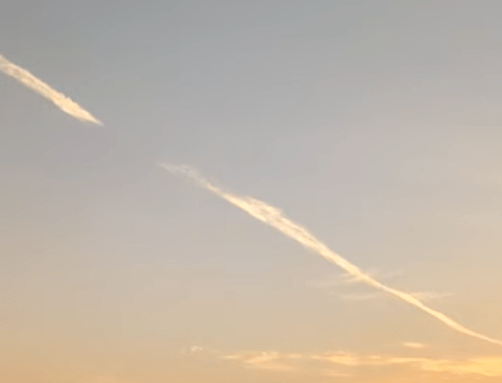
The ionosphere is the electrically charged upper layer of the atmosphere; “plasma” is gas so energized that its electrons break free, making it electrically active. Released up there, barium is photo-ionized by sunlight — light knocks its electrons loose — and it glows into a luminous, trackable cloud that lets scientists measure the electric and magnetic fields of near-Earth space. Some campaigns even paired these releases with high-frequency radio waves beamed up to heat the ionosphere and watch how it responded.
The strangeness of that is worth registering. The government routinely releases glowing metal vapor into the edge of space and zaps it with radio energy to study the electrical skin of the planet. It is genuinely odd, genuinely real, and genuinely happening far above where any contrail forms. And the binary does something specific to it.
The chemtrail frame insists the action is “low-altitude poison spraying.” The real program is high-altitude plasma physics. The frame points the public’s attention at the wrong layer of the sky and the wrong reason entirely — and in doing so, it hides the weirder, fully sourced truth behind a cartoon that is easy to laugh off.
The cartoon is not a distraction from the secret. The cartoon is the cover for it.
None of this requires a master conspiracy with a control room. It requires only a documented institutional habit. In 1967, in a dispatch later declassified through a 1976 Freedom of Information Act request filed by the New York Times, the CIA instructed its assets on how to handle Americans who doubted the official account of the Kennedy assassination. The memo directed operatives to discredit those critics by working through friendly editors and politicians.
It’s worth being precise: the CIA did not invent the phrase “conspiracy theory.” That term predates the memo, and anyone claiming the agency coined it is overreaching.
What the document does show — and this is the durable part — is a state apparatus deliberately deploying a discrediting label as a psychological operation, a coordinated effort to shape what the public believes, against citizens asking inconvenient questions. The tactic of turning “you are a conspiracy theorist” into a conversation-ending weapon is not a paranoid fantasy. It is a documented method with a paper trail.
Put the pieces together and the real open question comes into focus. It is not “are contrails fake” — the physics there is closed, and asking it is itself a symptom of the trap.
The genuinely open question is why the airspace is kept so legible and yet so unaskable: why the only two socially permitted responses to atmospheric activity are bored denial and tinfoil lunacy, and who benefits when every serious inquiry is discredited in advance by its forced association with the absurd one. That question is wide open. And the binary exists, whether by design or by drift, to keep it closed.
Perception is the battlespace
To understand why the sky has become so hard to read, you have to understand a shift in how modern militaries think about being seen. This is not a new or fringe idea; serious theorists have argued it for forty years, and the man who named it is the clearest starting point.
In 1984 the French theorist Paul Virilio published War and Cinema, in which he coined the phrase “the logistics of perception.” His argument, in plain terms: in modern war, the supply of images matters as much as the supply of bullets.
Once weapons outranged the human eye — once you were firing at things too far away to see directly, and relying on cameras, radar, and instruments to tell you what was there — the decisive struggle stopped being about hitting the target and started being about controlling what each side could perceive. Warfare became a permanent contest between visibility and invisibility, between surveillance and camouflage. Whoever controls perception controls the fight.
The military historian Antoine Bousquet carried the idea to the present in his 2018 book The Eye of War, tracing an unbroken line from the telescope to the targeting drone — a centuries-long project of turning sight itself into a weapon. The claim that perception is a battlefield is not something invented for a blog post. It is a developed body of scholarship, and the hardware has now caught up to the theory in ways that sit in the public patent record.

The hardware bears that out. In 2018 the U.S. Navy filed for a laser-induced plasma system, granted in 2022. In ordinary language: a laser ionizes the air at a chosen point, creating a glowing ball of plasma that radiates heat and light. A heat-seeking missile, which homes in on infrared signatures, can be lured toward that false glow instead of the real aircraft. But the patent does not stop at a decoy flare.
It describes “rastering” the plasma — sweeping the laser quickly to paint a shape, the way an old television painted an image line by line — to build a two- or three-dimensional “ghost” image hanging in open air. Generate several at once and an incoming missile has only a one-in-a-handful chance of striking the genuine target. The inventors explicitly float scaling the system up to protect a whole battle group, a base, or even a city.
A separate Navy filing describes an infrared holographic projector for thermal masking and decoys — encoding an image into a diffraction pattern and projecting it onto a distant surface. These are not illusions staged for the public to gawk at. They are tools built to fool the instruments that decide what a missile chases. The target audience for these projected images is not a human eye. It is a sensor.
This is exactly the patent Shapiro built his Wall Street Journal argument around — by his own citation, Publication No. US2020/0041236A1. And his description of the capability is accurate: such systems are designed to manipulate how missiles, radar, and infrared sensors interpret a target, and in principle they can present a false signature across more than one type of sensor at once. That much is documented, and it can be stated with full confidence.
Two things have to be kept separate here, because the binary blurs them and the distinction is the entire difference between a defensible argument and a debunkable one. A patent is evidence that someone is researching and intends to build a thing. It is not evidence that the thing has been built, deployed, and used in any particular incident. Governments and corporations patent thousands of speculative concepts that never leave the lab.
So when Shapiro takes the next step — arguing that this technology therefore explains the famous Tic Tac sighting and the rest of the catalog — he has crossed from documented fact into inference. That leap may turn out to be right. But it is not proven, and it is precisely the spot where a strong argument is most tempted to overclaim. The honest position holds the capability at full confidence and the specific causal claim at arm’s length.
The same discipline applies to the optical-camouflage systems people cite in these discussions. A European holographic camouflage patent that circulates online states, in its own text, that “a device seeking invisibility is not to be realized.” Its actual aim is far more modest: to blend an object into its background by diffracting sunlight, making it harder to pick out — not to conjure free-floating holograms over cities. The real research is surface-level signature management, the discipline of controlling how an object looks to sensors. Less cinematic than the hologram-fleet story, and more unsettling for being real.
And the skeptic’s strongest weapon turns, on inspection, into evidence. When the Pentagon’s own anomaly office resolved its 2023–24 cases, it attributed them overwhelmingly to ordinary causes — roughly seventy percent balloons, sixteen percent drones, the remainder birds, satellites, and aircraft. Its historical review listed the culprits explicitly: drones, rocket exhaust plumes, satellites, “infrared aberrations,” “sensor artifacts,” “vague radar returns,” and optical effects like parallax, where an object appears to move because the observer is moving.
A skeptic reads that list and says: see, it’s nothing — case closed. But read it again with the perception argument in hand. “Sensor artifact” is not the refutation of the thesis. It is the thesis.
The official conclusion is that a large share of these phenomena are produced not by objects in the sky but by the instruments doing the looking and by an airspace so crowded with drones, balloons, and signals that the sensors themselves generate confusion. The investigators are confirming, in their own dry language, that perception has become unreliable in exactly the way the theory predicts. The boring explanation and the unsettling one are the same explanation.
A worked example: the drones over Langley
One real case shows the whole pattern at work.
In December 2023, a swarm of unidentified drones repeatedly flew over Langley Air Force Base in Virginia, one of the most sensitive military installations in the country, for night after night. The Air Force could not identify them, could not determine who was operating them, and — remarkably — did not bring them down. A year later, in late 2024, a far larger wave of unexplained drones moved across New Jersey and neighboring states, prompting weeks of public alarm, conflicting official statements, and no clear resolution.
The binary processes these events in two predictable ways. The sensational frame asks whether they were alien. The dismissive frame insists they were just hobbyist drones and the public panicked over nothing. Both burn through the news cycle, and both leave the actual situation undescribed. Neither asks the question the documented record makes obvious.
The third box reads them differently. We know — from the patent record — that militaries are actively building systems to spoof sensors and project false signatures. We know — from the anomaly office’s own reports — that a large fraction of UAP cases resolve to drones and sensor confusion. We know — from a half-century of declassified history — that the state operates classified aerial systems and then declines to explain the resulting sightings.
We know the airspace is contested ground worked by multiple programs at once. Place a persistent, unattributed drone swarm over a frontline air base inside that context, and the genuinely interesting questions appear: whose systems were they, why could a superpower’s flagship base neither identify nor neutralize them, and what does it mean that the official response was silence rather than answers?
That is not a question about extraterrestrials, and it is not a debunking. It is a question about who controls the sky over a population and how little of that control the public can see. The binary is built to keep that question from forming. The third box is where it lives.
Convergence, not conspiracy
It is tempting, having assembled all this, to reach for a single hidden system — one master program quietly running the weather drones, the plasma decoys, the barium clouds, and the surveillance grids as coordinated parts of one machine. That reach is the mistake. It is, in fact, the exact mistake the binary wants you to make, because the moment you claim a single omnipotent conspiracy, you have made a claim no evidence can support, and the whole argument becomes easy to dismiss along with it. The overreach is the trapdoor.
The defensible claim — and the more disturbing one — is convergence. The word means simply that separate things, built for separate reasons by separate actors, increasingly arrive in the same place at the same time. No central coordination is required.
A great deal is now operating in the lower and upper atmosphere simultaneously: weather-modification programs run by a dozen states; electronic-warfare systems that jam, spoof, and generate false sensor returns; fleets of autonomous drones; networks of atmospheric and surveillance sensors; plasma and signature-management research; ionospheric experiments. Each was developed independently, for its own purpose. None of them needed the others to exist. But they now share one medium — the sky — and they crowd it.
That convergence alone produces the result, with no conspiracy needed to explain it: an atmosphere so dense with activity that no member of the public could possibly parse it, governed by institutions secretive enough that they will not. You do not need a control room. You need only many separate machines occupying one volume of sky and a state that declines to narrate any of them.
The least conspiratorial point is also the most damning. Grant that the capability exists. The next question is what it gets used for, and under capitalism that question very nearly answers itself. A powerful technology held by states and the capital interests entangled with them does not sit idle, reserved for benign ends. It bends toward whatever serves profit and power, because that is the logic the system runs on. No villain in a chair is required.
The uses such a capability would be drawn toward — land development, resource extraction, covert warfare, the management of popular unrest — make the structural expectation plain. This is not the claim that each of those has been documented. It is the claim that the incentives all point one direction, and that history offers no example of an actor holding a profitable instrument of power and declining, out of restraint, to use it.
Operation Popeye already proves the principle: the moment weather modification offered a battlefield advantage, it was deployed as a weapon and denied to Congress. The technology has only advanced since. The incentive has not changed.
This is the difference between a conspiracy theory and a structural one. A conspiracy theory needs a secret meeting. A structural account needs only a capability, an incentive, and the absence of any force strong enough to prevent its use — and then predicts the outcome the way one predicts water running downhill.
It is the same logic that explains why fossil firms buried what they knew, and why every documented case of corporate concealment here unfolded without a single coordinating hand. The system does not require a plot. It requires only that no one with the power to misuse a technology has a reason not to.
This is why the old mental categories keep failing the people who use them. The public still searches for a discrete object — a craft, a better airplane, a thing with edges. But convergence does not produce a thing. It produces a field: distributed drone activity, projected and spoofed signatures, atmospheric distortions, electromagnetic interference, and unstable sensor data, none of which resolves cleanly into a single object seen by a single instrument.
One witness sees lights. Radar logs erratic returns. Infrared catches inconsistent heat. The automated classifier cannot lock on. There may be no single object at all — only a layered environment of competing signatures, which is exactly what the anomaly office’s “sensor artifacts” and “vague radar returns” describe.
This reading is not confined to the political fringe; it has been made from the anti-war left as well. The journalist Caitlin Johnstone has described the renewed UFO discourse as a narrative pushed in conjunction with the U.S. military and the political class — a way of routing public attention toward spectacle and threat-inflation while the mundane, documented fact of an increasingly militarized atmosphere goes undiscussed.
The claim is not that every official is lying in concert. It is that the structure of secrecy rewards opacity, and that spectacle — whether alien or adversary superweapon — is the most reliable cover there is.
Back to the lights in the sky
Return to the document dump and the two frames that raced to fill it. The alien frame and the secret-superweapon frame are opposites in content and identical in function. Both deliver a thrill. Both foreclose the boring institutional question. Both leave the actual condition of the airspace undiscussed. One sells wonder and the other sells fear, and neither sells the truth, which is harder to compress into a headline: the sky above ordinary people has become a contested technological environment, managed by programs they never consented to and cannot see.
The disclosure push of 2026 delivers more of both frames and very little of the third — raw spectacle with no interpretation attached, modeled on a redaction-riddled Epstein rollout. That is precisely the pattern the historical record predicts, running from Popeye’s denial under oath, through the Warren-memo playbook for discrediting inconvenient questions, to the patent filings sitting in plain sight that almost no one reads.
The technologies that once read as impossible — stealth aircraft, drones, satellite surveillance, GPS — each passed through a phase of being mistaken for the supernatural before they were quietly declassified into ordinary furniture. The same process is now underway around atmospheric engineering and sensor warfare.
The modern battlespace no longer ends at land, sea, air, or space. It now includes perception itself — what you are permitted to see, and which of two pre-built answers you are allowed to reach for. The lights in the sky are the least interesting part of the story. The interesting part is the architecture, material and ideological, that decides in advance what those lights are allowed to mean — and keeps the third box, the true one, shut.
This logic of staggered disclosure implies that the real frontier is far more advanced than anything yet revealed. If any of that frontier touches energy generation or transmission — the domain Tesla’s foundational work first pointed toward — the incentive to keep it buried would be immense, because a technology capable of ending fossil-fuel dependence would threaten the most entrenched capital on earth.
This final point is offered as speculation rather than documented fact — but it is a question worth asking. As the rest of this piece has shown, official confirmation of yesterday’s secrets tends to be only a matter of time.
Sources
- Pentagon releases declassified UAP files under PURSUE, NBC News (May 8, 2026)
- Jeffrey Scott Shapiro, “UFOs Are a Threat to National Security,” Washington Times (2022), referencing his WSJ op-ed and patent US2020/0041236A1
- Operation Popeye — covert weather modification and Congressional denial
- Rebecca Pincus, weather control and weaponization by the US DoD, War & Society (2017)
- Project Stormfury (1962–1983) and the Castro weaponization allegation
- China’s weather-modification program since 1958, MIT Technology Review
- Aerial glyphosate spraying on First Nations forest land in Canada (“rain of death”)
- “Stop the Spray” — glyphosate forestry spraying protest, CBC News
- UAE drone-based electrical-charge cloud seeding (Communications of the ACM)
- NASA on barium and vapor-tracer releases for ionospheric study
- US Navy patent US20200041236A1 — laser-induced plasma decoy / ghost-image system
- EP4300028B1 — holographic camouflage patent (states it does not seek invisibility)
- Pentagon AARO FY2024 Consolidated Annual Report on UAP
- USS Nimitz “Tic Tac” — DoD-released, Navy-authenticated footage
- CIA Document 1035-960 and the “conspiracy theory” discrediting effort (with the coinage claim debunked)
- Paul Virilio, War and Cinema: The Logistics of Perception (1984)
- Antoine Bousquet, The Eye of War (2018)
- Caitlin Johnstone on the military-aligned UFO narrative