Formula 1 petrodollar sportswashing has built a spectacle so managed that audiences assume the weather is too — wrong on the facts, right on the system.
The strongest version of the Formula 1 cloud-seeding argument is not that the sport secretly controls the weather. There is no public evidence for that operational claim, and this piece does not make it. The strongest version is that Formula 1 now exists inside a political and economic structure where the suspicion itself feels rational — and the reason the suspicion persists, year after year, is that the structure producing it is real.
The internet version usually collapses into something cruder: wet qualifying sessions, dry races, suspicious forecast reversals, and Gulf cloud-seeding programs must mean F1 weekends are being environmentally engineered for spectacle or emissions optics. That is not the argument here, because the evidence for it does not exist. The argument is about why a baseless operational claim nonetheless feels plausible to millions of people, and what that says about the system they are watching.
Gulf petro-states openly run documented weather-modification programs. Formula 1 is increasingly dependent on Gulf-state money. Fossil-fuel companies openly use the sport as sustainability branding. Modern spectacle capitalism already manipulates nearly every other layer of public perception. The audience understands this intuitively, and even when they cannot prove a mechanism, they correctly read the system. The suspicion is wrong on the specific fact and right on the structure, which is a different and more interesting thing to be wrong about.
Cloud seeding is real, F1 manipulation is not proven
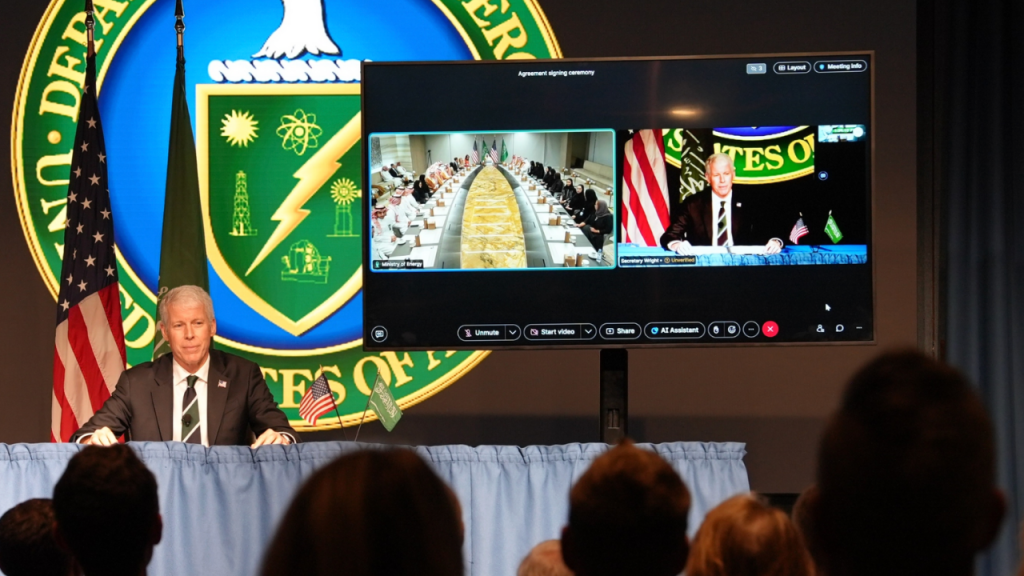
The thing that collapses the lazy dismissal of this topic is that cloud seeding is not a conspiracy theory. Saudi Arabia operates a National Center for Meteorology cloud-seeding program intended to increase rainfall across the kingdom. The United Arab Emirates has spent years funding weather-modification aircraft, atmospheric research, and infrastructure designed to stimulate rain in desert conditions. Governments describe this openly, as climate adaptation and water-security policy. It is not hidden and it is not fringe.
What the technology being real does not establish is that it has ever been used to manipulate a Formula 1 race, and it is worth being precise about that gap. When rumours circulated that cloud seeding had been deployed around a race weekend, Singapore’s National Environment Agency publicly denied it. The denial is the tell. The official position is not that weather modification is impossible — it is that it was not done here. The capability is conceded. Only the specific application is denied, and the denial is the part with no independent verification on either side.
Formula 1 became a Gulf-state asset
While cloud-seeding infrastructure expanded across the Gulf, Formula 1 became deeply integrated into Gulf petro-capital. Saudi Arabia, Qatar, Bahrain, and Abu Dhabi turned the sport into a centerpiece of their global branding strategy. The clearest single example is Aramco, which became a global Formula 1 partner while presenting itself as a sustainability and innovation company. One of the largest fossil-fuel corporations on Earth now sponsors a sport increasingly marketed through carbon-neutral messaging, sustainable fuels, and technological futurism.
The contradiction is almost too obvious to need stating, but it is the engine of everything else. Formula 1 is no longer simply a racing series. It is a legitimacy-production machine for fossil capital, and the spectacle itself is the message. The point is not that the racing is fake. It is that the racing is wrapped in a layer of meaning — green, modern, forward-looking — that exists specifically to launder the source of the money paying for it.
Sportswashing is no longer hidden
The word “sportswashing” exists because the strategy became impossible to ignore. In March 2026, Human Rights Watch called on Formula 1 and the FIA to address the risk that governments would use the season’s Grand Prix events to whitewash their human rights records. Abusive governments “relish the Grand Prix,” said Minky Worden, the group’s director of global initiatives, because it offers them a dazzling distraction from those records. The same regimes accused of labour exploitation and political repression present themselves through the aesthetics of luxury, engineering, and progress.
Formula 1 is the ideal delivery system for that because it is already controlled spectacle in every other respect. The circuits are artificial environments. The broadcasts are tightly managed. The branding is total, the audience is global, and the economics are inseparable from oil. A sport built end to end as a managed product is a sport in which one more layer of management is easy to believe. That is the bridge between the documented sportswashing and the unprovable weather claim, and it is worth walking carefully rather than sprinting across.
The spectacle feels engineered because it is
The modern audience already knows Formula 1 operates inside heavily managed conditions. They know the media narratives are managed, the sustainability branding is managed, the political image of the host regimes is managed, the race presentation is managed, the fan experience is managed, and the sponsorship ecosystem is managed. None of that is contested. All of it is openly the business model.
So when a suspicious weather pattern appears around a race weekend, audiences extend the logic they have already been taught: if every other layer of the spectacle is engineered, why would the atmosphere be the one exempt category? That reasoning does not prove environmental manipulation occurred, and it cannot. But it explains why the suspicion feels believable inside this particular system rather than outside it. The conspiracy theory is a folk attempt to name a real property of the thing it is watching, even when it names it wrong.
The wet quali, dry race pattern
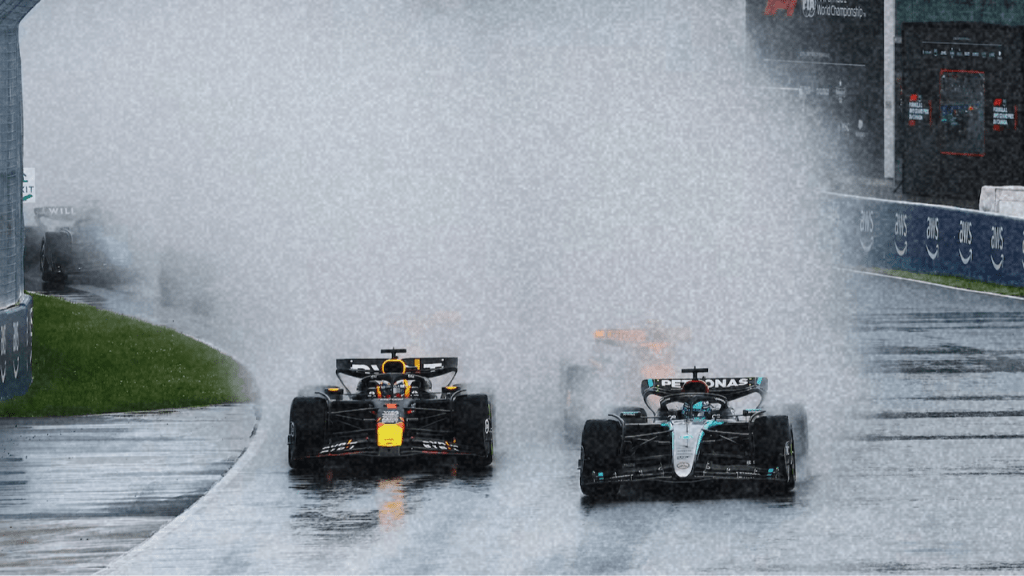
Fans have noticed the pattern for years. Forecasts shift, heavy rain threatens qualifying, and race day clears. Singapore became the most cited example, with online speculation about weather manipulation circulating for over a decade. The straightforward explanation is meteorological: RaceFans and working meteorologists have pointed out that the city’s tropical convection storms often dissipate by evening, which makes a dry night race more likely than not. That is a genuinely plausible account, and it is probably the correct one.
The deeper issue is that the audience no longer reaches for the plausible account first. Modern spectacle capitalism has spent decades manufacturing narratives, manipulating perception, and greenwashing power so aggressively that ordinary weather now reads as suspect. The suspicion does not come from evidence. It comes from institutional distrust, and that distrust was earned by the institutions, not invented by the fans. A public that has been lied to about emissions, working conditions, and the basic character of its entertainment is a public that stops extending good faith.
Crashes are the home runs of Formula 1
Formula 1 also runs on an economy of controlled danger. Crashes are simultaneously horrifying and central to the sport’s commercial gravity, functioning the way home runs do in baseball or knockouts in combat sports — moments of pure spectacle that spike engagement, viewership, and emotional investment. The sport lives in the tension between technological precision and catastrophic failure, and that tension is most of its emotional power.
The contradiction sharpens once sustainability branding enters the frame. Formula 1 markets itself as environmentally progressive while remaining structurally dependent on fossil capital, global air freight, luxury consumption, and oil-state sponsorship. The spectacle claims to transcend oil while being financed by it. The green messaging is not a lie the sport tells reluctantly. It is the product the oil money is buying.
Formula E collapsed and the V8 came back
The contradiction becomes clearest through Formula E and the growing push to return naturally aspirated V8 engines to Formula 1. Formula E was sold as the future of sustainable motorsport, and cities invested heavily in electric-racing spectacle as climate-transition branding. Many of those projects quietly collapsed, including Montreal’s heavily criticized Formula E venture, which became a byword for political mismanagement, financial waste, and public backlash.
At the same time, Formula 1 drifted back toward nostalgia for louder engines, synthetic fuels, and an emotion-driven racing identity. The market signal is not subtle. The future was never about abandoning fossil capital. It was about rebranding it, and when the electric rebrand failed to sell, the sport reached back for the engine note that does. The sustainability era and the V8 revival are the same strategy wearing different costumes.
Wrong on the facts, right on the structure
This is why the cloud-seeding discourse is worth taking seriously even as you reject its literal claim. The strong version is not that race officials push buttons to clear storms over qualifying. The strong version is that Formula 1 exists inside a petro-state spectacle system so intensely managed that audiences instinctively assume environmental management is happening somewhere behind the curtain. Given the structure of the capital involved, that instinct is not irrational, even though the specific accusation is unproven.
Cloud seeding is real. Sportswashing is real. Greenwashing is real. Fossil capital shaping public perception is real. The engineered nature of the spectacle is real. What remains unproven, and what this piece does not assert, is the narrow operational claim connecting those systems to specific race-weather outcomes. The suspicion is wrong precisely where it tries to be a fact and right everywhere it functions as a read on the system.
That is the part worth holding onto. People no longer experience global spectacle as organic. They experience it as managed, and most of the time they are correct. The cloud-seeding theory is what that correct instinct looks like when it has been handed no better tools than a weather forecast and a justified refusal to believe what it is told. Fix the second problem — the institutional lying that produced the distrust — and the folk theories take care of themselves.
Iran shows the same logic at gunpoint
The clearest case is not a race weekend. It is a country under bombardment. Iran has spent five-plus years in the worst drought in its modern history, with Tehran’s reservoirs falling to a fraction of capacity and the president openly discussing the evacuation of the capital. Iran has run its own cloud-seeding program since 2008 and stayed dry anyway. Then the war began in February 2026, and the rains came — enough that flooding has now replaced drought as the country’s most visible environmental emergency.
The conclusion drawn across Iranian and Iraqi media was immediate and direct: the enemy had been stealing the rain, and the war forced them to stop. The claim is not new. Iranian officials have made it since at least 2011, when the president accused Western states of using “special equipment” to strip the clouds before they reached Iranian soil.
The 2026 version updated the mechanism to grounded seeding aircraft and closed air corridors, and an Iraqi member of parliament took it to television as “atmospheric modifier weapons.” The accusation has a constituency because the constituency is living inside the right story with the wrong device.
Here is what is true without qualification. The Gulf monarchies bankrolling Formula 1 run the largest weather-modification operations on earth and brand them as water security. The UAE has flown roughly a thousand cloud-seeding hours a year since 1990. Saudi Arabia launched a $256 million regional program in 2022. China spends in the billions. The same imperial bloc bombing Iran openly manufactures rain over its own territory and sells the technology to its allies as climate adaptation.
A population watching that bloc engineer the sky for profit, and then watching its own drought break the moment the bombs fall, is not being paranoid when it reaches for weather warfare. It is reading the balance of power correctly and naming the weapon wrong.
The weapon is named wrong because the device does not exist. Cloud seeding makes rain-ready clouds slightly more efficient; it cannot generate, suppress, or steal a regional weather system, and the meteorologists who run these programs say so plainly. The wet winter of 2026 was forecast in the previous September, months before the first missile, by people with no stake in the war. The drought eased because the weather turned, on the schedule the models already showed. The mechanism is folklore. The structure it points at is not.
This is the same machine that runs Formula 1, stripped of the entertainment and pointed at a civilian population. Petro-capital engineers the spectacle, brands the engineering as stewardship, and bombs the country that sits on the oil it has not yet captured. The people on the receiving end understand exactly what is being done to them and reach for the only vocabulary spectacle capitalism has left them, which is the vocabulary of secret machines.
They are wrong about the machine and right about the hand on it. That is not a failure of their reasoning. It is the predictable result of a world in which the powerful really do engineer the weather, really do launder it as virtue, and really are at war.
Sources
- Human Rights Watch — Formula One: Put Human Rights in the Driver’s Seat, March 13, 2026
- The Guardian — Fossil fuel companies sponsor billions in global sportswashing deals, September 18, 2024
- Formula 1 — Formula 1 announces long-term global partnership with Aramco
- Saudipedia — Cloud Seeding Program in the Kingdom (Saudi National Center for Meteorology)
- CBC News — How cloud seeding works, and where Gulf states deploy it (explainer)
- Channel News Asia — NEA scotches rumour that cloud seeding was used around F1 weekend
- RaceFans — Singapore Grand Prix weather analysis (meteorological explanation)
- CBC News — Montreal Formula E race cancelled amid financial questions
- Jerusalem Post — Scientists dismantle viral Iran-Turkey “stolen rain” theory (2026 war, forecast predates conflict)
- Carbon Brief — How climate change and war threaten Iran’s water supplies (drought eased, root causes)
- NBC News / LiveScience — Could Iran’s enemies really be destroying its rain clouds? (2012 Ahmadinejad claim, expert rebuttal)
- CNBC — Cloud seeding: why more countries are turning to weather modification (Gulf/China program spending)
- Gulf News — UAE performs around 1,000 hours of cloud seeding a year (program scale and spending)