Palestinians are not settlers. Naming a stateless people as colonizers, on the 78th Nakba anniversary, inverts anti-colonial politics into projection.
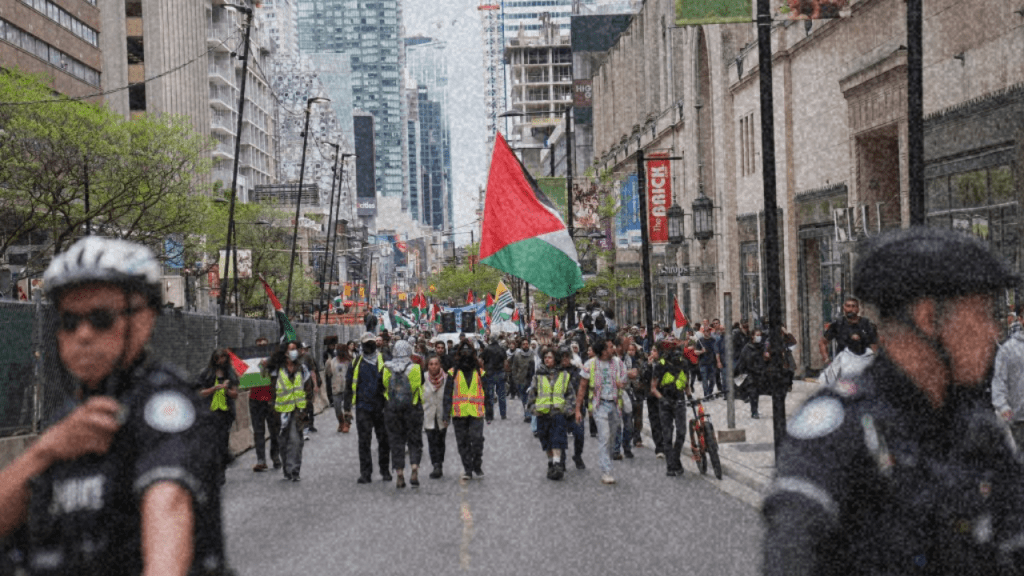
This past weekend, the 78th anniversary of the Nakba, tens of thousands of people marched in cities across the imperial core. The Toronto rally drew thousands to Sankofa Square on Saturday afternoon. The New York march filled Washington Square Park on Saturday evening before moving north through Manhattan. London, Sydney, Paris, Chicago, Montreal, and Washington all had crowds of similar size. Organizers around the world recorded 736 events across 39 countries marking the date.
In the middle of those marches, a short video circulated. A Palestinian man, on a sidewalk somewhere in North America, is being berated by a Zionist agitator. The agitator demands he justify his presence — at the protest, in the country, on the continent. The Palestinian man pushes back, frustrated, and says the words anyone with any sense of where his life sits in history would say. This is my country.
What followed online was the inversion the rest of this piece is about. Sections of left and identitarian discourse, including accounts that operate inside Indigenous-solidarity vocabulary, began processing the Palestinian man’s response as itself colonial. He was claiming a country. He was speaking in the language of belonging. He was, the argument went, expressing settler logic — because Palestinian refugees and immigrants living inside the Canadian state are functionally settlers on Indigenous land regardless of how they arrived.
The Nakba commemorations this year fell two weeks after the Gaza Health Ministry confirmed 72,763 Palestinians killed since October 2023 — 871 of them killed since the October 11, 2025 ceasefire that has not held.
Independent population surveys published in the Lancet have put the true violent-death figure 35 percent higher. The population of Gaza has declined by roughly 254,000 people in two and a half years through killings, displacement, and conditions designed to make survival impossible. This is the moment in which sections of imperial-core discourse have decided that the people enduring this — and the people displaced before this, and the people whose grandparents were expelled in 1948 — are themselves practising settler colonialism by saying the words my country.
What settler colonialism actually means
Settler colonialism is a structure, not an identity. It refers to a specific historical and material process in which an incoming population establishes political dominance over territory through the displacement, elimination, replacement, and long-term demographic consolidation of an Indigenous population, backed by sovereign state power. It is inseparable from the institutions that carry it out — armies, courts, land registries, police forces, treaty negotiations conducted in bad faith.
Patrick Wolfe’s foundational definition is the standard reference point: settler colonialism is a structure, not an event, and the logic of elimination is the structure’s organizing principle. Glen Coulthard, Audra Simpson, Lorenzo Veracini, and the rest of the serious settler-colonial-studies literature has spent two decades elaborating what that structural definition entails. None of it produces an analytical category in which a refugee or a stateless person becomes the settler by virtue of being present inside a settler state.
The reason is straightforward. The settler position requires sovereign state power over the land in question, or at minimum participation in the institutions of that sovereign power as a coloniser rather than as a colonised or displaced subject. A migrant worker labouring under conditions of precarity, an undocumented person, a refugee on a temporary permit, a stateless asylum seeker — these are people moving inside the territory of a settler state under conditions not of their own making.
The displacement is often a direct consequence of the imperial system that produced both the settler state and the refugee’s exile from somewhere else. They are not the settler in any meaningful structural sense.
Once “settler” becomes a moral identity rather than a structural location, anti-colonial analysis collapses. The CEO of a Canadian resource extraction firm, a migrant farmworker, an undocumented refugee, and a displaced Palestinian family all get flattened into the same category. The category becomes useless for analysing power because it can be applied to everyone in motion and to no one in particular. Liberalism has done this manoeuvre before, on a thousand other questions — it personalises a structural problem until the structural problem disappears under the moral one.
The Nakba is not a metaphor
The Palestinian Central Bureau of Statistics records that Israeli forces seized 774 Palestinian villages and cities in 1948, completely destroyed 531 of them, and committed more than 70 documented massacres that killed over 15,000 Palestinians. Approximately 750,000 people were expelled or fled — about half the entire Palestinian Arab population of Mandate Palestine at the time. Entire communities were erased from the map. Families were scattered into refugee camps in Lebanon, Jordan, Syria, the West Bank, and the Gaza Strip, where many of their descendants remain in 2026.
UN General Assembly Resolution 194, passed in December 1948, stipulated the right of Palestinian refugees to return to their homes and to receive compensation for those who did not wish to return or who suffered losses. Israel has refused to implement Resolution 194 for seventy-eight years. The right of return remains, alongside Resolution 194, a foundational element of international law on the Palestinian question. It has been blocked by the imperial-core’s diplomatic protection of Israel for the entire post-war period.
The Palestinian Central Bureau of Statistics reports that there are now 15.49 million Palestinians worldwide, more than half of whom live outside historic Palestine. The population of the State of Palestine — under Israeli military rule across all its component territories — is 5.56 million, including 3.43 million in the West Bank and 2.13 million in Gaza.
Millions more live in refugee camps across the region under restricted citizenship rights, in some cases as registered stateless persons for three generations. These are the conditions imposed on Palestinians as a population by the operation of settler-colonial power, not the conditions out of which Palestinians are themselves operating settler-colonial power.
In Gaza, the conditions have intensified to the point of UN-recognised genocide. The UN Commission of Inquiry on the Occupied Palestinian Territory concluded in September 2025 that four of the five acts defined by the Genocide Convention have been committed since October 2023. Phase 5 famine — the most severe food security emergency on the Integrated Food Security Phase Classification scale — was declared in Gaza City in August 2025. Israeli authorities have, since March 2025, blocked UNRWA from bringing humanitarian personnel and aid into Gaza directly. UNRWA has recorded 391 of its own colleagues killed.
In the West Bank, military operations have escalated since the October 2025 ceasefire was declared, with 1,071 Palestinians killed in the territory between October 2023 and March 2026 according to OHCHR figures. Settler attacks on Palestinian villages have continued without effective response from Israeli police or military, in many cases with active military escort. Ultranationalist Jerusalem Day marches through Palestinian neighbourhoods in May 2026 were attended under Israeli police protection while Palestinian residents barricaded themselves indoors.
This is the structural situation. A Palestinian person — anywhere in the world, in a refugee camp or a diaspora suburb or a tent in a Gaza humanitarian zone — is positioned inside this structure. They are not its agent. They are its target.
Projection as imperial-core discourse
Canada and the United States are consolidated settler-colonial states with active and ongoing dispossession projects against the Indigenous nations whose territories they occupy. The settler-colonial structure is not historical. It is operative.
Land theft continues through resource extraction. Pipeline projects continue across unceded territory. Indigenous communities in both countries continue to lack clean drinking water, adequate health care, and basic infrastructure. The Missing and Murdered Indigenous Women crisis is unaddressed. Police forces continue to kill Indigenous people at rates far above their share of the population.
None of those facts disappear from this analysis.
The opposite — they are a core part of this analysis.
The settler-colonial structure of the Canadian and American states is real, immediate, and morally implicating for any non-Indigenous person living inside those states. That is not the question. The question is what happens when imperial-core actors take that structural fact and redirect it outward onto Palestinians.
What happens, in observable practice over the past two years, is projection. The settler-colonial guilt produced by inhabiting Canada or the United States — guilt that has structural causes and structural remedies — gets displaced onto whichever racialised population is most legible as foreign to the imperial-core audience at any given moment.
After October 2023, that population has often been Palestinians and Arabs more broadly. The discursive move is to relocate the colonial role from the people doing the colonising onto the people they are colonising, and then to perform anti-colonial purity by accusing the colonised of being insufficiently anti-colonial.
This is not anti-colonial analysis. It is a way of using anti-colonial vocabulary to avoid the structural demands of anti-colonial politics inside one’s own state.
Any person living in Toronto or Brooklyn who spends their political energy interrogating whether Palestinian refugees in Mississauga or Bay Ridge are “settlers on Indigenous land” is producing a political account in which the settler relation to land is something Palestinians need to answer for — and not, primarily, something the speaker themselves needs to answer for. The accounting is being directed in the wrong direction.
The people doing the accusing are the ones whose tax dollars fund Israeli weapons. The people doing the accusing live inside the state that continues unceded-territory extraction at scale, with consolidated infrastructure, mobility rights, citizenship protections, and institutional access — even where their personal material conditions inside that state are difficult, even where they are themselves marginalized inside it. The Palestinian refugee is not in a position to do anything about either set of structural facts.
The orthodox formulation of settler responsibility, developed across decades of Indigenous-led scholarship in Canada and the United States, runs in the other direction.
Settlers — meaning the population of non-Indigenous people who carry the privileges of citizenship and state belonging inside a settler state — are responsible for organising against the settler state on the side of Indigenous nations.
That responsibility falls heaviest on those with the most institutional power inside the state.
The analytical move the imperial-core inversion misses is what happens at the lower end of that institutional-power gradient.
Indigenous people displaced into cities under conditions of urban poverty, racialized working-class people, undocumented migrants, refugees and asylum seekers from elsewhere — none of these populations occupy the settler position in the sense the structural literature names.
They are themselves targets of imperial-core state power, in different specific configurations.
What needs to be held alongside this statement, is the fact that basic infrastructural and political conditions inside a consolidated imperial-core state are not evenly distributed.
Dozens of First Nations communities in Canada have lived under long-term boil-water advisories for decades. Reserve housing collapses under federal underfunding. On-reserve health care, education, and child welfare systems are funded at fractions of comparable off-reserve provincial systems.
The state’s refusal to repair those conditions is not an accident of the imperial-core position. It is the imperial-core position, applied internally, on the territory the federation refuses to recognize as anything other than its own.
That difference matters, and it does not collapse the structural point.
A Palestinian in a Gaza tent camp surviving on intermittent humanitarian aid, denied medical evacuation, watching the population count drop by a quarter of a million people in two and a half years, is not in the same structural position as a precarious migrant worker in Toronto whose wages are stolen and whose immigration status is unstable — and neither of them is in the same structural position as a First Nations community living under a twenty-year boil-water advisory inside what the federation calls its own borders.
All three are subject to imperial-core power.
None of them is a settler in the structural sense. The conditions are not interchangeable. Active military siege, designed and executed by a foreign state with the explicit goal of making a population non-viable, is doing something different than chronic federal-state neglect of an internally-colonized nation, even where both produce intolerable conditions and both are forms of colonial violence that the same imperial-core publics are responsible for confronting.
The clearest way to see why the “Palestinian as settler” claim collapses is to put the two analogous cases beside each other.
An Indigenous person forced off their land and into urban centers, whether by institutionalized poverty, child apprehension, environmental destruction, or the slow elimination of conditions for survival on their own territory is obviously not a settler.
They are a person displaced by colonial dispossession into the urban centre of the colonial state that produced their displacement.
A Palestinian refugee forced out of their land by Israeli military operations, or by the conditions of siege and into a Canadian or American city is also not a settler.
They are a person displaced by colonial dispossession into the urban centre of an imperial-core state whose government funds and protects the system that produced their displacement.
The two positions are structurally parallel. Neither is the settler in the situation. Both are the displaced.
The difference between them, when there is one, runs the opposite direction from what the imperial-core inversion claims.
The Indigenous person displaced into Toronto or Minneapolis is a citizen of the state they have been displaced inside.
However violated their treaty rights are in practice, those treaty rights exist in Canadian constitutional law. They can vote in the federal elections that produced the policies that displaced them.
They possess a passport that grants them access across borders. They hold institutional recognition, however it may be contested, which allows them to bring legal claims against the state within its own courts.
Moreover, this recognition has been leveraged by First Nations’ to secure significant legal victories within the framework of the Canadian colonial state.
A Palestinian refugee in the same city has none of that anywhere.
No state. No passport issued by an entity not recognized as a state by the country they are living in.
No vote in the elections of the imperial-core state whose government funds their displacement. No vote in any state that holds standing to do anything about it.
Their political leadership is designated terrorist by the very governments whose tax revenues finance the siege.
The Indigenous person in that comparison has been failed by a state that recognizes them as one of its own and refuses to honour the terms of that recognition.
The Palestinian has been refused recognition by every state that could intervene on their behalf.
Both have been wronged. Both are owed solidarity. Neither is a settler.
And of the two, the one with measurably less formal political standing inside the imperial-core state is the Palestinian refugee — which is the exact figure imperial-core discourse has decided to redirect its settler-accusation toward.
A Palestinian refugee, by virtue of being a refugee, has effectively no institutional power inside the Canadian or American state.
To assign them the settler responsibility while letting any imperial-core speaker — comfortable progressive, marginalized worker, or anyone in between — hold the moral high ground over their attachment to land is the inversion that makes none of this make sense.
The structural responsibility for confronting settler-colonial power in Canada and the United States lies with the population of those states.
The structural responsibility for confronting the genocide in Gaza lies, primarily, with the imperial-core publics whose governments fund and protect it. Neither responsibility transfers to the Palestinian refugee at the receiving end of both systems.
Blood-and-soil logic in progressive vocabulary
Another stark contradiction emerges when displaced Palestinians are redefined as settlers by individuals residing in the imperial core: this reclassification perpetuates a rhetoric of blood-and-soil belonging, veiled in the language of leftist discourse.
Blood-and-soil politics treats belonging to land as a fixed and inheritable property — certain populations are essentially of the land, others are essentially foreign to it, and the categories do not change regardless of historical movement or material circumstance.
Settler-colonial states used this logic constantly. Indigenous populations were framed as obstacles to progress and Indigenous land claims as superstitions to be cleared away by the rational application of property law.
European nationalism produced a parallel version. Diasporic, displaced, and refugee populations were framed as permanently foreign, regardless of how many generations they had lived in a given place.
The Jewish populations of central and eastern Europe were the most prominent target of that logic, but the framework was applied repeatedly to Roma, Armenians, and other displaced peoples throughout the late nineteenth and twentieth centuries.
The logic always involves the same operation. A population is treated as outside the legitimate national body, suspect by definition, and structurally inferior in its claim to belong.
When Palestinians are reclassified as settlers in Canada or the United States, the same operation is being performed under progressive cover.
The implicit claim is that Palestinians belong properly nowhere — they cannot be at home in Palestine because they are dispossessed there, they cannot be at home in diaspora because diaspora makes them settlers, and they cannot claim attachment to land anywhere because attachment to land is reserved for the population with the proper ancestral relationship to it.
The framework treats Palestinian displacement itself as evidence of Palestinian illegitimacy, which is the exact discursive move Israeli state ideology has been making for seventy-eight years.
The irony of this happening in the name of Indigenous solidarity is that Indigenous nations themselves, across Turtle Island and elsewhere, have repeatedly extended solidarity to Palestinians on the basis of shared experience of colonial dispossession.
The Six Nations of the Grand River, the Mohawk Council of Akwesasne, the Wet’suwet’en hereditary chiefs, the Mi’kmaq Grand Council, the Standing Rock Sioux Tribe, and many other nations have issued formal statements over the past two years connecting their own struggles to Palestinian liberation.
The structural analysis that grounds those statements is precisely the one the imperial-core inversion abandons.
Material analysis or symbolic performance
The deeper problem under all of this is the substitution of symbolic identity sorting for material analysis.
Large sections of imperial-core liberal-left discourse over the past decade have converged on an account of politics in which political understanding emerges automatically from identity position.
Identity position becomes the analytical primitive.
Structural and material analysis becomes secondary, accessory, optional.
The framework does not work when applied to actual political questions.
Identity is not analysis.
Two people from the same identity position can hold opposite positions on a given political question. Material conditions, institutional power, class location, historical formation, and structural relations to capital and the state matter more for predicting political behaviour than any identity category alone.
This is not a controversial point in serious left scholarship. It is the foundational claim of the entire materialist tradition.
Online activist culture has tended to flatten this. The treatment of identity as automatic political authority has produced a politics in which the analytical work — the historical study, the structural diagnosis, the careful tracking of how power actually moves through institutions — gets replaced by competition over moral positioning.
Political discourse becomes a contest over who can perform the most legible and righteous anti-colonial identity, rather than an attempt to actually map and confront the colonial structures that exist.
The Palestinian-as-settler claim is what that substitution produces at its limit. The claim is not, in its content, anti-colonial. It is the inverse of anti-colonial analysis.
But it performs as anti-colonial because it uses the right vocabulary and it positions the speaker as morally serious about Indigenous land.
The performance is the point.
Whether the analysis tracks against the material situation of Palestinians under siege, in refugee camps, or under occupation is treated as a secondary question that the truly committed anti-colonialist will not lower themselves to engage with.
Real solidarity requires the work
None of the above is an argument that Indigenous struggles inside Canada or the United States should be minimised or instrumentalised in service of Palestinian solidarity.
The opposite.
Indigenous struggles are foundational to any coherent anti-imperialist politics on this continent, for the reason this paper has named in every previous piece on Canadian constitutional politics — the federation is a colonial-imperial formation that exists at the contested consent of the nations it was built to extinguish, and the work of unmaking that formation is what an anti-imperialist politics here actually consists of.
That work does not require flattening Palestinian dispossession into a category interchangeable with all other dispossession.
Solidarity does not require analytical sameness. It requires the opposite — careful attention to the specificity of each struggle, the precise structural conditions under which it occurs, and the points at which strategic alignment between movements is possible and useful.
The Mohawk and Cree and Wet’suwet’en and Mi’kmaq leadership who have stood with Palestinians have done it precisely on the basis of analytical specificity, not its abandonment.
The Palestinian man on that sidewalk this past weekend said this is my country as a stateless person under siege, whose grandparents were expelled from villages now buried under Israeli highways, whose passport — if he has one — is issued by a state operating under conditions no other state in the world is asked to negotiate, whose ability to move between regions of his homeland is controlled by checkpoints designed to make daily life impossible.
He was not invoking the language of settler entitlement.
He was invoking the language of survival.
Anti-colonial politics that cannot hear that distinction is anti-colonial politics that has stopped doing the work.
The work is material. It involves studying history, tracking institutional power, naming the specific structures of domination at issue in any given case, and confronting those structures directly.
It involves recognising that the people inside the imperial-core states bear the structural responsibility for the imperial system their states administer, and that this responsibility does not get discharged by accusing more dispossessed people of being the colonial actor.
Seventy-eight years after the Nakba, the basic test of anti-colonial seriousness is whether one’s politics can hold the actual structural situation in view.
Palestinians are not settlers.
The people calling them settlers, from the inside of Canada and the United States, are performing a position they have not earned and could not justify under any rigorous account of how settler colonialism actually works.
The Palestinian man on that sidewalk does not owe them an answer.
The structural situation answers for him.
Solidarity.
Sources
- WAFA — Despite ceasefire, Gaza death toll continues to rise, reaching 72,763 since October 2023, May 17, 2026
- WAFA — Thousands rally across US cities to mark 78th anniversary of the Palestinian Nakba, May 17, 2026
- Middle East Monitor — Palestinians mark 78th Nakba anniversary amid war, ongoing displacement, May 15, 2026
- Euronews — Palestinians gather to mark 78th anniversary of the Nakba and call for ‘right of return’, May 12, 2026
- UN Palestinian Rights Committee — Commemoration of the 78th anniversary of the Nakba, May 15, 2026
- The Lancet Global Health — Violent and non-violent death tolls for the Gaza conflict, February 2026
- Al Jazeera — Gaza death toll exceeds 75,000 as independent data verify loss, February 18, 2026
- UNRWA — Situation Report #214 on the Humanitarian Crisis in the Gaza Strip and the Occupied West Bank, March 2026
- Middle East Eye — Genocide in Gaza: How many Palestinians did Israel kill, March 2026
- Wikipedia — Casualties of the Gaza war (UN Commission of Inquiry findings, OHCHR data, MoH figures)
- Wikipedia — Nakba Day historical background
- Find a Protest — Nakba Day Protest Toronto, Sankofa Square, May 16, 2026