
US-Iran ceasefire Islamabad Accord: the Strait stayed closed, Lebanon kept burning, and Washington needed Pakistan to exit a war it could not end.
On April 8, 2026, hours after announcing a two-week ceasefire with Iran, Donald Trump posted on Truth Social that the United States had already met and exceeded its military objectives and that the agreement represented a total and complete victory. The same day, ship-tracking data compiled by Bloomberg showed three commercial vessels leaving the Persian Gulf. The daily average in peacetime is approximately 135. More than 800 freighters remained stranded inside the Gulf, waiting for a reopening that had been announced but had not occurred. The announcement was one thing. The water was another.
How the Ceasefire Was Actually Brokered
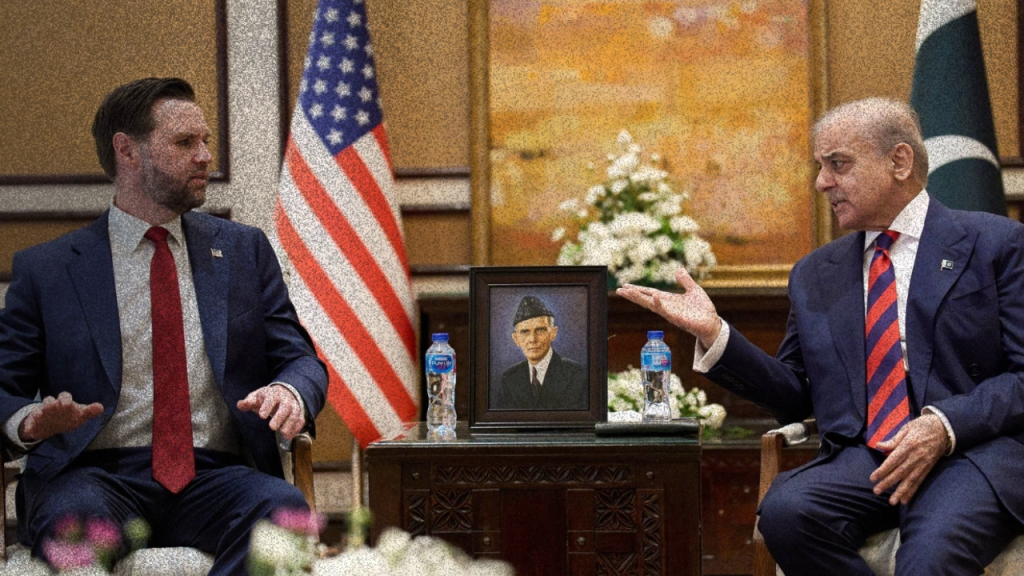
Pakistani Prime Minister Shehbaz Sharif, whose government had spent two weeks shuttling between Tehran and Washington, was the one who made the ceasefire possible. Sharif’s statement, welcomed by both sides, invited the delegations to Islamabad for further talks and said the agreement applied everywhere including Lebanon. Iran’s Foreign Minister Abbas Araghchi confirmed the terms on X. Trump accepted Iran’s 10-point proposal as a workable basis to negotiate. The war had not been ended by American defeat of Iran. It had been paused by a framework mediated by a non-Western government with channels to both capitals.
What Araghchi Agreed To, in the Text
The language of Iran’s acceptance repays careful reading. Araghchi said passage through the Strait would be possible via coordination with Iran’s Armed Forces and with due consideration of technical limitations. The first clause meant the Islamic Revolutionary Guard Corps — Iran’s parallel military, which controls the strait operationally — would decide which ships moved and when. The second clause referred to sea mines. Iran had deployed mines through the Strait using small boats over the preceding weeks, without systematic records of where each one was placed. Some had drifted on the current.
Mine removal is far more difficult than mine deployment. The ceasefire condition of a fully reopened Strait was already complicated by explosive ordnance in the water, some of it untracked, some of it in motion. CNN reported the same day that a drone had struck Saudi Arabia’s East-West Pipeline — the Abqaiq-to-Yanbu conduit, one of only two land routes that bypass Hormuz. Within a single news cycle, Trump had declared the Strait open, the IRGC retained veto power over who crossed, and the only meaningful alternative route had been damaged.
How Lebanon Stopped Being in the Ceasefire
The Lebanon clause fell apart within hours. Sharif’s statement explicitly included Lebanon. Araghchi confirmed it. Then, per CNN’s reporting that afternoon, Benjamin Netanyahu’s office announced that the two-week ceasefire did not include Lebanon. JD Vance called the discrepancy a legitimate misunderstanding. An Israeli airstrike on a seaside cafe in Sidon killed eight people that morning. The IDF ordered the evacuation of Tyre. Lebanon’s health ministry had already counted 1,530 people killed since March 2. The scope was not agreed between signatories and later clarified. It was announced with Lebanon included, then narrowed by Netanyahu with one phone call.
The IRGC Statement That Refused the Frame
Within twenty-four hours of Trump’s victory announcement, media outlets began reporting drone and missile strikes on Gulf state facilities. According to Islam Times, an IRGC statement issued on April 9 denied responsibility and said that if such attacks had occurred during ceasefire hours they were the work of the Zionist regime or the United States. The statement added that when the IRGC does strike, it announces it openly. Any action not in an official Iranian statement, the Guards said, does not belong to Iran.
Iran has lived inside a particular pattern since February 28: Iran is struck, Iran responds, and the response — rather than the original attack — is named by US media as the escalation. This is the inversion Spark Solidarity documented in late March. What the April 9 IRGC statement did was move ahead of the pattern. By preemptively attributing any Gulf incident during the ceasefire window to Israel or the United States, the IRGC was refusing the frame before the frame could be applied. This is what a military force that has already lost the narrative war sounds like when it decides to stop playing the game.
What the April 18 Closure Clarified
On April 18, Iran closed the Strait of Hormuz again. The Revolutionary Guards said the reason was the continued US naval blockade of Iranian ports — a blockade Trump had imposed after the Islamabad talks collapsed six days earlier. The ceasefire had lasted eleven days in name and hours in practice. The Strait never fully reopened, Lebanon was never included, and the IRGC had been proven right about the use of ceasefire hours. Sharif’s April 8 framework was the moment Washington needed a non-Western government to describe an unendable war as a war it had won.
Sources
- Bloomberg — Hormuz Stays Blocked for Now as Hundreds of Ships Seek Escape, April 8, 2026
- CNN — Live updates: Both US and Iran claim victory after two-week ceasefire deal reached, April 8, 2026
- Al Jazeera — Iran: Strait of Hormuz open with restrictions, April 9, 2026
- Islam Times — IRGC Denies Any Attacks During Ceasefire Period, April 9, 2026
- Spark Solidarity — Iran War Narrative Inverts Who Struck First, March 2026






 Spark Solidarity