Iran war synchronized addresses show how allied states manufacture consent — translating imperial disruption into domestic economic necessity.
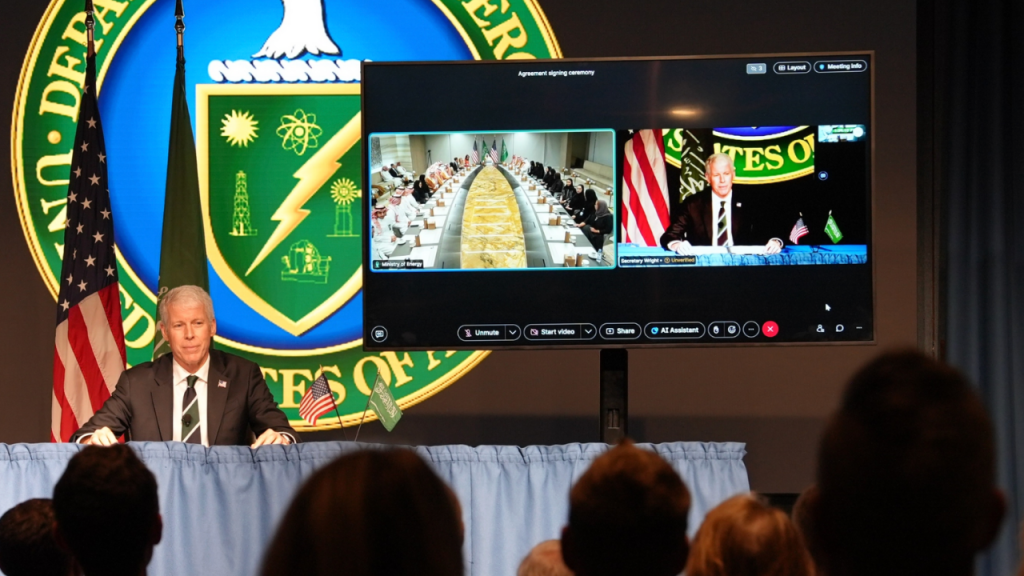
On April 1, 2026, the President of the United States, the Prime Minister of the United Kingdom, and the Prime Minister of Australia delivered coordinated national addresses within hours of each other. Each spoke about Iran, war, oil, and crisis. Each performed the same function: translating geopolitical instability into domestic economic expectations and positioning the state as manager of unavoidable consequences. Hours before the U.S. presidential address, Iran’s president released an open letter addressed directly to the American people, bypassing diplomatic channels entirely. The timing was exact, the audience deliberate, the message clear: legitimacy is now a battlefield resource, fought over with the same intensity as oil routes.
The material foundation is simple. The war itself began with a narrative inversion — and the April 1 speeches are a continuation of that same project. The Strait of Hormuz disruption created an immediate economic chain reaction: tanker rerouting, insurance cost spikes, supply tightening, and price surges that moved from financial markets into gasoline, heating, food transport, and manufacturing. What looks like distant war becomes local price increase. That is why every leader focused not just on Iran but on cost of living, not just on strategy but on bills, not just on conflict but on disruption. Once the chain starts — conflict in the Gulf leads to Hormuz disruption leads to oil shock leads to inflation leads to political pressure — governments cannot control global flows directly. What they control is how consequences are explained, managed, and justified. That is what the speeches were for. That is what the infrastructure of manufactured consensus exists to deliver.
Different Tones Performed Identical Functions
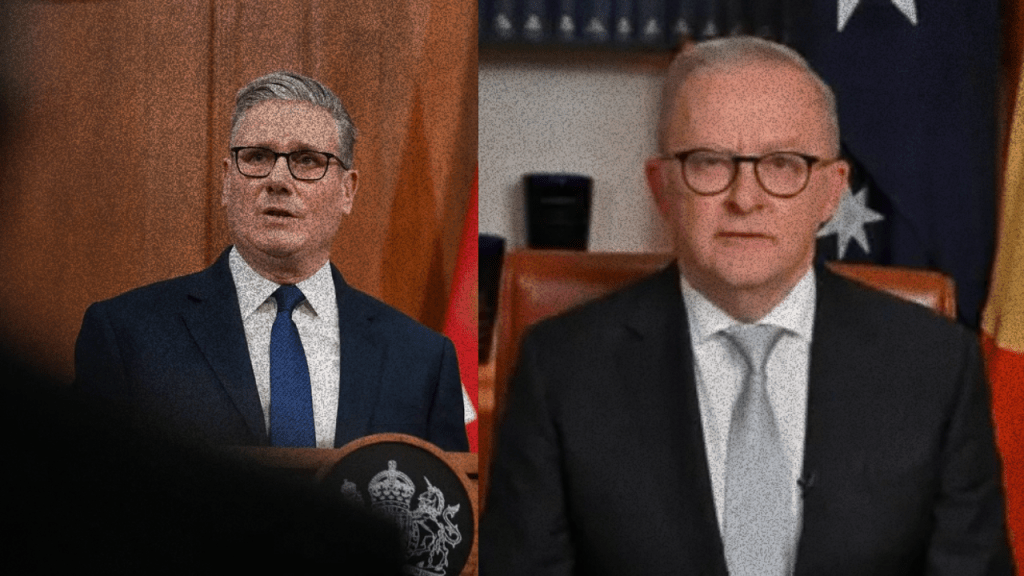
The U.S. presidential message centered on closure and limited objectives — the war had goals, those goals were being achieved, the United States could begin stepping back. That framing addresses domestic reality: the war is unpopular, rising fuel costs amplify opposition, the speech aimed to reassure a public that does not want another prolonged entanglement. Starmer’s UK message separated military involvement from economic exposure — “this is not our war,” but Britain will feel its effects — allowing the government to avoid direct military commitment while still justifying domestic economic intervention through energy subsidies and cost-of-living support. Albanese’s Australian message emphasized managed scarcity and public cooperation: use less fuel, avoid hoarding, switch to public transport, trust the system.
Three leaders, different tones, same structure: all translating geopolitical instability into domestic expectations, framing economic pain as unavoidable, positioning the state as both manager and stabilizer. This is not spontaneous communication. The alignment was structural before it was rhetorical. These countries share intelligence networks, rely on the same energy markets, and face similar political pressures when those markets are disrupted. Parallel messaging is not surprising because the underlying conditions are shared. The result is a unified tone shaping perception regardless of whether a single room coordinated every word.
Iran’s Open Letter Disrupted the Narrative Timeline
Into that environment, Iran deployed a different strategy. Iranian President Masoud Pezeshkian published an open letter to the American people hours before Trump’s prime-time address, asking them to “look beyond the machinery of misinformation” and question whether the war served their interests. The letter does not attempt to negotiate policy. It attempts to reshape perception by separating three things usually fused together: the American people, the American government, and the strategic interests driving the conflict.
Pezeshkian asked directly whether America had entered the war “as a proxy for Israel”, and whether Israel “now aims to fight Iran to the last American soldier and the last American taxpayer dollar.” The most important detail is not what was said but when. A national address in prime time functions as narrative anchor, defining how an event is understood moving forward. Whoever speaks first has advantage. Iran’s move sat between positions — introducing doubt before certainty was asserted, offering alternative interpretation before the dominant one was broadcast, forcing audiences to process two competing explanations at once. It does not need to convince a majority. It only needs to fracture consensus at the moment when consensus is about to be reinforced.
Two Narratives Competed for the Same Terrain
At the center of this moment is a shared audience — not governments, not military planners, not diplomats, but ordinary people. The Western framing presents the situation as necessary crisis: Trump insisted objectives were “nearing completion”, Starmer said Britain was “well-placed to weather the storm”, Albanese acknowledged the “economic shocks caused by this war will be with us for months” while urging calm. This emphasizes stability, responsibility, and inevitability. The Iranian framing presents the situation as constructed conflict: the war is not inevitable, the threat is manufactured, the economic consequences are the result of political decisions not natural forces, and the public is being asked to bear costs for interests that are not their own.
Both narratives operate on the same terrain, addressing the same questions: Why is this happening? Who is responsible? What should be accepted? What should be questioned? They differ not in topic but in interpretation. And that competition is material, not abstract. If the Western framing holds, the path forward is controlled de-escalation and managed economic pain. If the Iranian framing gains traction, public skepticism increases, political pressure intensifies, and the legitimacy of continued action erodes. One month in, U.S. public disapproval remains high while lawmakers have taken no action — the battle is already being lost on that terrain.
Public Persuasion Is Now Constitutive of Military Capacity
This dual-plane warfare — military operations in the Gulf, informational operations in domestic media — exposes the material truth that modern conflict requires continuous public persuasion. The information war is not supplementary. It is constitutive of military capacity itself. Starmer declared “this is not our war” while 23 long-range U.S. bombers were simultaneously using RAF Fairford as a launching pad for bombing missions over Iran. The gap between the statement and the material reality is not accidental. It is the operational mechanism through which states secure domestic consent while participating in conflicts they cannot formally acknowledge.
That is why Iran’s counter-letter was not symbolic gesture but strategic intervention. It exploited the dependency that Western governments have on continuous consent. By addressing the American public directly, Pezeshkian attempted to separate public interest from state interest at the exact moment when the state was trying to fuse them together. The military dimension continues in the background, but the visible struggle is informational: who defines the war, who assigns responsibility, who determines whether the costs are acceptable. Those questions are not secondary. They shape what comes next in exactly the same way that weaponized narrative shapes which voices get amplified and which get buried.
Narrative Dominance Is Now a Prerequisite for War
Nothing that happened on April 1 resolved the conflict. But it clarified something more important. The war is no longer just being fought with strikes, ships, and sanctions. It is being fought with speeches, timing, and framing. Three allied governments spoke to stabilize the domestic situation. One government spoke to destabilize the dominant narrative. And the outcome of that exchange will shape how the next phase unfolds, because in a conflict like this, control over events matters, but control over how those events are understood matters just as much.
This is what manufacturing consent looks like when capital’s supply chains face disruption. It is not crude propaganda. It is sophisticated crisis communication that translates distant military engagement into legible domestic economic terms, that coordinates messaging across allied governments without requiring central scripting, that anticipates counter-narratives and moves to preempt them. The Strait of Hormuz functions not just as geography but as narrative device — the chokepoint through which imperial action becomes comprehensible to publics who will bear its costs. When that chokepoint is threatened, the state does not debate intervention. It deploys the infrastructure of perception management to ensure that intervention appears necessary, limited, and unavoidable. That infrastructure activated on April 1, 2026. And it will activate again, because the dependency it serves is structural, not situational.
Sources
- Weaponized Diaspora and the Witnesses Empire Needs — Spark Solidarity
- Iranian President Pens Open Letter to American People — Time
- Iranian President Leaves Door Open to Diplomacy in Open Letter to US — The Hill
- Iran President Letter to Americans: Full Text — Insider Paper
- Trump Praises “Overwhelming Victories,” Says Iran War Will Wrap Up “Very Shortly” — CBS News
- PM Remarks: 1 April 2026 — GOV.UK
- Starmer Insists ‘This Is Not Our War’ as Iran Weighs Attacking UK Bases — Middle East Eye
- Australian PM to Address Nation as Iran War Drives Up Fuel Costs — Bloomberg
- Australia PM Albanese to Address Nation Over Iran Crisis — Al-Monitor/Reuters
- One Month In, Disapproval High but US Lawmakers Take No Action — Al Jazeera