
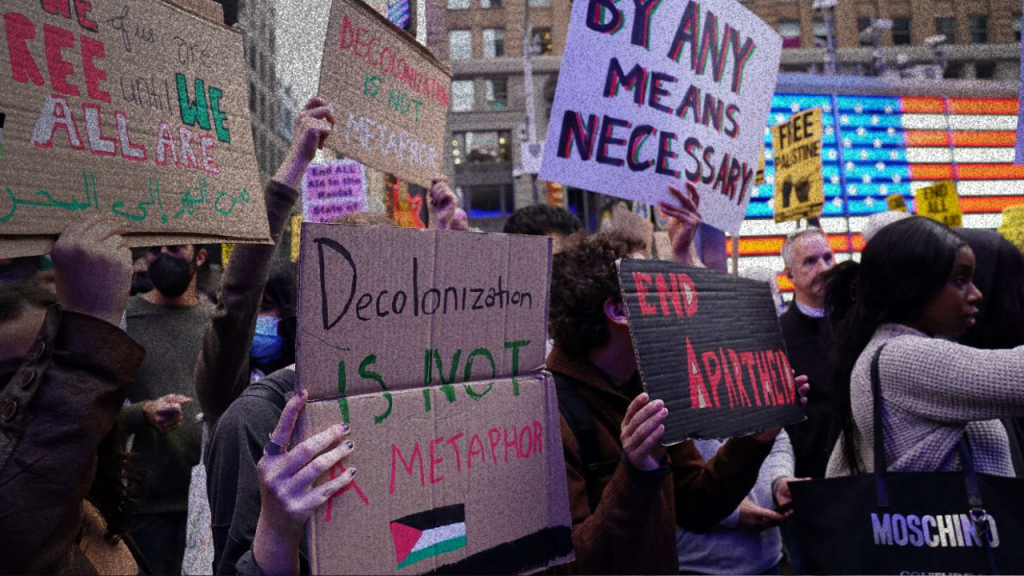
Western left genocide complicity is not a failure of will. DSA, NDP, and Labour are structurally designed to absorb resistance and redirect it away from anything that threatens power.
The Record: Statements, Resolutions, and Nothing Stopped
Israel has killed over 72,000 Palestinians in Gaza since October 2023. The United States has provided the weapons, the diplomatic cover, and the imperial framework throughout. Canada participates. Britain participates. The Western state apparatus has mobilized continuously to sustain the conditions of genocide. And through all of it, the organizations that claim the mantle of the Western left have produced the following: statements, convention resolutions, ceasefire demands, vote-uncommitted campaigns, and internal debates about endorsement criteria.
The DSA’s own record illustrates the pattern precisely. DSA has called for an arms embargo, passed anti-Zionist resolutions at its 2025 national convention, organized Labor for an Arms Embargo campaigns, and expelled members who affirm Israel’s right to defend itself. Its rhetoric is, at points, genuinely anti-imperialist. And yet: no arms shipments have been stopped. No weapons contracts have been canceled. No ports have refused to move military cargo on a sustained basis. The genocide continued through every convention resolution.
The organization that was supposed to be building material opposition to empire was arguing about an elected official’s voting record while people were buried in rubble.
The Form Is the Problem, Not the People
This is not an argument that DSA members don’t care or aren’t trying. Many of them are doing serious work. The argument is structural: the organizational form itself — the electoral socialist party operating within the Democratic Party ecosystem — cannot produce material opposition to U.S. imperial policy. It is not designed to. The ceiling is built into the architecture.
Electoral socialist organizations in the imperial core operate within a system that has already determined what kinds of opposition are permissible. You can criticize Israeli policy. You can call for a ceasefire. You can vote uncommitted in a primary. What you cannot do, within this form, is actually stop the weapons from moving. That requires disrupting the physical infrastructure of empire — the ports, the bases, the supply chains, the financial networks. It requires the kind of action that gets you arrested, not elected. Electoral politics is designed precisely to prevent this. It channels energy into campaigns, primaries, conventions, and endorsement debates — all of which produce no friction in the actual mechanisms of imperial violence.
NDP and Labour Demonstrate the Pattern at State Level
The New Democratic Party in Canada and Labour in the United Kingdom operate at a higher level of institutional power than DSA, which makes their record even more instructive. The NDP has parliamentary seats. It has leverage. During the Iran war — in which Canada’s airspace was used for U.S. bombing missions without parliamentary debate, and Canadian forces were present at Gulf bases that came under Iranian fire — the NDP issued statements, called for de-escalation, and participated in a four-hour parliamentary debate that produced no policy change. The weaponized diaspora framework that drives Canadian domestic securitization proceeded unchecked. The NDP did not block it. It could not block it — not because its members lack conviction, but because the parliamentary form gives it no lever that actually reaches the executive alliance architecture where these decisions are made.
Labour in the UK under Keir Starmer has been even starker. The party that once included a significant socialist wing under Jeremy Corbyn — who was destroyed partly through a coordinated antisemitism campaign, a case study in how the discourse policing apparatus functions — is now governing as a center-right formation that has actively supported British participation in the Iran war under the framework of “defensive operations.” The distance between what Labour said in opposition and what it does in power is the distance between a party that uses left language to win votes and a party that serves the same imperial interests as its predecessor once elected.
Qualified Solidarity Functions as Control
The most insidious function of Western left organizations is not their occasional failures of nerve or their internal contradictions. It is the role they play in defining the boundaries of acceptable opposition. When DSA debates whether to censure a congressperson for affirming Israel’s right to defend itself, it is simultaneously establishing that the outer limit of permissible left politics is: you must not say Israel has a right to defend itself. That’s the red line. Everything beyond it — unconditional support for armed resistance, alignment with the Axis of Resistance, material disruption of arms shipments — is outside the frame entirely. It is not debated at conventions. It is simply absent.
This is how qualified solidarity functions as a control mechanism. It does not suppress dissent through force. It absorbs it. It gives people a place to put their political energy that feels meaningful — attending rallies, voting uncommitted, passing resolutions — while ensuring that energy never accumulates into the kind of material pressure that actually threatens the imperial system. The system does not need to suppress the Western left. The Western left suppresses itself by remaining committed to forms of action the system has already immunized against.
The Working Class Does Not Need These Institutions to Lead It
The counterargument to this analysis is always: what’s the alternative? Without these organizations, there is nothing. This is the argument for staying. It is also the argument that has kept people investing energy in formations that produce no material change for decades. The alternative is not an already-formed organization waiting to be joined. It is the recognition that the crisis itself produces the conditions for new institutions. The organizations that matter in a revolutionary period are not built in advance through convention resolutions. They are built in the moment of rupture, by the people closest to the contradictions — not by socialist parties managing their relationship to the Democratic Party from DSA chapters in Brooklyn.
The genocide in Gaza, the Iran war, the sharpening contradictions of imperial overextension — these are not problems that DSA resolutions will resolve. They are the conditions under which the inadequacy of existing Western left institutions becomes undeniable. Every statement issued while bombs fall, every internal debate conducted while families are buried, every convention resolution passed while the weapons keep moving — these are evidence not of a movement building toward something, but of a form exhausting itself while the actual work goes undone. The choice is not between these institutions and nothing. It is between these institutions and building something that can actually produce friction where friction is needed — in the physical infrastructure of empire, not in the endorsement debates of electoral socialist organizations.





 Spark Solidarity