
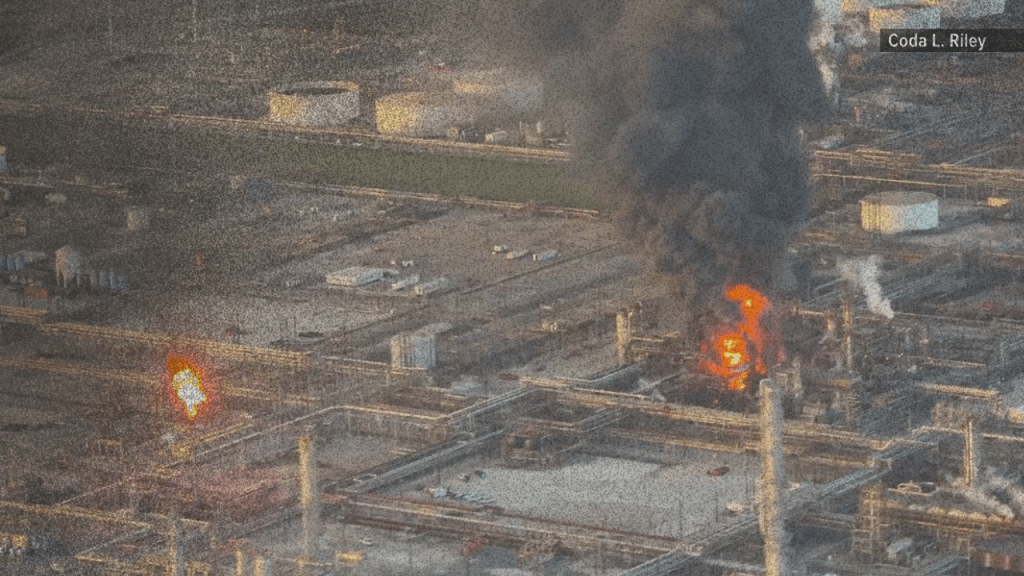
Port Arthur refinery explosion at Valero on March 23 is called a heater malfunction. Critical Gulf Coast energy infrastructure sits at a permanent pressure point.
What Happened on March 23
At approximately 6:30 p.m. on March 23, 2026, an explosion tore through the Valero refinery in Port Arthur, Texas. Thick black smoke climbed into the sky and spread across the horizon. Residents reported a blast strong enough to shake homes miles away in Groves and Nederland. The Port Arthur Fire Department confirmed an incident at the Valero facility. Authorities issued a shelter-in-place order for the west side of Port Arthur — covering areas from Stilwell West to south of Highway 73, including Pleasure Island and Sabine Pass. Jefferson County officials closed State Highways 82 and 87. Sabine Pass ISD announced school would be closed the following day. Valero issued a statement confirming all personnel were accounted for and that its emergency response team was coordinating with local authorities. No injuries were reported.
Jefferson County Sheriff Zena Stephens said the explosion was likely caused by an industrial heater. That framing arrived within hours of the event. It closed the narrative before investigation had concluded. A heater malfunction tells you what failed. It does not tell you why it failed, or under what conditions.
The Valero Facility Is Not Peripheral Infrastructure
The Valero Port Arthur refinery is one of the largest in the United States, processing crude into gasoline, diesel, jet fuel, and refined products that move through domestic and global supply chains. Port Arthur hosts two major refineries — Valero and the adjacent Motiva facility, which is the largest refinery in North America at 640,500 barrels per day. Together they make Port Arthur one of the most concentrated nodes of refining capacity anywhere in the world.
The Gulf Coast functions as the world’s largest refining hub, processing over 9 million barrels of crude daily. Approximately 44 percent of U.S. refining capacity sits along this coastline. Disruptions here do not stay local. They move through pricing structures, supply chains, and export flows in ways that are felt nationally and internationally. When something fails at this scale, it becomes an economic and geopolitical event regardless of its cause.
The Official Explanation Closes the Question Prematurely
Industrial heaters preheat crude before it moves through distillation and conversion units. They operate under high pressure and temperature. When they fail, the results can be severe: fires, explosions, chain reactions through interconnected systems. Heater malfunctions happen. They are a documented category of industrial incident. The explanation is plausible.
It is also doing something else. It collapses the question of cause into the mechanics of failure. Knowing what failed is not the same as knowing why it failed. That gap is where the rest of the story either begins or gets foreclosed. In the hours after a major industrial incident, the first explanation is almost always the most stabilizing one available. That is not evidence of deception. It is how institutions manage events under uncertainty. It is also how more complicated explanations get displaced before they can form.
Critical Infrastructure Is a Permanent Pressure Point
Energy infrastructure has always been a strategic target. Pipelines are disrupted. Tankers are seized. Facilities come under pressure — not always through overt military action, but through means that preserve deniability. The global energy system is structured so that even temporary disruptions at key nodes produce outsized effects on prices, supply chains, and economic stability. That is not a theoretical vulnerability. It is the operating reality of a system built on geographic concentration and physical interdependence.
The Strait of Hormuz closure, now in its fourth week, has already demonstrated what happens when a chokepoint goes offline. Brent crude peaked at $126 per barrel. Goldman Sachs raised U.S. recession odds to 25%. The IEA released 400 million barrels from emergency reserves and described it as insufficient to replace the lost function of a disrupted corridor. The Gulf Coast refining complex sits in that same category of irreplaceable infrastructure — not a transit chokepoint but a processing one, where crude from global sources becomes the refined products that run the domestic economy.
Modern Disruption Does Not Announce Itself
Refineries are cyber-physical systems. They rely on industrial control networks that regulate temperature, pressure, flow rates, and safety thresholds across hundreds of interconnected processes. Those same systems are attack surfaces. A misread sensor value. A delayed safety shutdown. A pressure limit adjusted outside normal parameters. A disabled fail-safe. These are not dramatic interventions. They are small adjustments with potentially catastrophic consequences. They create the conditions under which failures become inevitable — failures that, when they occur, are logged as mechanical, attributed to the component that gave way, and categorized as industrial accidents.
There is nothing contradictory about an event being both a genuine malfunction and the result of external interference. When a system is pushed outside its safe operating range, it fails according to its design limits. The failure is real. The component that broke is real. What is not necessarily visible is how the system arrived at the conditions that produced the failure. That distinction is not always recoverable from the physical evidence, and it is rarely recoverable within hours.
The Incentives Favor the Simplest Explanation
Strong institutional incentives exist to frame major industrial incidents as accidents, at least initially. Labeling an event as sabotage introduces geopolitical consequences that extend far beyond the physical site — questions of attribution, retaliation, and security exposure that no institution wants to open before the facts are established. Public acknowledgment of potential external interference in critical infrastructure also undermines confidence in systems that are already under strain. And corporate liability frameworks are structured differently around accidents than around security failures.
None of this requires deliberate deception. It is a structural tendency — the result of institutions operating under uncertainty with strong incentives toward the most manageable version of events. The narrative stabilizes around the explanation that minimizes disruption beyond the physical damage. This is how perception is managed through institutional behavior rather than directive. The heater malfunction framing is the most stabilizing explanation available. That is partly why it was the first one offered.
The More Important Point Is Structural
Whether this specific explosion at Valero Port Arthur resulted from sabotage is not established by available evidence. That remains the baseline. What can be said is this: the site is strategically significant at a moment of active global energy disruption. The type of failure is consistent with both internal malfunction and induced disruption. The systems involved are documented attack surfaces. And the institutional incentives all point toward the simplest explanation being offered first, regardless of what the investigation eventually determines.
The more structural point does not depend on the answer to that specific question. The Gulf Coast refining complex is irreplaceable, concentrated, and vulnerable. It processes the crude that keeps the domestic economy running. It sits inside a global energy system already under historic strain from the Hormuz closure. It relies on cyber-physical control systems that cannot be fully secured. These conditions do not change based on whether March 23 was an accident or something else. They define the permanent risk profile of an economy that built its energy system for efficiency rather than resilience — and is now discovering what that trade-off costs when the geopolitical environment changes faster than the infrastructure can adapt.
Sources
- KFDM — Reported explosion at Valero in Port Arthur sends black smoke and fire skyward, March 23, 2026
- FOX 26 Houston — Port Arthur explosion: Fire, smoke seen at Valero refinery, March 23, 2026
- 12NewsNow — Explosion at Valero refinery in Port Arthur prompts shelter-in-place, March 23, 2026
- KPLC — Shelter-in-place advised in Port Arthur after refinery explosion, March 23, 2026
- BNO News — Explosion reported at refinery in Port Arthur, Texas, March 23, 2026
- U.S. Energy Information Administration — Seven large refineries account for half of U.S. Gulf Coast refining capacity
- Reuters — U.S. Gulf Coast: The world’s largest refining hub

 Spark Solidarity