
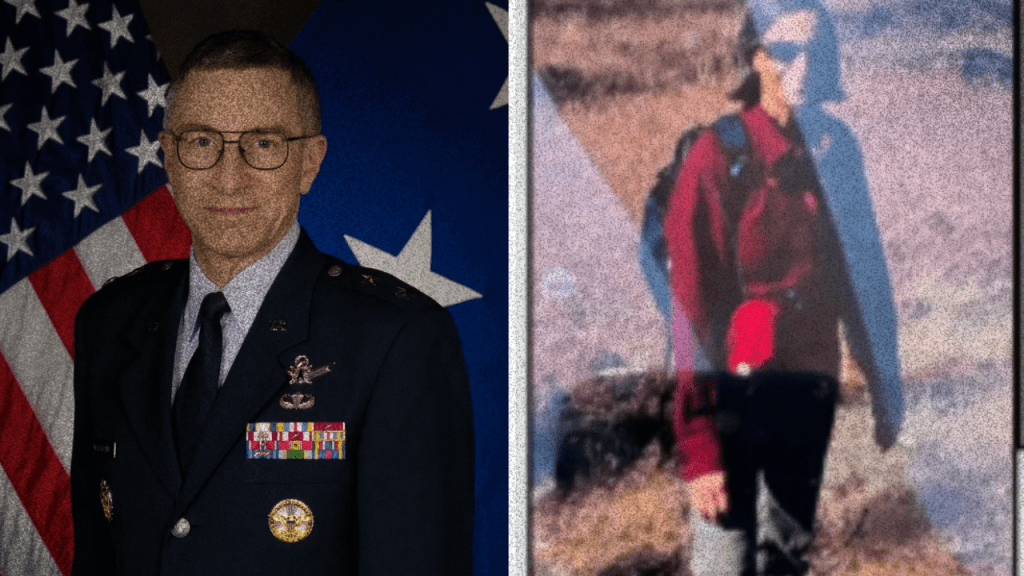
McCasland Reza disappearances are being called unproven inference — but the proof standard being demanded has never once been met by a covert program while it was still active.
The standard response to the McCasland and Reza disappearances has a consistent shape. The facts get reported. The professional overlap gets acknowledged. Then comes the qualifier: no official agency has confirmed the cases are connected, the link is circumstantial, and drawing conclusions from proximity is a leap the evidence doesn’t support.
That qualifier is presented as analytical responsibility. What it actually is, is a proof standard. And that proof standard has never once been met by a covert government program while the program was still running.
The Standard Has a Track Record
COINTELPRO ran from 1956 to 1971. For fifteen years the FBI surveilled, infiltrated, and actively sabotaged civil rights organizations, antiwar movements, and socialist parties. The people whose organizations were being destroyed knew something was wrong. They said so publicly. They were told they were paranoid. No official report confirmed the program. No law enforcement agency acknowledged what was happening. The connection between FBI activity and the systematic disruption of their movements existed, in the language currently being applied to McCasland and Reza, “primarily as inference.” It took a burglary of an FBI field office in 1971 and the Church Committee hearings in 1975 to produce official confirmation — nineteen years after the program began.
MK-Ultra ran from 1953 to 1973. The CIA conducted experiments on unwitting American and Canadian citizens — administering LSD without consent, testing psychological coercion, running behavior modification programs through front organizations. People who experienced these programs and reported them were dismissed. No official report confirmed the program’s existence while it was active. The Church Committee exposed it in 1977, and only because a small number of documents survived a CIA destruction order.
Operation Popeye ran from 1967 to 1972. The U.S. military seeded clouds over the Ho Chi Minh Trail to weaponize rainfall against North Vietnamese supply routes. The Secretary of Defense categorically denied to Congress that any weather modification program existed — while it was running. When the story broke publicly in 1971 the government stonewalled. Official confirmation came in 1974. At every point before that, the claim that the U.S. was conducting covert weather warfare met exactly the same response now being applied to the McCasland-Reza pattern: unproven, circumstantial, inference mistaken for evidence.
This is not a list of edge cases. These are programs confirmed by congressional investigation, documented in declassified records, and acknowledged by the U.S. government. Every one of them, while active, satisfied the same description now applied to the two disappearances: overlapping institutional backgrounds, plausible but unconfirmed connections, no official acknowledgment of a link. Every one of them was real.
What the Inference Actually Shows
The established facts in the McCasland-Reza cases are not thin. An aerospace engineer who co-invented a superalloy of direct strategic importance to U.S. rocket propulsion independence vanished without trace in June 2025. The general who commanded the Air Force Research Laboratory — the institution that funded her program — vanished without trace eight months later. The Bernalillo County Sheriff’s Department has confirmed detectives are actively investigating whether the cases are connected. A sitting U.S. congressman has publicly said the pattern of deaths and disappearances across adjacent research fields is too concentrated to dismiss. The disappearances occurred during a period of active government UAP disclosure pressure and weeks before the start of an active war involving the classified weapons systems McCasland spent his career building.
The argument that this does not constitute evidence is technically accurate. It is also the argument that was technically accurate about COINTELPRO in 1965, about MK-Ultra in 1965, and about Operation Popeye in 1969. Technical accuracy about the absence of official confirmation is not the same as analytical accuracy about what is actually happening.
Why the Standard Fails Here
The proof standard being applied to these cases has a structural problem: the evidence that would satisfy it is precisely what classified programs are designed to prevent from existing. Official confirmation is not forthcoming when the institution doing something wants it kept secret. Direct traceable links are not preserved when operational security requires they not be. The absence of documentation is not proof of absence — it is proof that the system is working as designed.
The Church Committee recognized this explicitly in 1975. Senator Church described intelligence programs that had operated for decades without oversight, sustained by the same difficulty of establishing direct, traceable evidence that the current dismissals of the McCasland-Reza connection are citing as their justification. The programs he was describing had been called conspiracy theory right up until the moment they weren’t.
COINTELPRO was conspiracy theory until 1971. MK-Ultra was conspiracy theory until 1977. Operation Popeye was conspiracy theory until 1974. The McCasland and Reza disappearances may turn out to have mundane explanations. They may not. But the standard of proof currently being used to foreclose that question is not a neutral analytical tool. It is a standard with a documented track record of being wrong about exactly this category of event — and of being wrong in ways that served the interests of the institutions doing the concealing.
Sources
- Wikipedia — COINTELPRO
- U.S. Senate — Church Committee
- Wikipedia — Church Committee
- FBI Vault — COINTELPRO documents
- Wikipedia — Operation Popeye
- Spark Solidarity — Weather Modification Military History: It Already Happened
- Spark Solidarity — Fireball Cluster March 2026: The Sky Keeps Getting Stranger


 Spark Solidarity