

US imperial overextension is no longer a theoretical warning. The debt, the dollar, and the multi-theater commitments are all pointing in the same direction at once.
The Numbers Are Not Theoretical Anymore
Empires do not collapse because their enemies defeat them in a single battle. They collapse because the cost of maintaining the empire exceeds what the domestic economy can sustain. That process is underway in the United States right now, and the indicators are no longer abstract projections. They are current figures, updated daily, pointing in the same direction simultaneously.
As of March 4, 2026, total U.S. gross national debt stood at $38.86 trillion, increasing at an average rate of $7.23 billion per day. Interest payments on the federal debt reached $1.2 trillion in fiscal year 2025 — the third-largest spending category in the federal budget, behind only Social Security and Medicare, and already exceeding what the United States spends on its military. The dollar posted its biggest first-half loss since 1973 in 2025, falling approximately 11% against major currencies and ending a structural bull cycle that had run since 2010. Morgan Stanley Research estimated the currency could lose a further 10% by the end of 2026. The dollar did not decline because of the Iran war. The Iran war arrived into a dollar that was already in structural retreat.
Three Theaters, One Budget, No Exit Strategy
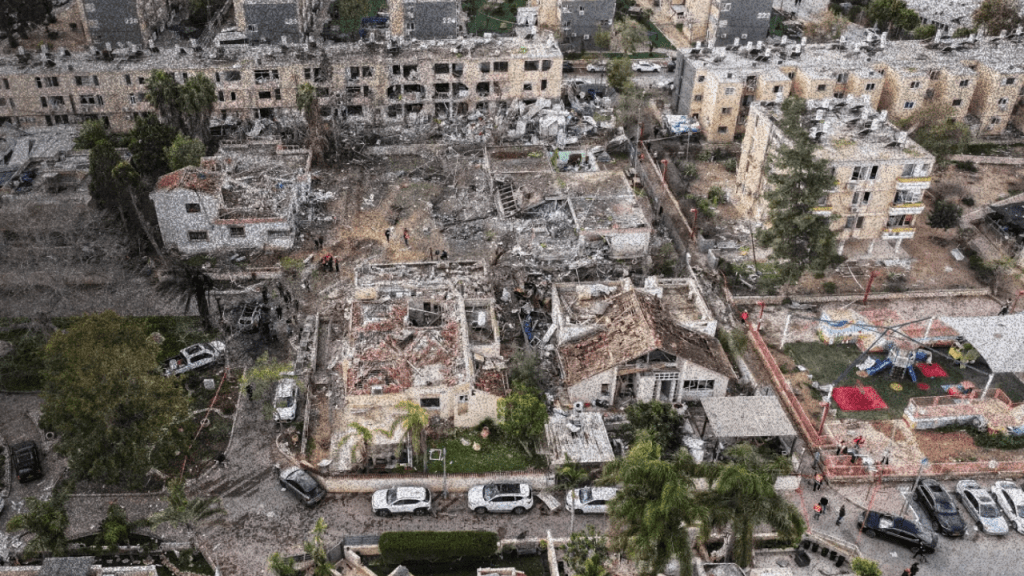
The United States is currently maintaining active military commitments across three theaters simultaneously — and conducting an active bombing campaign in a fourth. Military assistance to Ukraine reached $66.9 billion since February 2022, with total congressional allocations including economic and humanitarian support reaching $188 billion by the end of 2025. No new aid legislation has passed since April 2024, but the ongoing commitment to ceasefire negotiations and European security architecture continues to consume diplomatic and military resources. Israel received $6.82 billion in foreign aid in fiscal year 2024 alone. The Pacific theater requires sustained naval presence, forward basing, and an expanding Taiwan security cooperation framework. And since February 28, 2026, the United States has been conducting active airstrikes on Iranian nuclear and military infrastructure while simultaneously attempting to keep the Strait of Hormuz open through naval escort operations in one of the most hostile maritime environments in the world.
Each of these commitments is individually defensible within the imperial logic that produced it. Together, they form a structure of overcommitment that historical precedent suggests is unsustainable. The British Empire did not decide to decline. It extended itself across too many theaters in too short a period, borrowed against future strength it did not have, and found that the costs of maintaining the system exceeded its capacity to generate the revenues to pay for it. The United States is running the same pattern, with the additional complication that the Strait of Hormuz closure is now imposing a direct economic penalty — a 2.9 percentage point annualized reduction in global GDP, recession odds raised to 25% by Goldman Sachs — on the domestic economy of the country doing the fighting.
Dollar Decline Is the Long-Term Signal
The dollar’s structural decline matters more than any single quarterly economic indicator because the dollar’s reserve currency status is the mechanism through which the United States finances imperial overextension. When other countries hold dollars as their primary reserve currency, they are effectively lending to the United States at below-market rates, subsidizing U.S. deficit spending that would otherwise be impossible to sustain. That arrangement — in place since Bretton Woods and reasserted after Nixon closed the gold window in 1973 — is the financial architecture of the American imperial system.
When the dollar falls 11% in a single half-year, when foreign investors begin hedging their dollar exposure and rotating into gold and other currencies at rates not seen in decades, when central banks globally increase gold purchases as a hedge against dollar volatility — these are not isolated market movements. They are signals that the implicit subsidy underpinning U.S. deficit spending is being withdrawn. The dollar’s decline does not mean the system collapses tomorrow. It means the cost of maintaining the system is rising, the financing is becoming less certain, and the timeline for sustainability is shortening. That is the context in which the United States chose to launch a new war.
The Domestic Cost Is Already Visible
Imperial overextension is not only a geopolitical abstraction. Its domestic costs are material and immediate. Interest payments on the national debt now consume more federal revenue than defense spending. Every dollar spent servicing debt at 3.355% average interest on $38.86 trillion is a dollar not spent on infrastructure, healthcare, housing, or any of the domestic functions that constitute the implicit social contract through which the state maintains legitimacy. The Congressional Budget Office projects net interest payments rising from $1 trillion in 2026 to $2.1 trillion by 2036. The oil price shock from the Hormuz closure added more than 50 cents per gallon to U.S. gasoline prices within weeks. The recession risk Goldman Sachs quantified is not a risk in some distant future. It is a present probability being priced by financial institutions into their 2026 planning.
The population that bears the cost of this overextension is not the population that makes the decisions. The financial class that holds Treasury bonds and benefits from dollar hegemony is not the same population paying higher gasoline prices, watching public services erode, and being asked to support a war in the Persian Gulf. The weaponized diaspora apparatus — the infrastructure of exile communities deployed to manufacture consent for imperial operations — exists precisely because the state understands that the population bearing the cost needs to be managed into accepting it. That management is itself a cost. It requires institutions, media infrastructure, funding, and continuous narrative production. It is not free. And it becomes harder to sustain as the material gap between what the state says the system delivers and what people actually experience widens.
The Crisis Is the Opening
The convergence of these pressures — debt, dollar decline, multi-theater military overcommitment, an active war producing an oil price shock, and a domestic population bearing costs it did not choose — does not automatically produce political transformation. History is full of empires that sustained decline for decades before the contradictions became acute enough to force rupture. But the convergence does produce conditions. It creates the material basis for a politics that cannot be manufactured in periods of relative stability. When the system cannot deliver what it promises — when the cost of gasoline, the cost of healthcare, the cost of housing all rise simultaneously while the state is conducting airstrikes on the other side of the world — the gap between official narrative and lived experience becomes undeniable.
The work of building counter-power is not the work of the crisis itself. It is the work that makes it possible to act when the crisis arrives. Mutual aid networks, community institutions, alternative media, the skills and organizational capacity that allow people to act collectively outside state-mediated channels — these are not alternatives to political struggle. They are the infrastructure that makes political struggle viable when the moment comes. The trajectory is legible. The debt is compounding. The dollar is retreating. The empire is fighting wars it cannot afford in theaters it cannot abandon. The question is not whether the crisis is coming. It is whether the people who understand what is happening are building something that can act when it does.
Sources
- Joint Economic Committee — Monthly Debt Update, March 4, 2026
- GAO — Financial Audit: FY 2025 Schedules of Federal Debt, January 2026
- Morgan Stanley — Devaluation of the U.S. Dollar 2025
- U.S. State Department — U.S. Security Cooperation with Ukraine, January 2026
- Council on Foreign Relations — How Much Aid Has the United States Sent Ukraine?
- Dallas Federal Reserve — What the closure of the Strait of Hormuz means for the global economy, March 20, 2026
- Axios — Oil prices, recession: What happens if Strait of Hormuz stays closed, March 12, 2026
- Spark Solidarity — Weaponized Diaspora and the Witnesses Empire Needs, February 28, 2026




 Spark Solidarity