
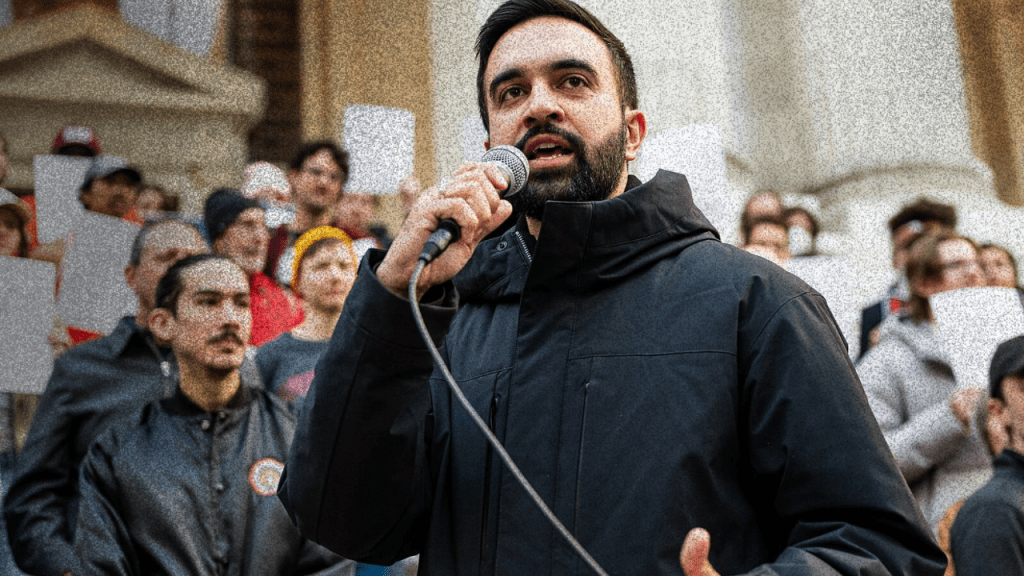
Mamdani Palestine solidarity has a ceiling he set himself. He won the New York mayoralty as the Palestine candidate, took office, and immediately demonstrated where his support ends.
He Won on Palestine and Then Defined Its Limits
Zohran Mamdani ran for mayor of New York City on a platform that made Palestine central. He co-founded his college’s Students for Justice in Palestine chapter. He called the Palestinian cause “central to my identity.” He called Israel’s war on Gaza a genocide. He supported BDS. He promised to arrest Netanyahu if he set foot in New York. He won — a stunning upset over Andrew Cuomo in the June 2025 Democratic primary, taking office on January 1, 2026 as the first Muslim mayor of America’s largest city.
On his first day in office, he revoked a series of pro-Israel executive orders signed by Eric Adams — including one that adopted the IHRA definition of antisemitism, which classifies some criticism of Israel as antisemitic, and one that barred city agencies from boycotting Israel. Palestinian rights organizations praised the move. The Israeli government condemned it, calling him a “Muslim Brotherhood Islamist.” That reaction was predictable and, in anti-imperialist terms, something like a credential.
But Mamdani came in with a ceiling already installed. Throughout the campaign, he repeatedly stated that Israel has a right to exist — qualified by the condition that it must guarantee equal rights for all citizens, not a hierarchy based on religion. He refused to say it has a right to exist as a Jewish state specifically. That’s a meaningful distinction, and it cost him significantly in the Jewish community. But it also set the boundary: Mamdani supports Palestinian rights up to the point where he would need to say the Israeli state as currently constituted is illegitimate. He will not go there.
A Palestinian Man Named the Contradiction Publicly
In mid-March 2026, a Palestinian man with family in Gaza confronted Mamdani at a public event. The video circulated widely. The man’s point was precise: you say “Free Palestine” while affirming Israel’s right to exist. These two positions are not compatible. Freeing Palestine — ending occupation, ending apartheid, achieving self-determination — cannot coexist with affirming the legitimacy of the state structure that produces those conditions. The man was not making a theoretical argument. He was describing his family’s situation.
Mamdani’s response was calm and institutional. He acknowledged Palestinian suffering. He defended his position as pragmatic. He did not change his position. The confrontation produced a social media cycle in which many Western leftists rallied to Mamdani’s defense, characterizing the Palestinian activist as unreasonable or counterproductive. That reaction — defending the politician who holds qualified solidarity against the Palestinian who demands unconditional support — reveals more about the Western left’s priorities than anything Mamdani himself said.
The Wife Controversy Shows How the Machine Works
In early March, right-wing outlets reported that Mamdani’s wife, Rama Duwaji, had liked Instagram posts celebrating October 7. Then it emerged that she had illustrated a book for Palestinian-American author Susan Abulhawa, whose social media posts include language directed at Jewish people that is genuinely indefensible. Then old Tumblr posts from Duwaji’s teenage years surfaced, showing support for Palestinian resistance figures the U.S. government designates as terrorists.
The machine worked exactly as designed. Each revelation was calculated to force Mamdani to distance himself from Palestinian solidarity incrementally. And he complied. He called Abulhawa’s language “patently unacceptable” and “reprehensible.” He stressed that his wife is a “private person” with no role in his administration. He met with Orthodox Jewish leaders. Pro-Palestinian organizer Nerdeen Kiswani accused him of “throwing his own wife under the bus.” Abulhawa described his response as “unfortunate capitulation to Zionist power.” Israel’s diaspora ministry moved to ban Duwaji from entering Israel for using the words “genocide,” “occupation,” and “ethnic cleansing.”
The Abulhawa controversy is instructive not because Mamdani was wrong to condemn language that targets Jewish people as a group — he wasn’t — but because of the asymmetry. The same week Mamdani called Abulhawa’s posts “reprehensible,” Israel was bombing Dimona and Arad, injuring 180 people. The United States was conducting airstrikes on Iranian nuclear facilities. The conditions that produce the rage in those posts — 72,000 Palestinians killed, families obliterated, a people under decades of siege — were continuing without interruption. The mayor’s strongest condemnation was reserved for a Palestinian author’s social media posts, not for the governments conducting the slaughter.
What Qualified Solidarity Actually Produces
Mamdani is not a villain in this story. He is a genuine progressive who has done more for Palestinian rights from an elected position in the United States than almost any politician before him. Revoking the IHRA definition on day one was meaningful. Calling Gaza a genocide in official settings matters. His presence in office changes the terrain.
But qualified solidarity has a structural function within the imperial system that operates independently of individual intentions. The weaponized diaspora framework requires figures who can absorb Palestinian energy and redirect it toward respectable channels — who can say “I support you” while maintaining the legitimacy of the state architecture responsible for the dispossession. Mamdani fills that role whether he intends to or not. His “right to exist” position is the load-bearing wall. Everything else — the BDS support, the genocide language, the revoked executive orders — operates within its constraint.
The Palestinian man who confronted him understood this intuitively. You cannot both affirm “Free Palestine” and affirm the right to exist of the state whose existence, in its current form, forecloses Palestinian freedom. These are not positions that can be held simultaneously without one of them being subordinated to the other. In Mamdani’s politics, it is Palestine that gets subordinated — not because he doesn’t care, but because the electoral system he operates within requires it. That is the ceiling. It was always there. The confrontation just made it visible.
Sources
- Al Jazeera — Palestine advocates praise NYC’s Mamdani for revoking pro-Israel decrees, January 2, 2026
- CNN — Mamdani revokes Israel-related executive orders signed by Adams, January 2, 2026
- Times of Israel — What NYC Mayor-elect Zohran Mamdani has actually said about Jews, Israel and antisemitism, November 2025
- Pakistan Today — Palestinian man confronts Mamdani over Israel-Palestine stance, March 17, 2026
- Al Jazeera — Why is NYC’s Mamdani facing criticism over response to attacks on wife, March 15, 2026
- Jewish Telegraphic Agency — Mamdani condemns rhetoric of Palestinian author whose work his wife illustrated, March 16, 2026
- Jewish Telegraphic Agency — Israel moves to ban Rama Duwaji, NYC Mayor Zohran Mamdani’s wife, March 20, 2026
- Spark Solidarity — Weaponized Diaspora and the Witnesses Empire Needs, February 28, 2026




 Spark Solidarity