
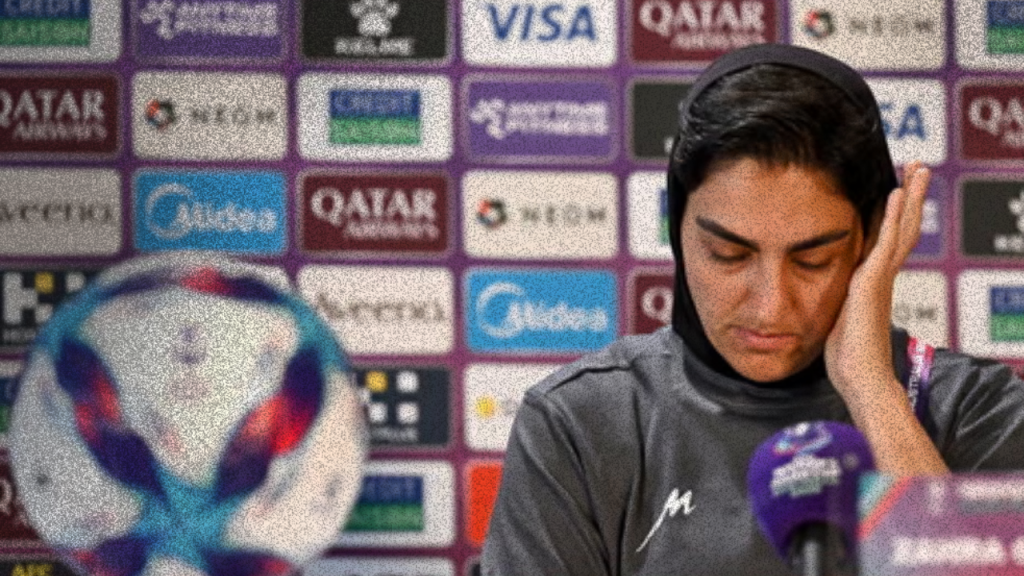
Imperial feminism turns women’s suffering into war justification — the Iranian soccer team asylum story shows how that narrative operates in real time.
Seven Iranian Players Sought Asylum While War Raged at Home
When the Iranian women’s national soccer team arrived in Australia for the Women’s Asian Cup in February 2026, they planned to compete in an international tournament. War broke out in Iran on February 28. Within days, seven members of the squad — six players and one support staff — requested and received humanitarian visas. The sports story became a geopolitical spectacle. Governments issued statements. Media coverage framed the athletes as victims fleeing oppression, seeking protection from liberal democracies. The war that stranded them appeared mostly as backdrop. The humanitarian drama of rescue became the story’s center.
The narrative structure was instantly recognizable. Vulnerable women caught between an oppressive regime and the safety offered by Western states. The moral arc was emotionally simple and politically powerful. But the framing also revealed a familiar pattern: when Western military action requires moral justification, the suffering of women in the targeted country becomes one of the most compelling exhibits. The athletes who traveled to Australia to play football suddenly represented something else — a symbol in a much larger story about authoritarianism, freedom, and the necessity of intervention.
Laura Bush Framed Afghanistan Invasion as Women’s Liberation
The weaponization of women’s suffering as war justification did not begin in 2026. The pattern became unmistakable after the September 11 attacks. As the United States prepared to invade Afghanistan, the oppression of women under the Taliban became a central element of political messaging. On November 17, 2001, First Lady Laura Bush delivered the presidential weekly radio address — the first time a First Lady had done so. She declared that the fight against terrorism was also a fight for the rights and dignity of women.
Public speeches emphasized the suffering of Afghan women under Taliban rule. Images of women forced to wear burqas, stories of girls banned from school, and descriptions of severe punishments quickly saturated Western media coverage. The oppression described in those reports was real. Taliban restrictions on women’s education, movement, and employment were brutal and documented. But the political function of these narratives was equally clear. They helped frame military intervention not as a strategic decision or a security calculation, but as a humanitarian necessity. The invasion became an act of liberation.
Scholars later named this phenomenon imperial feminism — the incorporation of feminist rhetoric into geopolitical projects such as war. A similar dynamic appeared before the 2003 invasion of Iraq. Commentators highlighted the repression of women under Saddam Hussein as part of the moral case against the Iraqi government. Again, the abuses were not invented. But the suffering of Iraqi women became evidence that regime change was justified. War was presented as the mechanism of their protection.
Rescue Narratives Transform Geopolitics Into Moral Drama
Stories about rescuing vulnerable people are among the most powerful moral narratives available in politics. They transform complex geopolitical conflicts into something emotionally simple. The structure follows the same pattern: a vulnerable group is identified, their suffering is highlighted, outside actors intervene to protect them. In these stories, the suffering of women becomes evidence that intervention is necessary and morally justified. The intervention itself becomes framed as protection. The story becomes about the savior rather than the system.
This narrative does not require bad intentions. Journalists reporting on human rights abuses may care about the victims. Politicians highlighting those abuses may believe they are defending universal values. But once the narrative takes shape, the focus shifts. Attention moves toward the act of rescue and away from the broader political conditions that created the crisis. The women whose suffering justified the intervention are no longer the central characters. They become symbols in a story about power.
War Displaces Women While Claiming to Liberate Them
There is a structural contradiction at the heart of humanitarian war rhetoric. War is one of the most destructive events any society can experience. It destroys infrastructure, destabilizes governments, and displaces millions. Women and girls make up roughly half of all refugee and internally displaced populations globally. Hospitals close. Schools shut down. Economic systems collapse. Refugee camps become environments where gender-based violence is common and resources are scarce.
Yet this same process is presented as the means by which vulnerable populations will be protected. The logic becomes circular: military violence is justified as a way to prevent violence. If the goal is to improve the safety and autonomy of women, war is a remarkably blunt instrument for achieving it. Military interventions empower armed actors, strengthen security states, and concentrate power in institutions that are not known for advancing gender equality. The humanitarian language that accompanies intervention fades once the war begins. The priorities of military occupations revolve around security, counterinsurgency, and geopolitical alliances rather than long-term social reform.
Women in Conflict Zones Become Symbols in Others’ Stories
The danger of imperial feminism is not simply that it justifies violence. It turns real people into symbolic evidence. Women in conflict zones become images representing oppression. Their suffering becomes proof of moral urgency. Their lives are folded into narratives about civilization, democracy, or liberation. But the women themselves rarely control the story being told about them. The Iranian soccer players illustrate this dynamic. Their personal decisions were shaped by fear, uncertainty, and the safety of their families. Those choices deserved careful reporting on their own terms. Instead, their situation became a symbol in a geopolitical narrative about authoritarianism and rescue.
This is the structural function of imperial feminism. It recognizes injustice — discrimination, violence, political exclusion — while instrumentalizing that recognition to justify military force. The existence of injustice does not automatically justify military intervention as the solution. The history of the past several decades proves the opposite. War rarely produces the stable social conditions necessary for long-term progress in education, healthcare, and political participation. More often it destroys the institutions that make such progress possible. The language of liberation makes war sound morally necessary. But when liberation is pursued through bombs, occupation, and displacement, the promise collapses under the weight of its own contradictions.
The Moral Inversion at the Heart of Humanitarian War
The result is a strange moral inversion: a campaign of destruction framed as an act of protection. And once that narrative takes hold, the people whose suffering inspired it are no longer the central characters. They become symbols in a story about power. The Iranian women who sought asylum in Australia were caught in this dynamic. Their individual circumstances were real. The dangers they faced were real. But the geopolitical spectacle that surrounded their decisions served a different function — it reinforced the narrative that Western states protect vulnerable populations, while the wars those same states wage are the primary cause of mass displacement.
Imperial feminism does not challenge the system that produces war. It legitimizes it. The suffering of women becomes the moral cover for interventions that displace millions more. The contradiction is not accidental. It is structural. War does not liberate people. It displaces them, kills them, and destroys the material conditions for their survival. The rhetoric of liberation simply makes the violence easier to justify.
Sources
- CNN — Seven members of Iranian women’s soccer team granted visas, March 10, 2026
- CNN — Member of Iranian soccer team granted asylum changes her mind, March 11, 2026
- NPR — Australia grants asylum to 5 members of the Iranian women’s soccer team, March 10, 2026
- Al Jazeera — Australia grants asylum to 2 more members of Iranian women’s football team, March 11, 2026
- White House Archives — Radio Address by Mrs. Bush, November 17, 2001
- Dialectical Anthropology — Imperialist feminism redux, 2012
- UNHCR — Women and Girls in Displacement




 Spark Solidarity