
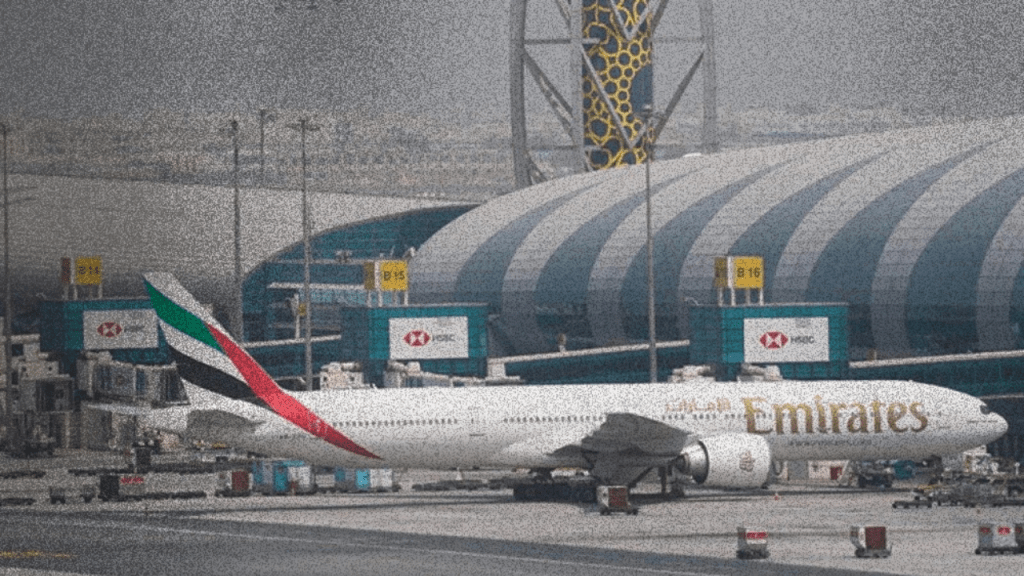
Emirates suspended all Dubai flights as EASA declared the Gulf a conflict zone. What the shutdown reveals about war, civilian infrastructure, and empire’s risk model.
On February 28, Emirates — the world’s largest long-haul airline — announced it was suspending all operations to and from Dubai. The reason given was precise and revealing: “multiple regional airspace closures.” Not weather. Not a labor dispute. Not a technical failure. The skies themselves had become unreliable. The suspension, initially set until 3pm UAE time on March 1, was extended to 3pm on Monday, March 2. Etihad, flydubai, and Air Arabia followed. Thousands of passengers across South Asia, Europe, Africa, and Australasia lost connections simultaneously.
This is what system-level shutdown looks like. Not a disrupted flight. Not a delayed departure. A coordinated pause across one of the world’s most critical aviation hubs, triggered not by operational failure but by the recognition that the environment in which aviation operates had become unsafe.
The European Union Aviation Safety Agency formalized that recognition within hours. EASA issued Conflict Zone Information Bulletin CZIB 2026-03 for the Middle East and Persian Gulf, advising airlines against operating in the affected airspace at all flight levels and altitudes. Its language was unambiguous: U.S. and Israeli military strikes on Iran, and the likelihood of continued Iranian retaliation against states hosting U.S. military bases, had introduced “high risks” that extended across the entire region’s civilian air corridors. India’s civil aviation regulator issued its own emergency advisory on the same basis. Aviation authorities across Europe, South Asia, and the Gulf were reading from the same threat assessment simultaneously.
That convergence is the signal. When regulatory bodies on multiple continents agree, in real time, that an entire region’s airspace has crossed into a conflict zone, the question is not whether something significant is happening. The question is what it means.
Why Airspace Closures Break Aviation Systems
Commercial aviation does not operate on improvisation. It depends on tightly coordinated corridors, predictable routings, and constant cooperation between national air traffic control authorities. Aircraft cannot simply route around a conflict zone at scale without those permissions and ground systems remaining intact.
When one country closes its airspace, airlines reroute. When several do so simultaneously — Iran, Iraq, UAE, Qatar, Kuwait, Bahrain, Jordan, all affected in the same 24-hour window — the system begins to fail. Aircraft stack at choke points. Alternate corridors overload. Fuel calculations break down. Crews time out. Aircraft end up stranded far from maintenance bases.
For a hub carrier like Emirates, the problem compounds immediately. Dubai’s role is not just origin and destination traffic. It is connective tissue. Flights pass through from dozens of countries in every direction. Aviation data firm Cirium tracked 232 cancellations — 6.7 percent of all scheduled regional flights on Saturday alone, with Israel (37.3 percent of its scheduled flights cancelled), Jordan (13.3 percent), and Qatar (10.1 percent) hit hardest. Those figures represent the opening wave. The trailing effects — mispositioned aircraft, displaced crews, collapsed itineraries — extend for days beyond any individual closure.
This is why partial, rolling closures are often more disruptive than total ones. With a full closure, airlines plan decisively. With closures that shift hour by hour across a dozen jurisdictions, planning becomes impossible. Emirates’ language — “multiple regional airspace closures” — is industry shorthand for: the system we depend on no longer functions safely enough to operate.
When the Sky Becomes a Threat Environment
Airlines do not need direct attacks on civilian aircraft to suspend operations. They stop when the risk envelope expands beyond acceptable limits.
Modern military conflicts do not involve clean front lines. They involve missile barrages, drone swarms, interception systems, and overlapping radar activity across wide geographic areas. Even when interceptions succeed, debris falls across civilian space. Even when targets are military installations, flight paths pass through the same corridors used by passenger jets. Even when no one intends to hit a 777, the margin for error narrows to a point where operating becomes indefensible.
EASA’s bulletin identified the specific hazards: cruise missiles, ballistic missiles, all-altitude air defense systems with interception capability. These are not risks contained to low-altitude military airspace. They operate across the full vertical range that commercial aviation uses. The bulletin explicitly noted that the risks extended beyond Iran’s airspace to “neighbouring States hosting U.S. military bases or otherwise affected by the hostilities.” That language describes the UAE, Qatar, Bahrain, and Kuwait — all of which host American military infrastructure, all of which saw Iranian missiles and drones the night before.
The misidentification risk is not theoretical. In January 2020, Iranian air defense forces shot down Ukraine International Airlines Flight 752 over Tehran, killing all 176 people on board, after misidentifying the aircraft as a hostile target — hours after Iran had conducted missile strikes on U.S. bases in Iraq. The pattern that produced that disaster — high-tempo military operations, saturated radar environments, degraded command-and-control chains — is precisely the pattern now active across the Gulf region.
Aviation safety doctrine is built on learning from those disasters, not repeating them. Once missile-heavy conflict enters regional airspace, the correct operational decision is not to wait and assess. It is to clear the sky.
The Hub Model and Its Limits
Dubai is not a regional airport. It is a global switchboard. Emirates connects South Asia to Europe, Africa to East Asia, Australasia to the Middle East through a hub built on the assumption of stable, predictable airspace in every direction. That assumption is foundational. The efficiency of the model — the reason passengers from Nairobi to Manila route through Dubai — depends entirely on the hub remaining accessible.
When Emirates stops flying, the effects do not stay local. Aircraft are stranded in foreign airports. Crew rosters collapse globally. Cargo shipments halt. Other airlines absorb overflow they were never designed to handle. An Indian tourist in Dubai trying to reach Milan. A Hungarian traveler with no alternate route home. A PV Sindhu trying to reach the All England Open Badminton Championship. These are not edge cases. They are the ordinary texture of global mobility built on the assumption that the hub works.
The disruption also carries significant economic weight. Aviation consultant Linus Bauer, speaking to The National, noted that if airspace avoidance persists, airlines face “structurally higher operating costs, weaker aircraft utilisation and profit margin pressure — especially on long-haul networks reliant on Middle East transit corridors.” That is the language of structural damage, not temporary disruption.
This Is How Aviation Always Responds to War
What is happening now fits a documented historical pattern.
In the aftermath of the 1991 Gulf War, airlines suspended routes across the region as coalition air operations began. Fuel prices spiked, demand collapsed, and some carriers never recovered. In Syria’s civil war, airlines abandoned Syrian airspace entirely, forcing permanent rerouting that still affects flight paths today. When Russia invaded Ukraine in 2022, European and Asian aviation maps were redrawn overnight — flights avoided Russian and Ukrainian airspace, adding hours and costs to routes that remain altered years later. During escalations involving Israel and Gaza, major international carriers repeatedly suspended Tel Aviv flights even when airports reopened intermittently.
In each case, the logic was identical. Missile warfare and modern air defense systems create unacceptable risk for civilian aircraft. Airlines act early because waiting invites catastrophe. The industry learned this at the cost of 298 lives when MH17 was shot down over eastern Ukraine in 2014, in an airspace that multiple carriers had continued to use because the risk had not yet formally registered.
What feels dramatic in the moment is routine in aviation safety planning. Optimism kills.
What the Suspension Reveals About the Conflict
The grounding of Emirates is not simply an aviation story. It is a geopolitical signal rendered in operational language.
When the world’s largest long-haul carrier suspends all operations from its home hub, it is marking the boundary where military conflict has crossed into the civilian systems that global commerce depends on. This is a different threshold than strikes on military bases or retaliatory missile salvos. Those affect populations in conflict zones. A hub shutdown affects anyone on earth whose movement passes through Dubai — which, at the scale Emirates operates, is a substantial fraction of global passenger traffic.
Empire runs on the assumption that war is something that happens elsewhere, to other people, in contained spaces. The events of the past 48 hours in the Gulf are a case study in how that assumption dissolves when conflict reaches the infrastructure on which the global order circulates. For more on the structural role the UAE plays in that order — and why that role made it a target rather than a bystander — read When the Hub Gets Hit.
When Flights Resume
Airlines do not resume service because fighting pauses for a few hours. They resume when systems stabilize across three conditions: airspace must reopen consistently, not sporadically; military deconfliction must hold predictably; and aviation authorities must signal that civilian traffic is once again prioritized and protected.
This is why suspensions extend in increments. Emirates offered affected passengers rebooking within 20 days or full refunds. That window reflects the airline’s internal assessment of how long the uncertainty is likely to persist — not a specific prediction, but an acknowledgment that conditions could remain unstable for days, not hours.
Passengers watching individual flights resume should not confuse movement with normalization. A handful of test flights does not mean the system is safe. It means someone is checking the edges.
A civilian line has been crossed. A conflict that began with stated military objectives has expanded into the civilian infrastructure and global systems that constitute ordinary life for hundreds of millions of people. When airlines stop flying, it is because the margin of safety has disappeared. The skies are usually where geopolitics fades into background noise. When they become contested, the separation between war and daily life is revealed for what it always was: a managed illusion.
Emirates did not suspend flights because something might happen. It did so because enough already has.
Sources
- Gulf News. “Emirates Suspends Dubai Flights Until 3pm Today as US–Israel War on Iran Continues.” February 28, 2026. https://gulfnews.com/uae/emirates-suspends-dubai-flights-until-3pm-today-as-us-israel-war-on-iran-continues-1.500459366
- The National. “UAE Airlines Extend Flight Suspensions Until Monday Amid Waves of Iranian Missile Strikes.” March 1, 2026. https://www.thenationalnews.com/business/2026/03/01/uae-airlines-extend-flight-suspensions-until-monday-amid-waves-of-iranian-missile-strikes/
- The National. “Airlines Suspend Flights Amid US–Israel Strikes on Iran and Gulf Airspace Closures.” February 28, 2026. https://www.thenationalnews.com/business/aviation/2026/02/28/airlines-suspend-flights-amid-us-israel-strikes-on-iran-and-gulf-airspace-closures/
- EASA. “Airspace of the Middle East and Persian Gulf — CZIB 2026-03.” February 28, 2026. https://www.easa.europa.eu/en/domains/air-operations/czibs/2026-03
- Time Out Dubai. “UAE Airspace Closure Amid Regional Tensions: All DXB Flights Cancelled.” February 28, 2026. https://www.timeoutdubai.com/news/uae-airspace-closure-dxb-flights
- LoyaltyLobby. “Emirates Extends Flight Suspension Until 3 PM Local Time on Monday, March 2, 2026.” March 1, 2026. https://loyaltylobby.com/2026/03/01/emirates-extends-flight-suspension-until-3-pm-local-time-on-monday-march-2-2026/
- IBTimes UK. “Doha and Dubai in Lockdown Mode After US Strike Escalation Sparks Regional Airspace Crisis.” February 28, 2026. https://www.ibtimes.co.uk/us-strike-iran-airspace-closures-middle-east-1782226
- Safe Airspace. “Conflict Zone & Risk Database — Iran / Ukraine International Airlines Flight 752.” https://safeairspace.net/summary/
- Business Standard. “Civil Aviation Ministry Sets Up 24×7 Control Room Amid Middle East Airspace Crisis.” March 1, 2026. https://www.business-standard.com/industry/aviation/civil-aviation-ministry-sets-up-24×7-passenger-assistance-control-room-amid-middle-east-airspace-crisis-126030100026_1.html
 Spark Solidarity