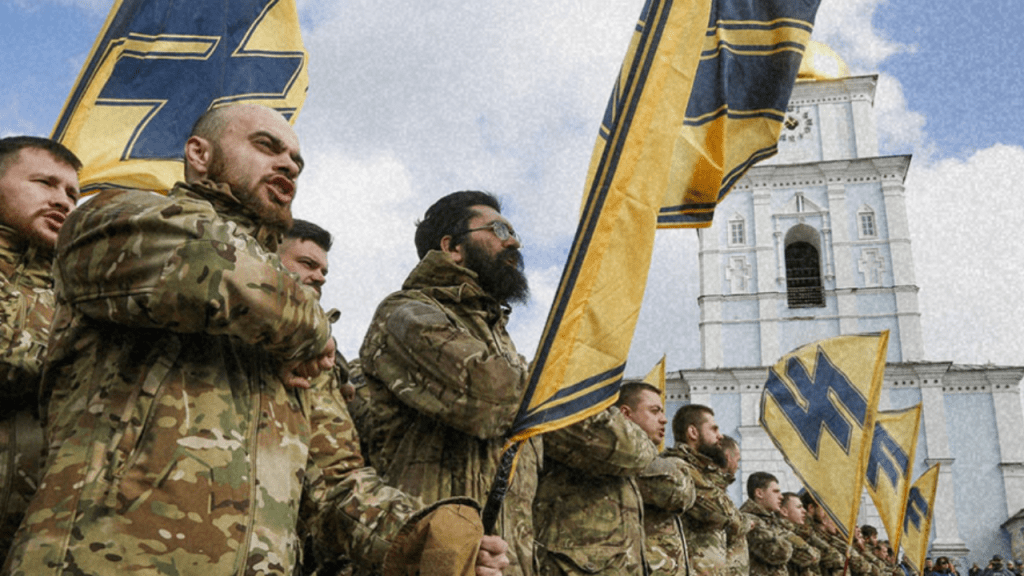
Azov rehabilitation moved a far-right formation from U.S. restriction to U.S. clearance once the war made direct support useful.
On June 11, 2024, the United States cleared Ukraine’s 12th Special Forces Azov Brigade to receive American weapons and training. The State Department said the unit had passed Leahy Law vetting, which bars U.S. assistance to foreign security units implicated in gross violations of human rights. A formation long restricted because of its far-right and neo-Nazi origins could now receive the same military assistance as other Ukrainian units.
Reuters reported that the review found no evidence of human-rights violations by the current brigade. The Associated Press noted the earlier U.S. ban had cited the neo-Nazi ideology of some Azov founders, while current members reject accusations of extremism.
Azov was useful in war. The record is clear on that. Its fighters held Mariupol, became symbolic defenders of the Ukrainian state, and gained battlefield legitimacy after Russia’s full-scale invasion. Usefulness then became the mechanism of rehabilitation. A unit once too toxic for direct U.S. support was reclassified once the restriction became inconvenient.
The sequence did not begin in 2024. It began in 2014 with tolerance, incorporation, rebranding, rehabilitation, and arming. Azov’s lineage did not disappear. The strategic value of pretending it no longer mattered increased.
Azov came from the far right
Azov formed in 2014 during the violence that followed Maidan and the outbreak of war in the Donbas. It emerged from a far-right milieu organized around Andriy Biletsky, who had led Patriot of Ukraine and the Social-National Assembly before becoming Azov’s central figure.
OpenDemocracy traced Azov’s rise through Biletsky’s earlier organizations and the patronage of Interior Minister Arsen Avakov. Biletsky was recognized as a political prisoner after Yanukovych’s fall, released from prison, and folded into the new security landscape under Avakov’s ministry.
Biletsky’s politics were not ambiguous. TIME later described his manifesto language as drawn directly from Nazi ideology, including a call for Ukrainian nationalists to lead white nations against “Semite-led Untermenschen.” Not every later Azov fighter personally endorsed Biletsky’s words. The founding political culture was not invented by enemies or inferred from bad optics. It was articulated by the unit’s founder.
Azov’s transformation from militia into state unit was rapid. The volunteer formation was incorporated into Ukraine’s National Guard and became one of the most prominent military formations produced by the post-Maidan order. The far right was not merely tolerated on the street. It was institutionalized through the security state.
Avakov made incorporation possible
Azov’s rise cannot be separated from Arsen Avakov. After Maidan, Avakov became Ukraine’s interior minister, controlling the ministry under which Azov was formalized. OpenDemocracy described Avakov as patronizing Patriot of Ukraine, Azov, and Biletsky himself after February 2014.
Avakov gave Azov more than tolerance. He gave it institutional cover. A far-right militia gained access to state legitimacy, weapons, recruitment capacity, and a place inside the National Guard. Its earlier ideological character was not resolved. It was absorbed through administration.
Far-right formations outside the state can be described as extremism. Once they become useful to the state, the language changes. They become controversial, complex, battle-hardened, patriotic, or reformed. The organization does not need to disappear. It needs to be renamed into usefulness.
Azov’s incorporation created the template. Once the state had absorbed the unit, the political question shifted from whether Azov’s origins were disqualifying to how long Western governments would keep treating those origins as stronger than battlefield utility.
Congress already knew
American legislators were not ignorant of the problem. In 2015, Representatives John Conyers and Ted Yoho pushed an amendment to block U.S. arms and training from reaching Azov. A later House Rules Committee record described the bipartisan amendment plainly: it blocked funds from providing weapons or training to the neo-Nazi Azov Battalion in Ukraine.
The House record shows how explicit the concern was in Washington. Azov was not an obscure unit misunderstood by outsiders. It was a named object of congressional restriction because its politics were legible to U.S. lawmakers.
The restriction did not hold cleanly. The Nation reported in 2016 that the ban was removed from year-end spending legislation under pressure from the Pentagon. The explanation was that existing Leahy Law vetting already handled the problem. The result was a bureaucratic escape hatch.
The Leahy Law focuses on gross violations of human rights by specific units. It does not disqualify a military formation because its founding ideology was fascist, neo-Nazi, or white supremacist. Once the problem was narrowed to current documented human-rights violations, founding politics could be treated as background.
The terrorist listing never came
By 2019, concern had escalated beyond appropriations language. Forty members of Congress, led by Representative Max Rose, called for the State Department to designate the Azov Battalion and other foreign far-right organizations as foreign terrorist organizations. The request followed concern that Azov had become a node in transnational white-supremacist organizing.
TIME reported in 2021 that Azov had used Facebook to recruit and radicalize new members. Lawmakers had raised alarms about Americans travelling overseas to train with far-right networks, and FBI Director Christopher Wray had confirmed that American white supremacists were travelling abroad to train.
The designation never came. The far-right threat was real enough to appear in hearings, letters, and investigative reporting, but not serious enough to override the strategic value of the Ukrainian security relationship. The record was acknowledged, contained administratively, and politically outgrown.
By 2024, the same structure that once generated restrictions produced clearance. The State Department did not need to prove Azov’s origins were false. It only needed to say the current unit passed a Leahy review. The laundering was legalistic, not historical.
Rebranding did the work
The 2024 argument depended on a separation between the old Azov Battalion and the current Azov Brigade. The State Department treated the current formation as different enough for assistance purposes. Azov’s own institutional memory complicates that claim.
The Intercept reported that the State Department characterized the Azov Battalion and Azov Brigade as significantly different organizations. Azov figures themselves have presented the unit’s history as continuous, and the brigade’s public narrative celebrates a ten-year arc from volunteer militia to elite military formation.
The 3rd Army Corps, led by Biletsky, presents the lineage directly. Its official history begins with Patriot of Ukraine, moves through Maidan’s force wing and the Black Corps, then identifies May 5, 2014 as the date Biletsky founded the Azov Battalion and became its first commander.
Rebranding does not erase history. It organizes which parts of history remain visible. The volunteer militia becomes a regiment. The regiment becomes a brigade. The brigade becomes a special-forces formation. The origin story is not denied exactly. It is domesticated into institutional maturity.
The June 2024 clearance did not discover that Azov had never been rooted in the far right. It ratified the argument that those roots no longer mattered enough to block weapons.
Votes are not the only power
The standard reply to concerns about Ukraine’s far right is electoral. Far-right parties performed poorly in national elections. In 2019, the combined far-right bloc of Svoboda, Right Sector, National Corps, and allies won 2.15 percent of the vote and no seats through the national party list. The electoral fact is real. The usual conclusion is too narrow.
Election results measure votes. They do not measure the institutional leverage of armed formations incorporated into the state’s security apparatus. A militia does not need parliamentary seats to matter if it has weapons, commanders, training pipelines, veterans’ networks, street power, and access to state institutions.
Jamestown’s election analysis noted that the united far-right list failed badly at the ballot box. Political influence can still move through coercive capacity rather than electoral popularity. Most Ukrainians do not vote for far-right parties. Armed organizations with limited electoral support still acquired military legitimacy, state protection, and international rehabilitation.
Azov became a model
Azov was not frozen in 2014. It became a model for a broader nationalist military culture. Its battlefield reputation after Mariupol gave it symbolic capital. Its recruitment capacity expanded. Its leaders moved into larger military and political roles.
In February 2026, the Polish Centre for Eastern Studies described Biletsky as one of the most influential figures in Ukraine’s nationalist movement. OSW reported that Zelenskyy had awarded him the rank of brigadier general in September 2025 after his appointment as commander of the 3rd Army Corps. That is not marginalization. It is promotion.
OSW described the project as an effort to forge a nationalist model army. The report traced common roots from the Azov Volunteer Battalion into the 12th Special Purpose Brigade, the 1st Corps of the National Guard, the 3rd Separate Assault Brigade, and the 3rd Army Corps.
When a state promotes the founder of a formation with neo-Nazi roots into higher command, and when the United States clears that formation for weapons after years of restriction, the issue is no longer only Azov’s past. It is the present decision to make that past compatible with official power.
The useful far right
Azov’s rehabilitation follows a familiar rule. Western governments treat far-right forces as a problem when those forces are domestically inconvenient and as an asset when those forces are geopolitically useful.
The Cold War version is well known: fascist collaborators, anti-communist militants, Latin American death squads, Afghan mujahideen, and stay-behind networks were tolerated or supported when they served Western strategic priorities. Ukraine is not outside that history. It is one of its most visible contemporary chapters.
The contradiction sharpened after 2022 because Western governments were presenting white nationalism as a domestic security threat while rehabilitating a Ukrainian unit whose founder had articulated white-supremacist ideology. Before 2022, Azov’s far-right origins were widely reported. After 2022, the same record was increasingly treated as a propaganda problem rather than a political fact.
Western officials do not need to admire Azov’s founding ideology for the rehabilitation to matter. Anti-fascism is subordinate to strategy when strategy demands it. Once a far-right formation becomes useful, the political task is to rename it, professionalize it, and move the weapons through.
What the clearance exposed
The June 2024 clearance did not settle the Azov question. It exposed the machinery behind it. A unit with documented far-right origins was restricted, absorbed, rebranded, and cleared for U.S. assistance because the war made the old restriction inconvenient.
The record was never hidden. Biletsky’s politics were known. Azov’s origins were known. Congressional objections were known. Transnational far-right concerns were known. The political cost of acknowledging them changed.
Organizations can change. Military units can evolve. The evidence required to declare that transformation complete is the political question. In Azov’s case, the standard shifted from a historical record of far-right formation to a narrow Leahy review of current gross human-rights violations.
Azov became acceptable because the Ukrainian war effort needed the unit, Washington needed the Ukrainian war effort, and liberal institutions needed language that could make the contradiction manageable. A decade of documentation ended not with a historical accounting, but with a State Department review converting a political problem into a cleared partner.
Sources
- Reuters report on the June 2024 U.S. clearance for Azov Brigade, the State Department Leahy review, and the reversal of a long-running restriction.
- Associated Press report on the lifted U.S. weapons and training ban, Azov’s National Guard integration, and the neo-Nazi ideology cited in earlier restrictions.
- OpenDemocracy investigation on Azov’s formation, Andriy Biletsky, Patriot of Ukraine, the Social-National Assembly, and Arsen Avakov’s patronage.
- TIME investigation on Azov’s online recruitment, Biletsky’s manifesto language, international far-right concerns, and U.S. congressional warnings.
- House Rules Committee record for H.R. 5293, including the Conyers-Yoho amendment blocking funds for weapons or training to Azov.
- The Nation reporting on the removal of Azov restriction language from year-end spending legislation under Pentagon pressure.
- The Forward report on the 2019 congressional letter urging foreign-terrorist designation for Azov and other far-right organizations.
- The Intercept report on the State Department separation between Azov Battalion and Azov Brigade, and disputes over Azov continuity.
- Jamestown Foundation analysis of Ukraine’s 2019 parliamentary election, including the poor performance of the united far-right list.
- The 3rd Army Corps official history presenting organizational continuity from Patriot of Ukraine through Black Corps, Azov, the 3rd Assault Brigade, and the 3rd Army Corps.
- Centre for Eastern Studies analysis of the Azov movement, Biletsky’s role, 3rd Army Corps, 1st Corps, National Guard structures, and nationalist military culture.
- Al Jazeera profile on Azov’s formation, far-right reputation, National Guard integration, and wartime controversy.