Toronto avoided Ottawa’s occupation, but the convoy still showed how traffic disruption, hospital access, and selective enforcement shaped Canada’s public-order crisis.
Toronto did not become Ottawa. That distinction matters. The city avoided a weeks-long downtown occupation, in part because police closed roads around Queen’s Park and Hospital Row before the main protest formed. University Avenue was closed between College Street and Queen Street. College Street was closed from University Avenue to Yonge Street. The stated purpose was to protect the hospitals clustered south of Queen’s Park, where officials anticipated a convoy protest could interfere with access to care.
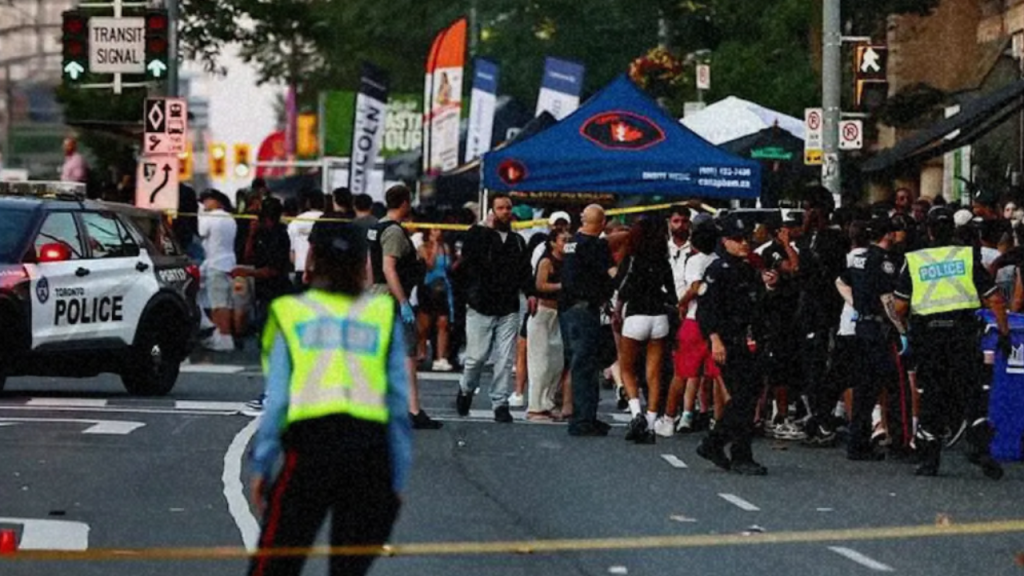
But avoiding Ottawa does not mean nothing happened. On February 5, 2022, convoy vehicles and protesters converged around Queen’s Park and surrounding routes. Public Safety Canada’s own overview says streets became congested by a large volume of trucks and protesters, making it difficult for emergency service vehicles to pass through. Toronto Police also told CBC that a Peel ambulance was slowed during the protest. Police called that unacceptable. The enforcement response did not match the language.
That gap is the point. The Toronto convoy was not only a protest against vaccine mandates. It was a test of what kind of political disruption the Canadian state tolerates, what kind it suppresses, and whose disorder gets translated into legitimate frustration before it is translated into threat.
The tactic was traffic disruption
The convoy’s defenders framed criticism as hostility toward protest itself. That was always evasive. The issue was not whether people had the right to assemble, speak, chant, hold signs, or oppose government policy. The issue was that the convoy’s power came from vehicles being used as infrastructure weapons.
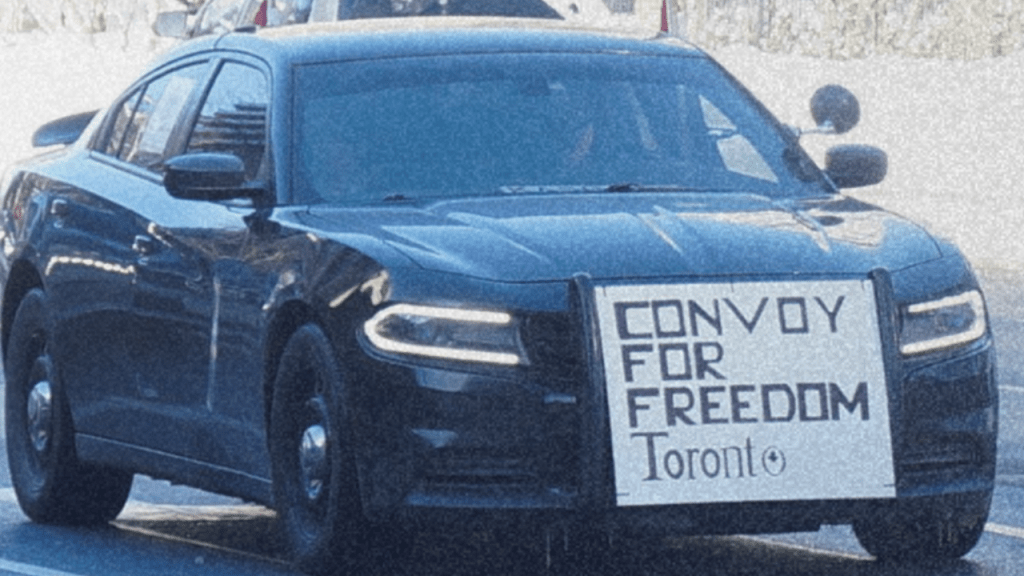
In Toronto, that meant slow rolls, blocked intersections, repeated circling, prolonged honking, and commercial vehicles moving through dense urban corridors in ways that strained ordinary circulation. In Ottawa, the same political logic hardened into occupation. At border crossings, it became economic blockade. The form changed by location, but the mechanism stayed consistent: produce disruption, then present the disruption as democratic expression.
The Public Order Emergency Commission later documented the convoy as a national crisis built around occupations, blockades, and police failures to contain escalating public disorder. Public Safety Canada described the movement as rooted in anti-government sentiment attached to the pandemic response. That description matters because it moves the convoy beyond a narrow labour or mandate dispute. It identifies the movement as a broader political formation.
The Toronto version was smaller and better contained than Ottawa. But it still belonged to the same tactical family. Vehicles did not simply bring protesters to the protest. Vehicles were the protest’s force multiplier. They made bodies harder to move, streets harder to clear, and ordinary city life easier to disrupt.
Hospital access was not a side issue
The convoy arrived in Toronto after two years of pandemic exhaustion, mass death, hospital strain, and attacks on health-care workers. That context cannot be separated from the route. Queen’s Park is not an abstract political stage. It sits directly north of Hospital Row. Sick patients, hospital staff, ambulances, transit riders, and families moving through medical appointments were all part of the terrain the convoy entered.
Health-care workers organized counter-protests because they understood the practical stakes. A Canadian Healthcare Network account described workers and patients being escorted through the area while road controls preserved space for ambulances. The same account says more than 1,500 health-care workers signed a letter condemning threats to hospital functions, and that downtown hospitals warned staff not to wear uniforms or identifying clothing during the convoy period.
This is where the “peaceful protest” framing begins to collapse. A protest can be non-shooting, non-burning, and still coercive in practice. When a vehicle convoy interferes with emergency routes, it creates risk whether or not every participant intends that risk. The harm comes from the tactic itself.
The original Toronto Police statement captured the contradiction. Slowing an ambulance was unacceptable, police said. But the broader political response treated the convoy as a difficult crowd-management problem rather than the kind of public-safety threat that would normally justify immediate, aggressive enforcement. The state recognized the danger while negotiating with the movement’s legitimacy.
Selective enforcement shaped the convoy moment
The convoy exposed a basic truth about Canadian policing. Tactics are not policed in isolation. They are policed through political identity. Indigenous land defenders, unhoused people, Palestine solidarity activists, anti-capitalist demonstrators, and labour militants do not usually receive weeks of public debate over whether blocked roads are really a form of democratic expression. They receive injunctions, kettles, raids, surveillance, arrests, and force.
The convoy moved through a different political atmosphere. Its participants were often framed as frustrated ordinary Canadians, even when their actions disrupted residents, threatened hospital access, blocked borders, and immobilized downtown streets. The same tactics that become extremism when attached to left movements were softened into grievance when wrapped in Canadian flags, pickup trucks, and the language of freedom.
Toronto police did act more quickly than Ottawa police. That is why the city avoided a permanent occupation. But the scale of preparation shows what officials feared. Global News later reported that Toronto police spent $7.6 million on the local operation to prevent the convoy from occupying the city, plus another $1.2 million sending officers and resources to Ottawa. That was not the cost of ordinary protest management. It was the cost of preventing a political occupation from taking root.
The money tells the truth the rhetoric tried to avoid. Officials understood the convoy as a serious threat to urban order. Publicly, however, the movement was still granted a level of social legibility rarely extended to disruptive movements against colonialism, capitalism, police power, or imperial war.
The coalition was never just truckers
The convoy was sold as a trucker revolt. That was already misleading. Major trucking organizations rejected the protest, and the movement quickly expanded beyond the workplace dispute it used as its entry point. As the convoy grew, its centre of gravity shifted away from a narrow border-rule complaint and toward a wider anti-government coalition.
That coalition included people angry about vaccine mandates, but it also drew in libertarian anti-state politics, conspiracist networks, right-populist media ecosystems, Christian nationalist currents, anti-Trudeau resentment, and far-right organizers. Public Safety Canada described the movement as centred on anti-government sentiment related to the public health response. The Public Order Emergency Commission heard extensive evidence about how the protests evolved beyond one policy demand.
The symbols in Toronto reflected that broader convergence. Canadian flags dominated, but anti-Trudeau banners, Gadsden flags, anti-media slogans, and performative nationalist imagery circulated through the crowd. A Gadsden flag is not automatically a declaration of fascism. That is the weak version of the argument. The stronger point is that symbols take their political meaning from the movements that carry them.
Inside the convoy context, the Gadsden flag did not appear as a neutral historical reference. It appeared inside a protest formation already organized around anti-government grievance, pandemic conspiracism, and a fantasy of righteous minority revolt against illegitimate authority. The symbol mattered because the coalition gave it meaning.
The convoy made infrastructure political
The convoy’s real innovation was not ideological. It was logistical. It showed how a relatively small number of people with large vehicles could create a disproportionate political crisis by targeting circulation itself. Roads, bridges, borders, downtown cores, hospital routes, and residential streets became pressure points.
This was clearest at the border blockades, where economic disruption became impossible for governments to ignore. But the same principle operated at the city level. A convoy does not need majority support to dominate space. It needs choke points, vehicles, fuel, communications, and enough police hesitation to hold ground.
Toronto’s response was designed around that lesson. Police did not merely prepare for a rally. They prepared to prevent a repeatable infrastructure tactic from becoming permanent. Roads were closed before protesters fully arrived. Hospital access was prioritized. Officers were staged around the downtown core. The city treated the convoy as a mobility threat even while the political discourse kept calling it a protest.
That distinction matters because liberal democracies often pretend coercion only arrives through spectacular violence. The convoy showed another version. Coercion can also arrive as traffic paralysis, sleep deprivation, ambulance delays, border disruption, supply-chain pressure, and the threat of indefinite occupation.
The Emergencies Act debate does not absolve the convoy
The later legal debate over the Emergencies Act has often been used to retroactively sanitize the convoy. That is a mistake. The Canadian Civil Liberties Association opposed the federal government’s invocation of the Act, and the Federal Court of Appeal later confirmed that the invocation was unreasonable and ultra vires, and that it infringed Charter protections for expression and privacy. Emergency powers are dangerous, and the state should not be trusted with them lightly.
But opposition to the Emergencies Act is not a defence of the convoy. The CCLA itself stated that its legal challenge was not an endorsement of the Freedom Convoy. It condemned reported acts of violence, racism, and homophobia, and agreed that police needed to dismantle the blockades given the disruption and protracted timeline.
That is the necessary distinction. The state can overreach in response to a movement that is still reactionary, disruptive, and coercive. Rejecting emergency rule does not require pretending the convoy was harmless. It requires holding both facts at once: the convoy created a real public-order crisis, and the state used that crisis to normalize dangerous emergency powers.
For the left, that distinction is not optional. The answer to right-wing infrastructure disruption is not blind faith in police power. It is political clarity. The convoy should be understood as a reactionary pressure campaign, not because the state said so, but because its own tactics, coalitions, and demands made that clear.
What Toronto revealed
Toronto avoided the worst-case scenario. It did not endure Ottawa’s occupation. It did not become Windsor’s border blockade. It did not produce the same national image of police paralysis. But the Toronto convoy still revealed the structure of the crisis.
Commercial vehicles and personal trucks moved through the city as political instruments. Emergency routes were strained. Police condemned disruption while managing it cautiously. Health-care workers had to organize against a movement whose rhetoric placed their workplaces inside a theatre of grievance. Symbols of anti-state reaction circulated under the cover of national belonging.
The convoy’s politics were never just about mandates. They were about who gets to disrupt public life and still be called legitimate. They were about whose anger is treated as authentic, whose tactics are treated as understandable, and whose coercion is softened by race, class, nationalism, and proximity to the police.
That is why Toronto matters. Not because it became Ottawa, but because it almost did not have to. The point of the convoy was to prove that infrastructure could be seized, traffic could be weaponized, and the state could be forced to hesitate when the people doing it looked enough like the constituency Canadian power already understands as its own.
Sources
- CBC News — Toronto convoy planning and police statements regarding a delayed Peel ambulance response.
- Global News — Toronto police road closures around Queen’s Park and Hospital Row before the February 2022 convoy protest.
- Public Safety Canada — Freedom Convoy 2022 overview; Toronto convergence, emergency-service access difficulty, and anti-government sentiment framing.
- Public Safety Canada — Freedom Convoy 2022 timeline; February 5 Toronto convergence and simultaneous national convoy activity.
- Public Order Emergency Commission — Final Report of the Public Inquiry into the 2022 Public Order Emergency.
- Global News — Toronto police convoy costs: $7.6 million local operation, $1.2 million assisting Ottawa.
- Canadian Healthcare Network — First-person account of escorting Toronto hospital workers and patients during the convoy protest; health-care worker letter and hospital safety warnings.
- Canadian Civil Liberties Association — Emergencies Act legal challenge and civil-liberties critique of emergency powers used during the convoy crisis.
- Canadian Civil Liberties Association — January 2026 statement clarifying that its Emergencies Act challenge was not an endorsement of the convoy and that police needed to dismantle blockades.
- Federal Court of Appeal — Plain-language summary of 2026 FCA 6 confirming the Emergencies Act invocation was unreasonable, ultra vires, and Charter-infringing.
- Associated Press — Public-record summary of the 2024 Federal Court ruling finding the Emergencies Act invocation unreasonable and unjustified.