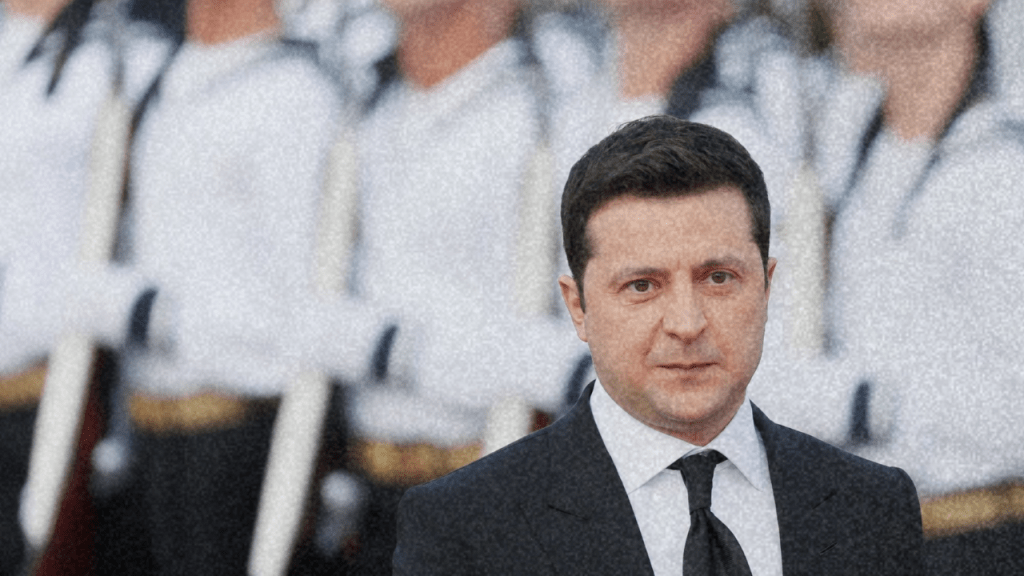
Volodymyr Zelenskyy became the West’s symbol of democratic resistance. That symbol does not erase the oligarchic system that produced him, the offshore structures around his circle, or the political limits of reform inside post-Maidan Ukraine.
The Western media portrait of Volodymyr Zelenskyy is now fixed. He stayed in Kyiv when evacuation was offered. He appeared in military green before parliaments and summits. He became the shorthand image of democratic courage against Russian aggression.
None of that is false. Russia invaded Ukraine. Zelenskyy did not flee. His wartime communication mattered. But as a portrait of political reality, the icon is incomplete. Understanding Zelenskyy requires understanding the system he emerged from: oligarchic television, offshore finance, anti-corruption branding, nationalist pressure, and a Ukrainian state shaped by both popular aspiration and elite capture.
That analysis is not anti-Ukrainian. It is the basic standard applied to political leaders everywhere else. The problem is that Western discourse has treated Zelenskyy less as a politician than as a wartime symbol, and symbols exist to simplify what politics makes complicated.
The television president had a patron
Before Zelenskyy was president, he was a television star. Before he was a television star-president, his national rise depended on the media infrastructure of Ihor Kolomoisky, one of Ukraine’s most powerful oligarchs.
Kolomoisky co-owned PrivatBank, Ukraine’s largest lender before its 2016 nationalization. The U.S. Justice Department alleged that Kolomoisky and Gennadiy Boholiubov embezzled and defrauded PrivatBank of billions of dollars, using proceeds to acquire assets in the United States. Kolomoisky and Boholiubov denied wrongdoing for years, but the allegations formed one of the central corruption battles of post-Maidan Ukraine.
PrivatBank became a test of whether Ukraine’s reform state could actually discipline oligarchic power. In July 2025, Reuters reported that PrivatBank won a London lawsuit against Kolomoisky and Bogolyubov over nearly $2 billion in alleged fraud through sham loans and supply agreements. The English court held them jointly and severally liable for around $1.9 billion. Both men denied misappropriation.
Kolomoisky also controlled 1+1, the television channel that made Zelenskyy a national figure. Zelenskyy’s production company, Kvartal 95, produced content for Kolomoisky’s media empire. Servant of the People, the series in which Zelenskyy played a schoolteacher who becomes president after an anti-corruption rant goes viral, aired on 1+1. The fiction became a campaign architecture.
This does not mean Kolomoisky controlled every Zelenskyy decision. It means Zelenskyy’s anti-oligarch image was built through an oligarch’s platform. That contradiction was present before a single Russian tank crossed Ukraine’s border in 2022.
The offshore network was documented
In October 2021, the Pandora Papers pulled that contradiction into public record. OCCRP reported that Zelenskyy and partners from Kvartal 95 set up a network of offshore companies dating back to at least 2012, the same year the company began making regular content for television stations owned by Kolomoisky.
The same investigation found that Zelenskyy associates used offshore companies to purchase and own London properties. It also reported that shortly before he became president, Zelenskyy transferred his stake in one key offshore company to longtime associate Serhiy Shefir, while documents suggested a later arrangement for dividends to continue flowing to Zelenskyy’s family.
The precise claim has to be handled carefully. The Pandora Papers documented an offshore network around Zelenskyy and his circle. They documented timing that overlapped with the Kolomoisky media relationship. They documented property ownership through offshore vehicles. They did not conclusively prove in the leaked files that Zelenskyy’s offshore companies received stolen PrivatBank funds.
That distinction matters because the strongest argument does not require overclaiming. A president who ran on anti-corruption and anti-oligarchic renewal had himself participated in offshore corporate structures before taking power. The scandal was not that he was uniquely corrupt by Ukrainian standards. The scandal was that he was typical of the class system he promised to transcend.
The reform project hit the oligarchic wall
Zelenskyy entered office in 2019 with an enormous mandate and an anti-corruption brand. The early record showed how quickly that mandate collided with Ukraine’s oligarchic state.
In May 2019, Reuters reported that Zelenskyy appointed Andriy Bogdan as head of the presidential administration. Bogdan had come under scrutiny for ties to Kolomoisky, who was then fighting authorities over PrivatBank. Zelenskyy denied he would help Kolomoisky regain control of the bank, but the appointment made the relationship impossible to treat as imaginary.
In March 2020, Ukraine’s parliament removed Prosecutor General Ruslan Ryaboshapka in a no-confidence vote. Reuters reported that lawmakers criticized him for not prosecuting cases aggressively enough. Other reporting at the time noted that Western governments and anti-corruption activists were alarmed by his removal, because it raised doubts about the reform trajectory.
That same year, the pressure around Ukraine’s financial system intensified. In July 2020, National Bank Governor Yakiv Smolii resigned, citing systematic political pressure and attempts to curb the central bank’s independence. The National Bank had been central to the PrivatBank nationalization fight. Smolii’s resignation was read widely as a warning that reform institutions remained vulnerable to political and oligarchic pressure.
The pattern was not clean enough to reduce to one puppet-master. Ukrainian politics rarely is. But the direction was clear: anti-corruption institutions existed, Western patrons demanded reforms, oligarchs resisted them, and Zelenskyy governed inside the collision rather than above it.
Washington sanctioned the patron
In March 2021, the U.S. State Department publicly designated Kolomoisky for significant corruption. Secretary of State Antony Blinken said Kolomoisky had been involved in corrupt acts that undermined the rule of law and the Ukrainian public’s faith in democratic institutions. The designation barred Kolomoisky and immediate family members from entering the United States.
This matters because it came from Ukraine’s primary patron state. Washington was not repeating Russian propaganda. It was identifying one of the oligarchs most closely associated with Zelenskyy’s rise as a corrupt actor whose conduct damaged Ukrainian democracy.
That did not make Zelenskyy responsible for every Kolomoisky act. It did make the Western myth harder to sustain. The anti-corruption president had been elevated by a media system owned by an oligarch later publicly sanctioned by the United States for significant corruption.
Zolote showed the limit of command
Zelenskyy also entered office promising to seek peace in the Donbas. That promise ran into another force Western coverage minimized: armed nationalist pressure inside Ukraine itself.
In October 2019, Zelenskyy travelled to Zolote, a frontline town in Luhansk Oblast, as part of a disengagement effort tied to the Steinmeier Formula and Minsk process. Kyiv Post reported that Zelenskyy clashed with veterans opposing the withdrawal. Andriy Biletsky, then head of National Corps and associated with Azov’s political milieu, threatened that more veterans would go to Zolote if Zelenskyy tried to remove those already there.
The confrontation was politically revealing. Zelenskyy was the elected president and commander-in-chief. He had a peace mandate. But nationalist veterans and paramilitary-linked networks could openly resist disengagement and impose political costs. The point is not that these forces controlled the entire Ukrainian state. The point is that they constrained the president’s room for manoeuvre at a critical moment.
That is why the Zolote episode matters. It shows the gap between electoral mandate and coercive power. Zelenskyy could win an election promising de-escalation. He could not simply force the nationalist field to accept it.
The arrest came when the patron became disposable
Kolomoisky was eventually arrested. In September 2023, Reuters reported that a Ukrainian court ordered him held in custody on suspicion of fraud and money laundering. Reuters noted that Kolomoisky was a one-time supporter of Zelenskyy whose 2019 election he backed, and that the detention came as Kyiv tried to signal progress during a wartime anti-corruption crackdown.
Additional allegations followed. In May 2024, Reuters reported that Ukrainian authorities named Kolomoisky a suspect in a decades-old attempted murder case. Kolomoisky, already detained on fraud and money-laundering allegations, denied wrongdoing.
The arrest can be read two ways. It can be read as evidence that Ukraine’s anti-corruption machinery eventually reached one of the country’s most powerful oligarchs. It can also be read as evidence that oligarchs are most vulnerable when they cease to be useful to the political order protecting them.
Both readings can be true. By 2023, Kolomoisky had become a liability: sanctioned by the United States, tied to the PrivatBank scandal, associated with Zelenskyy’s pre-presidential rise, and increasingly expensive for a wartime government dependent on Western aid to defend. The oligarch who helped make the president became easier to prosecute once prosecuting him became useful.
The contradiction is structural
The point is not that Zelenskyy is simply a corrupt puppet. That is too crude. Zelenskyy is better understood as a politician produced by Ukraine’s oligarchic media system, elected on a mass anti-corruption mandate, constrained by nationalist pressure, dependent on Western backing, and eventually forced by war to perform reform credibility for both domestic and foreign audiences.
That is a more serious picture than either Western liberal sainthood or Russian state caricature. Zelenskyy has shown real wartime leadership. He also came from an entertainment and offshore network attached to an oligarchic system. He became a symbol of democracy while governing a state whose reform institutions remained fragile, contested, and externally supervised.
Raising these facts does not support Russia’s invasion. It refuses the demand that analysis stop where Western alliance begins. Ukraine has the right not to be invaded. Ukrainians have the right to resist occupation. Those facts do not require pretending that Ukraine’s post-Maidan political order was clean, sovereign in any simple sense, or free from oligarchic contradiction.
The Western story needs Zelenskyy to be simple because the war narrative needs Ukraine to be simple. But Ukraine is not simple. It is a country fighting an illegal invasion while carrying the unresolved burdens of oligarchic capitalism, foreign dependency, nationalist pressure, corruption reform, and war-state consolidation.
Zelenskyy embodies that contradiction. That is why the icon is politically useful, and why the politician behind it still has to be analyzed.
Sources
- OCCRP – “Pandora Papers Reveal Offshore Holdings of Ukrainian President and his Inner Circle,” October 3, 2021; Zelenskyy/Kvartal 95 offshore network, Kolomoisky media timing, London property ownership through offshore firms.
- Kyiv Post / OCCRP – “Pandora Papers reveal offshore holdings of Zelensky and his inner circle,” October 3, 2021; Ukrainian republication of OCCRP investigation.
- U.S. Department of Justice – Civil forfeiture complaint tied to alleged PrivatBank fraud and theft; allegations that Kolomoisky and Boholiubov embezzled and defrauded PrivatBank of billions.
- Reuters – “Ukraine’s PrivatBank wins UK lawsuit against former owners over alleged fraud,” July 30, 2025; London lawsuit, nearly $2 billion claim, joint liability ruling, denials by Kolomoisky and Bogolyubov.
- Reuters – “Ukraine president appoints lawyer linked to PrivatBank tycoon as administration chief,” May 21, 2019; Bogdan appointment and Kolomoisky ties.
- Reuters – “Ukraine’s prosecutor general axed in parliament no-confidence vote,” March 5, 2020; Ryaboshapka removal and criticisms of prosecution record.
- Reuters – “Ukraine central bank chief abruptly resigns, citing political pressure,” July 1, 2020; Smolii resignation and systematic political pressure claim.
- U.S. Department of State – Public designation of Ihor Kolomoyskyy due to involvement in significant corruption, March 5, 2021; rule-of-law and public-trust language.
- Kyiv Post – “‘I’m not a loser’: Zelensky clashes with veterans over disengagement,” October 28, 2019; Zolote confrontation, veteran resistance, Biletsky threat to send more veterans.
- Reuters – “Ukrainian tycoon Ihor Kolomoisky detained in fraud case,” September 2, 2023; fraud and money laundering suspicion, one-time Zelenskyy supporter, anti-corruption signaling context.
- Reuters – “Ukraine tycoon Kolomoisky named suspect in decades-old murder attempt,” May 8, 2024; attempted murder allegation and Kolomoisky denial.