
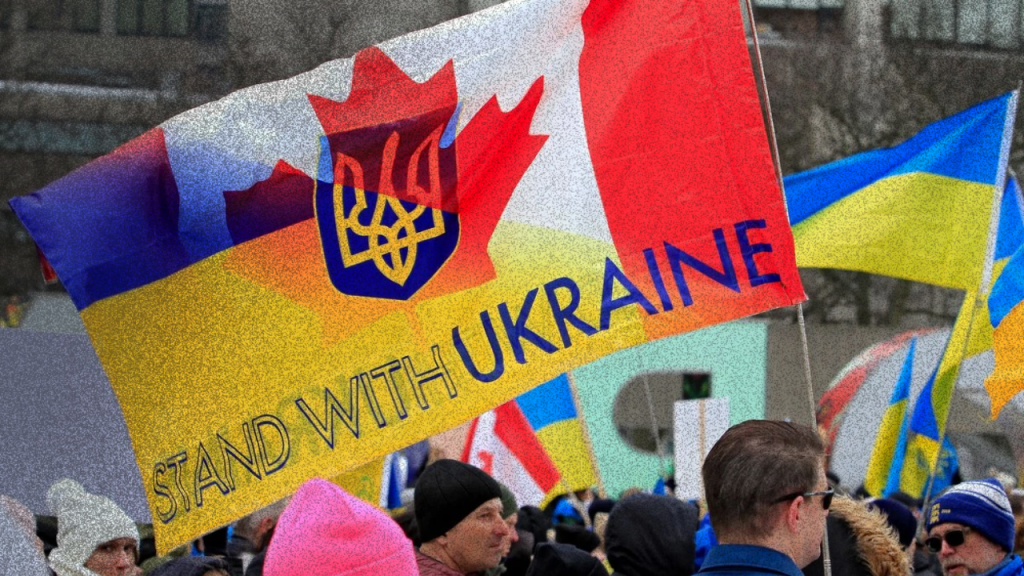
Ukraine invasion anniversary statements omit Canada’s Maidan backing, Operation UNIFIER training, and pre-2022 military integration.
Every February 24, Canadian officials mark the anniversary of Russia’s full-scale invasion of Ukraine with declarations of moral clarity. Ukrainians are fighting for “their freedom and ours.” Canada “stands with Ukraine.” Democracy confronts aggression. The framing is familiar, consistent, and essentially unquestioned in mainstream political discourse.
None of these moral claims are false. Russia launched the invasion. Russia violated international law. Russia shattered the European security architecture that had governed the post–Cold War order. Those facts are not in dispute.
What is systematically omitted from anniversary statements is the decade of Canadian strategic engagement that preceded February 2022. Canada was not a bystander that became an ally when war broke out. It was an active participant in shaping the geopolitical environment — diplomatically, militarily, and financially — that the war emerged from.
Understanding that distinction requires returning not to 2022, but to 2013.
On the Maidan: Canada’s Boots on the Ground Before the Guns
The rupture begins with the Euromaidan protests. When then-President Viktor Yanukovych declined to sign an association agreement with the European Union in late 2013, protests erupted in Kyiv’s central square. By February 2014, Yanukovych had fled.
Canada’s response was not neutral observation. It was active participation.
Foreign Affairs Minister John Baird flew to Kyiv and stood on stage at Maidan Square alongside Paul Grod, president of the Ukrainian Canadian Congress, as crowds chanted “Thank you, Canada.” Baird called the protests a democratic uprising against a president moving Ukraine toward “an anti-democratic Soviet past.”
As Yves Engler documented at CounterPunch, the Canadian embassy adjacent to Maidan became a safe haven for protesters for at least a week — including, according to University of Ottawa professor Ivan Katchanovski, members of the far-right Svoboda-affiliated C14 group. Ottawa had also provided funding to opposition civil society groups before and during the protests.
When Yanukovych’s government fell — in a sequence George Friedman, CEO of the CIA-aligned Stratfor, described as “the most blatant coup in history” — Canada moved quickly to recognize the new authorities. Baird declared their appointment “a vital step forward in restoring democracy.” Canada had sent election observers to monitor the 2010 elections that Yanukovych won — elections the OSCE called an “impressive display of democracy” — but raised no such procedural concerns about the constitutional irregularity of his removal.
Ottawa stayed entirely silent when far-right nationalists consolidated significant influence within the interim government, and when a wave of political violence followed. A massacre that left 48 dead at Odessa’s trade union headquarters — carried out by ultranationalist groups — produced no Canadian condemnation.
Canada did not merely react to 2014. It actively supported one side in a contested political rupture and quickly recognized the government that emerged from it.
Operation UNIFIER and the Military Transformation
What followed diplomatically was followed militarily. In September 2015, Canada launched Operation UNIFIER, a training mission officially described as defensive support for a sovereign state under pressure.
The scale is documented directly on the Canadian government’s own website: between September 2015 and February 2022, approximately 33,000 members of Ukraine’s Security Forces received training in Ukraine. Canadian personnel ran 726 course sessions spanning tactics, combat engineering, tactical medical response, logistics, and NCO development. From 2019 onward, Canada led the Multinational Coordination Cell — coordinating training priorities across Denmark, Lithuania, Poland, Slovakia, Sweden, the United Kingdom, and the United States.
The RCMP also deployed civilian police trainers to Ukraine continuously from 2015.
This was not humanitarian aid. It was systematic military professionalization designed to bring Ukrainian forces into alignment with NATO doctrine and interoperability standards. Ukraine was not a NATO member — but by 2022, its armed forces were structurally integrated with NATO training methodologies, command practices, and equipment specifications.
From Moscow’s perspective, this distinction was immaterial. A country armed, trained, and organized to fight alongside NATO forces — regardless of formal membership status — represented precisely the kind of encroachment that Russian security doctrine had identified as a red line since the 1990s.
Whether Canada was “right” to build Ukraine’s military capacity is a political argument. What is not arguable is that Canada was actively doing so — for seven years before the invasion began.
The Minsk Agreements: A Diplomatic Cover for a Military Buildup
Between 2014 and 2022, a ceasefire framework called the Minsk Agreements formally governed the conflict in the Donbas. Minsk I was signed in September 2014 after Ukrainian forces suffered a decisive defeat at Ilovaisk. Minsk II followed in February 2015. Western leaders — including German Chancellor Angela Merkel and French President François Hollande — served as guarantors.
The agreements required a ceasefire, withdrawal of heavy weapons, OSCE monitoring, and a Ukrainian constitutional commitment to decentralized autonomy for Donetsk and Luhansk. Almost none of it was implemented by any party.
What has emerged since 2022 is a documented admission from Western leaders themselves about the actual function of the agreements.
In a December 2022 interview with the German daily Die Zeit, Merkel stated explicitly that the Minsk agreements were designed to give Ukraine time to develop — militarily, economically, and diplomatically — between 2014 and 2022. She said “it was clear to everyone” that the conflict had been frozen rather than resolved.
Former Ukrainian President Petro Poroshenko made parallel statements: the Minsk framework gave Ukraine time to build an army, an economy, and an international coalition.
This admission is not fringe analysis or Russian propaganda. It is a documented on-the-record statement by the former leader of Western Europe’s most powerful economy — the country that co-signed and co-guaranteed the agreements.
What this means structurally: Operation UNIFIER, Canada’s training mission, operated precisely within this diplomatic holding window. While the Minsk framework nominally suspended hostilities and Western leaders publicly promoted it as a path to peace, Canada was training tens of thousands of Ukrainian soldiers. These two policies were not in tension. They were coordinated — a diplomatic pause serving a military preparation.
This is the architecture that the anniversary narrative consistently fails to describe.
The use of diplomatic frameworks to create space for military preparation is not unique to Ukraine. As we examined in our analysis of the quiet mechanics of U.S. intervention in Venezuela, Western states consistently deploy legal and procedural language to legitimize strategic operations whose actual function is determined well in advance.
The Political Economy of Solidarity: Who Profits
Canada’s Ukraine commitment has a political economy, not just a moral one.
Since 2022, the Canadian government has committed over $25.5 billion in total aid to Ukraine, including $8.5 billion in military assistance. These are not abstract transfers — they flow through specific companies.
The 39 armoured combat support vehicles donated in late 2022 were manufactured by General Dynamics Land Systems Canada in London, Ontario — a new $165 million contract. The 208+ Senator armoured personnel carriers came from Roshel in Mississauga — $90 million. On February 24, 2026, the day of the fourth anniversary, Canada announced another package including 66 LAV-6 vehicles from General Dynamics and 383 more Senators from Roshel.
Roshel has delivered over 2,000 vehicles to Ukraine since 2022. It has opened a new manufacturing plant in Michigan. Its production capacity runs to approximately 140 vehicles per month, with Ukraine as its primary market. The war has made it one of Canada’s fastest-growing defence manufacturers.
General Dynamics Land Systems Canada — the London, Ontario subsidiary of one of the world’s largest arms corporations — has also benefited significantly. The 39 vehicles sent to Ukraine were originally ordered for the Canadian Army, and the government signed a new $165 million contract to replace and expand that procurement.
Roshel and General Dynamics are not anomalies — they are the supply chain of Canadian foreign policy. As we examined in our analysis of how Canada’s global justice mask is wearing thin, the gap between Canada’s humanitarian self-image and its material interests in conflict and arms production is structural, not incidental.
None of this implies bad faith in the original decision to support Ukraine. It does describe the material reality: Canada’s “solidarity” has a supply chain, and that supply chain runs through Ontario factory floors. When political leaders use “standing with Ukraine” as domestic messaging, the industrial interests that benefit from sustained military commitment are not incidental. They are structural.
NATO Expansion and the Security Architecture That Collapsed
Ukraine’s trajectory cannot be understood outside the broader NATO expansion debate — and that debate cannot be understood outside its class character.
Since the Soviet Union’s dissolution, NATO expanded eastward through five rounds of enlargement, incorporating fourteen countries. Each expansion was framed as voluntary accession by sovereign states — formally correct. Each expansion was also a projection of U.S. geopolitical influence into formerly Soviet-aligned territory, extending the political and economic conditions under which Euro-Atlantic capital operates.
Russia consistently objected. Its objections were consistently dismissed. Western analysts described Russian concerns as illegitimate, imperial nostalgia, or negotiating theater. What they were, structurally, was a predictable response from a declining regional power watching its strategic buffer zone dissolve.
Ukraine occupied a uniquely sensitive position. It was neither formally integrated into NATO nor genuinely neutral. Western states — including Canada — supported its Euro-Atlantic orientation while deliberately leaving its final status ambiguous. This ambiguity was not accidental. It maintained Western strategic leverage without triggering the formal commitments Article 5 membership would require.
For Russia, the prospect of Ukraine in NATO or functionally aligned with it represented what Putin had called a “red line” since at least 2008’s Bucharest summit. For Western states, this framing was dismissed as pretextual.
Canada did not design NATO expansion policy. But it consistently and enthusiastically supported it — and it actively contributed to Ukraine’s military transformation into a de facto NATO-interoperable force.
The political climate that Canada’s Ukraine commitment has produced extends beyond foreign policy. As examined at Sparked Sports, the 2026 Olympic gold medal game felt different precisely because the geopolitical realignments that Canada helped shape — Russia’s exclusion, rising U.S.–Canada tension, the collapse of the post–Cold War sporting order — had transformed even the hockey rink into contested political terrain.
The question a materialist analysis asks is not whether Russia was “right” to invade — it was not, and the invasion has caused enormous suffering. The question is whether the security architecture that collapsed in 2022 was the result of miscalculation, or of choices made by identifiable states with identifiable interests. Canada made choices. Those choices had structural consequences.
The Asymmetry of Responsibility and the Limits of Moral Clarity
The original piece concludes carefully: Canada was “not the architect of the war, but an active participant in shaping the geopolitical environment that preceded it.”
That formulation is accurate but understates one dimension: Canada’s participation was not passive structural contribution. It was active, documented, and publicly defended at each stage. Canadian officials stood on the Maidan. Canadian soldiers trained Ukrainian troops. Canadian diplomats recognized a post-coup government without procedural scrutiny. Canadian companies built the armored vehicles now deployed on the front lines.
This pattern — active structural participation beneath a surface of principled neutrality — is not new in Canadian foreign policy. As we documented in our analysis of the myth of Canada’s non-involvement in the Iraq War, Canada has a well-rehearsed habit of denying its own footprints while leaving them everywhere.
None of this makes Canada “responsible” for the invasion in the direct causal sense. Russia made that decision. But it does mean that the moral simplicity of anniversary declarations — the language of pure democratic solidarity uncontaminated by geopolitical interest — is not honest.
Canada has material interests in Ukraine’s outcome: the stability of a NATO-aligned European order, the continued relevance of its own military capacity and industrial base, the political utility of a conflict that justifies increased defence spending at home. These interests are not incidental to the policy. They are constitutive of it.
This does not mean Ukrainians should not resist military occupation. It means being honest about the full timeline, the full political economy, and the full cast of actors who shaped the conditions in which that occupation became possible.
The anniversary narrative begins in February 2022. The strategic timeline begins in November 2013. Canada was present for all of it — not as a bystander, but as a participant.
That is not an accusation. It is a description. The question it raises is not whether Canada was wrong to stand with Ukraine, but whether it is capable of standing with Ukraine honestly — including about everything that came before.
Sources
- Canadian Department of National Defence — Operation UNIFIER Official Page
- Government of Canada — Canada Reaffirms Support for Ukraine, Fourth Anniversary Statement, February 24, 2026
- Yves Engler / CounterPunch — Canada and Ukraine
- Yves Engler — Remembering Canada’s Role in Ukraine’s “Blatant Coup”
- Rabble.ca — Canada’s Interference in Ukrainian Democracy
- Canada-Haiti Information Project — Condemn the Invasion, But Retain Your Critical Faculties
- CBC — John Baird in Kyiv Announces Medical Aid for Ukraine Victims, February 28, 2014
- TASS — Merkel Confirms Minsk Agreements Were Meant to Give Ukraine “More Time”
- World Socialist Web Site — Former German Chancellor Merkel Admits the Minsk Agreement Was Merely to Buy Time
- Defense News — Canada Buys 39 General Dynamics Vehicles, Eyes Anti-Tank Weapons
- CBC — Canada Has Promised More Than $1.5B in Military Aid to Ukraine
- Defence Blog — Canada Confirms New Armored Vehicle Shipment to Ukraine, February 24, 2026
- Wikipedia — Operation Unifier
- Wikipedia — Minsk Agreements
 Spark Solidarity