
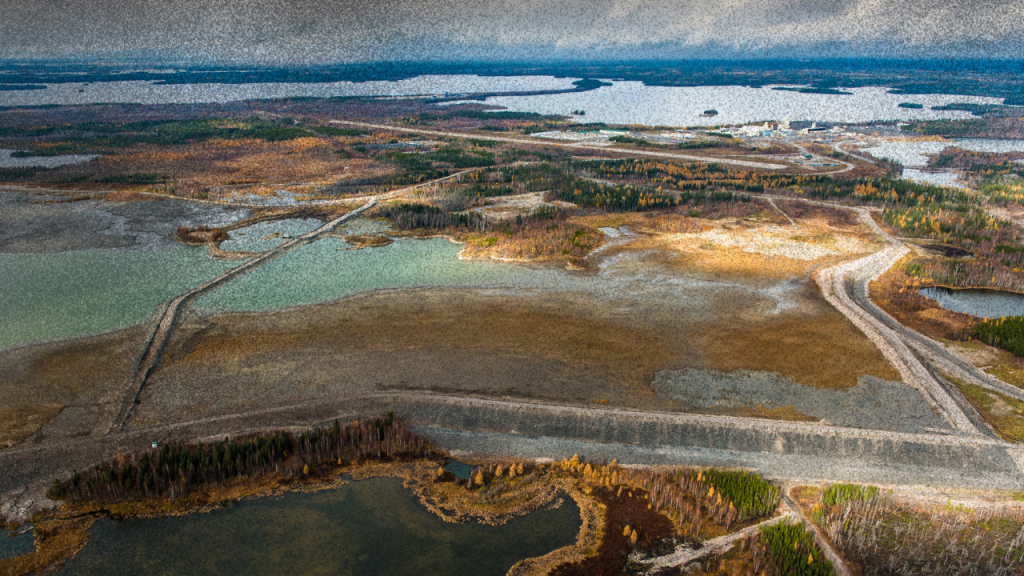
How Ontario’s Ring of Fire is framed as climate progress while reproducing colonial extraction, sidelining Indigenous sovereignty, and risking ecological collapse.
For more than a decade, Ontario premiers have promoted the Ring of Fire as a transformative economic opportunity, but Doug Ford has turned it into a centerpiece of Canada’s supposed “green transition.” In Ford’s telling, the mineral-rich wetlands of Northern Ontario will power electric vehicles, secure supply chains, and uplift Indigenous communities. Words like “growth,” “clean energy,” “partnership,” and “shared prosperity” dominate the government’s messaging. Yet behind these polished slogans lies a familiar pattern.
The Ring of Fire is not a radical departure from the politics of extraction that have defined Canada since its inception. It is a modern expression of the same colonial logic, only this time wrapped in the rhetoric of climate responsibility and reconciliation. The state’s promise is a “clean future.” The material reality is another round of resource extraction carried out on Indigenous land without meaningful Indigenous authority.
Economic “Investment” as a New Form of Extraction
Governments frequently frame resource development in Indigenous territories as benevolent investment, a welcome chance to bring jobs and wealth into communities long denied basic infrastructure, housing, and services. But the economic structure of these projects exposes the gap between rhetoric and reality.
When mining companies enter Indigenous land, the primary goal is not to build Indigenous power or autonomy; it is to secure access to resources.
Profits flow to corporations and shareholders. Infrastructure is designed for transport corridors, not local needs. Communities are offered wage labor rather than land control, consultation instead of consent, and short-term benefits instead of long-term sovereignty. “Investment” becomes a euphemism for extraction — a way of describing the removal of wealth from Indigenous territory as though it were a contribution.
It is not a system designed to produce Indigenous self-determination. It is designed to produce Indigenous compliance.
The Ring of Fire: A Case Study in Green-Branded Extraction
The Ring of Fire, located in the James Bay Lowlands, is one of the most ecologically sensitive areas in the country. Its vast peatlands hold tens of billions of tonnes of carbon, making them indispensable in the fight against climate change.
Disturbing these peatlands risks releasing enormous amounts of greenhouse gases, destabilizing water systems, and destroying a landscape central to the cultural and subsistence practices of several First Nations. Despite these risks, the Ford government has aggressively pushed for mining development, promoting the region as the beating heart of Canada’s future battery economy. To fast-track this vision, Ontario introduced Bill 5, which designates the area as a “Special Economic Zone.”
This designation empowers the province to override environmental assessments, accelerate road approvals, and weaken the duty to consult. The message is unmistakable: ecological fragility and Indigenous rights are obstacles to be managed, not parameters that shape the project’s legitimacy. The Ring of Fire is marketed as a green solution, but in practice it risks becoming one of the largest ecological liabilities in Canadian history.
Sovereignty, Consultation, and Divide-and-Rule Governance
At the center of the Ring of Fire controversy is the question of Indigenous sovereignty and the state’s attempt to manufacture the appearance of consent. Ontario has engaged in a selective consultation strategy that brings some First Nations to the negotiating table while sidelining others.
Communities facing chronic underfunding and economic pressure may feel compelled to participate in development talks because the alternative — continued abandonment — is not viable. Meanwhile, nations asserting strong environmental or treaty-based opposition find themselves marginalized. The government then uses these asymmetrical relationships to claim that “Indigenous communities are partners” in the project.
This strategy fractures Indigenous unity, pits communities against one another, and transforms consultation into a performance rather than a meaningful political process. It is a divide-and-rule approach that maintains the authority of the state while eroding the sovereignty of the very nations it claims to include. What emerges is not genuine collaboration but consultation theater — a simulation of partnership that does not alter the underlying imbalance of power.
Settler Colonialism Under New Branding
Although the government advertises the Ring of Fire as a breakthrough in reconciliation and sustainable development, the underlying logic is continuous with Canada’s history of settler colonialism. The pattern is painfully familiar: take the land, extract the wealth, leave the damage, and call the whole process “progress.”
The language has evolved over time — from civilizing missions to employment promises to economic modernization — but the fundamental structure remains intact. Today, the extraction is justified through the language of climate necessity and Indigenous partnership, even when the material processes reproduce dispossession. Indigenous communities are framed as stakeholders rather than sovereign nations.
Their treaty rights are treated as negotiable. Stewardship of the land is portrayed as an obstacle. Canada’s self-congratulatory narrative of moral evolution is not matched by its actions. What the Ring of Fire demonstrates is that the country has not outgrown its colonial foundations; it has merely updated its marketing strategy.
The “Green Transition” as a Tool for Dispossession
The most striking feature of the Ring of Fire is how climate rhetoric is used to neutralize criticism and justify accelerated extraction. Mining is framed as essential to the green transition, especially for electric vehicle batteries, creating a moral argument for disturbing fragile Indigenous ecosystems.
This allows governments and corporations to claim that resisting extraction is irresponsible — even harmful to the planet. The result is a climate narrative that scapegoats Indigenous sovereignty for slowing down “green progress.” Under this framework, mining companies become climate heroes, governments become climate stewards, and Indigenous nations become barriers to saving the world.
Meanwhile, the ecological harm remains localized: water contamination, habitat destruction, and massive carbon releases from disrupted peatlands. A green transition that reproduces colonial violence and ecological destruction is neither green nor a transition. It is simply extraction with new branding, justified not by industrial growth but by climate virtue.
The Future Canada Claims vs. the Future It Creates
Canada presents the Ring of Fire as a vision of a prosperous, sustainable future — a convergence of economic growth, Indigenous partnership, and climate responsibility. But when stripped of its rhetoric, the project looks much more like a continuation of the same colonial economic systems that have shaped Canadian development for centuries. Extraction still supersedes sovereignty. Economic goals still override ecological knowledge.
Political power still dictates the terms of development. Indigenous nations are still positioned as participants in a process they do not control. If Canada’s green transition requires violating treaty rights, destabilizing ecosystems, and deploying divide-and-rule tactics, then it is not a transition at all — it is the status quo with better public relations.
A just future cannot be built on the same foundations that produced the crisis Canada claims to solve. Unless the approach changes, the future Canada is building looks less like transformation and more like a greener version of its past.







 Spark Solidarity